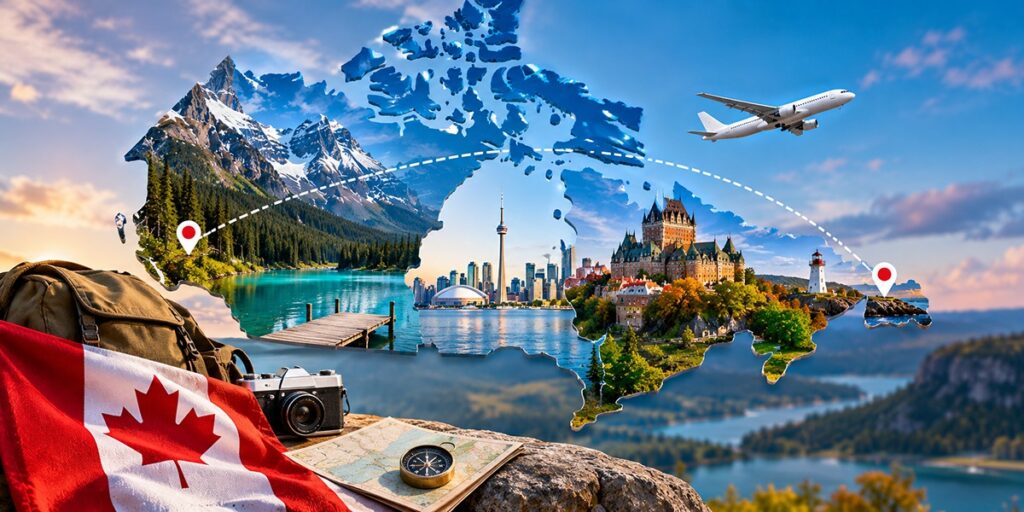
Canada is the second-largest country on earth, and that single fact quietly wrecks more travel itineraries than almost anything else on this list. Scroll through most roundups of places to visit in Canada and you'll find Banff, Toronto, and Quebec City sitting side by side. None of that makes Canada any less worth visiting; it just means the planning has to be a little smarter than a flat top-10 list usually allows for, especially if this is your first trip.
This guide covers the ten places that consistently earn their spot on any serious Canada itinerary, grouped by region so you can actually see which ones belong on the same trip, along with realistic distances, seasonal timing, and a detail about staying connected here that catches almost every visitor off guard. Keep reading before you start booking flights, because the region you choose will shape everything else about the trip, from how many destinations you can realistically fit in, to how much of your budget goes toward internal flights rather than the experiences themselves.
Why a Canadian Itinerary Is Harder to Plan
A few numbers explain why treating Canada as one destination rarely works out:
Larger than Europe: at just under 10 million square kilometres, Canada is bigger than the entire European continent, yet it's routinely searched and marketed as though it were a single, compact destination.
Six time zones: flying from Vancouver to Halifax takes roughly the same time as flying from London to Cairo.
Domestic flights add up fast: internal flights within Canada are rarely cheap, and stitching together a coast-to-coast trip eats into both budget and itinerary time in ways a two-week European trip simply wouldn't.
The Top 10 Places to Visit in Canada, Grouped by Region
Western Canada: Mountains and Coastline
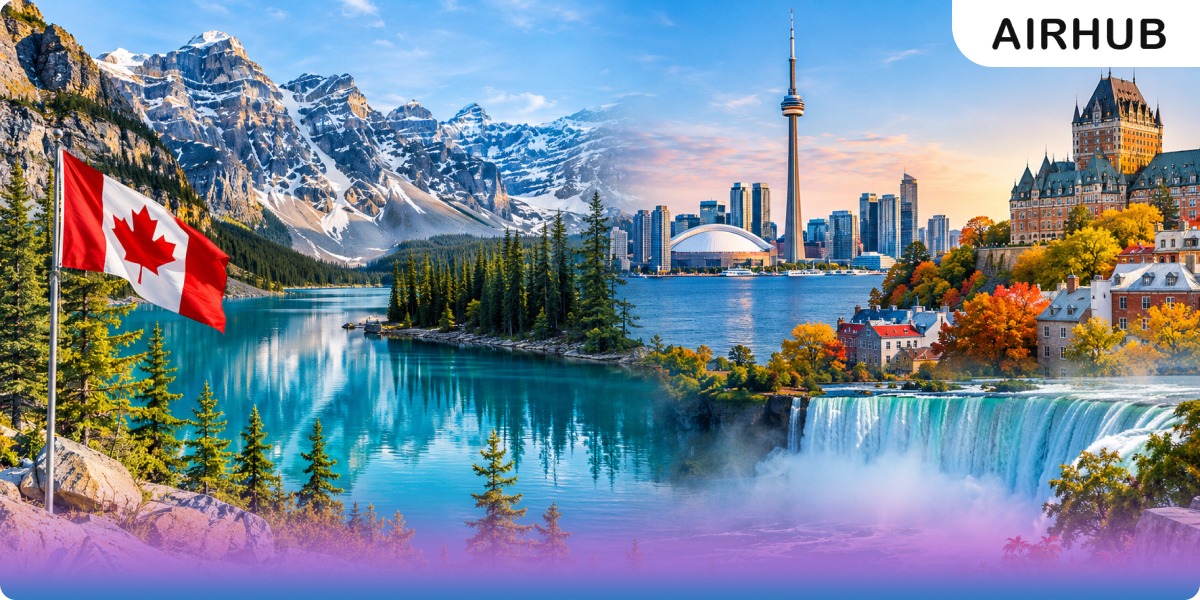
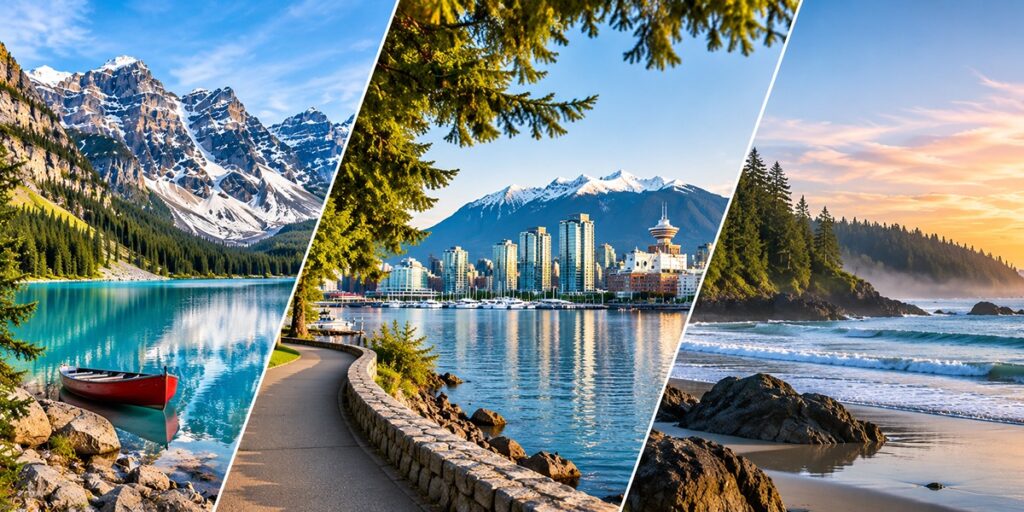
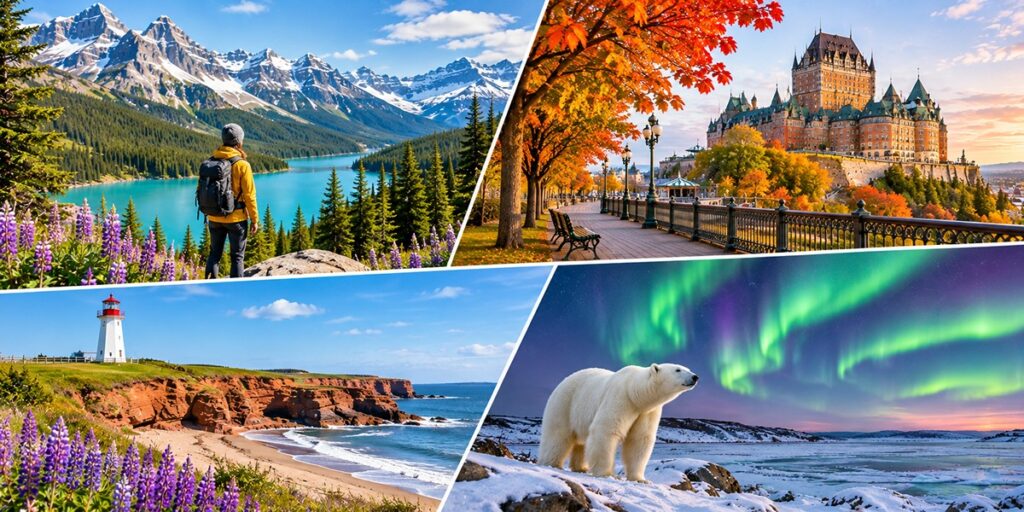
Banff National Park and Lake Louise, Alberta - The Turquoise glacial lakes, flowing through the snow capped peaks, makes this experience of exploration unprecedentedly tranquil. The beauty of its landscape supplements life so seamlessly that wildlife sightings ranging from an elk to the occasional grizzly bear seem commonplace. Banff, Canada's oldest national park, spends its summers thick with hikers headed for Moraine Lake and Johnston Canyon, and its winters given over almost entirely to skiers who've heard the snow here is drier and deeper than most of what the Alps can offer, and thus they hurry to cap in.
Vancouver, British Columbia - The landscape of this coastal city manages mountains, ocean, and rainforest within city limits, anchored by Stanley Park and easy day trips to Whistler. Vancouver is the rare city where you can genuinely surf, ski, and eat dim sum in Chinatown in the same 24 hours, and locals take deep pride in this geographical diversity. Stanley Park's seawall loops around the downtown peninsula with the mountains as a backdrop the entire way culminating into a serene experience.
Victoria and Tofino, Vancouver Island - Victoria brings English-inspired charm and afternoon tea culture to the table while Tofino, on the island's wild west coast, is Canada's surf town, known for storm-watching season and old-growth forest. Victoria plays up its English roots hard with activities resembling a scene straight out of Bridgerton. The time in this town feels at a pace that is a full notch slower than the mainland. Tofino, on the island's exposed west coast, is the opposite as it draws visitors who want to sit behind glass with a hot drink and watch the Pacific throw itself against the coastline, and where old-growth rainforest trails start almost directly off the highway.
Central Canada: The Ontario–Quebec Corridor
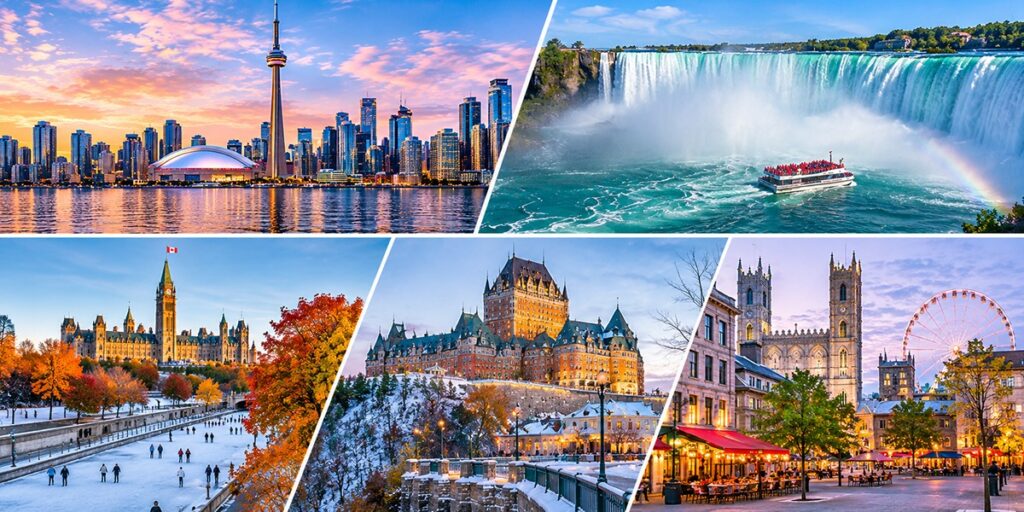
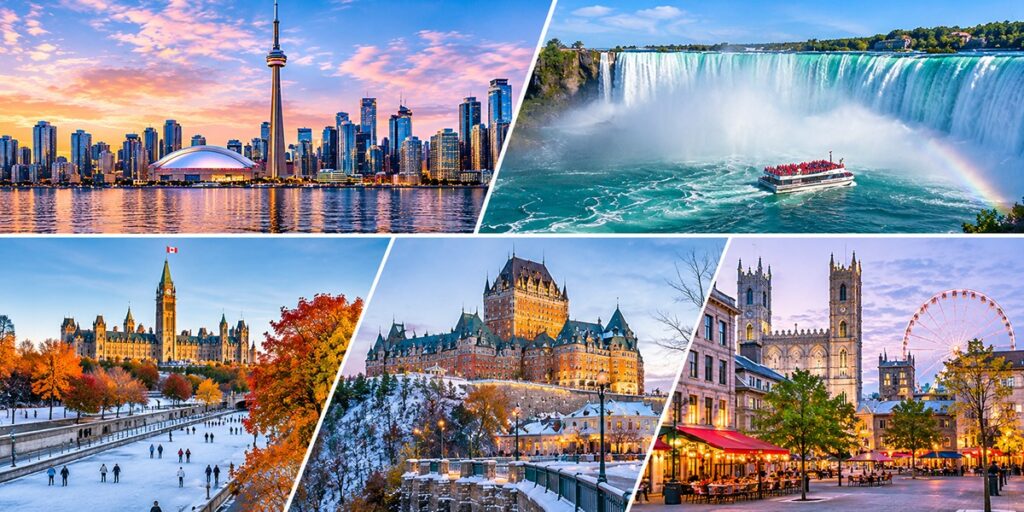
Toronto, Ontario - Canada's largest city, home to the CN Tower, a genuinely excellent food scene shaped by decades of immigration, and the country's biggest festival calendar. Toronto is Canada's biggest city by a wide margin, and it wears that scale as a genuinely excellent, chaotic food scene shaped by generations of immigration. It also carries the country's busiest festival calendar, and that's not incidental to why people visit.
Niagara Falls, Ontario - Still one of the most-visited natural attractions in North America, best experienced up close on a boat tour rather than just from the viewing platforms above.The viewing platforms above are fine for a first look, but the boat tours that motor right up toward the base of Horseshoe Falls where the sheer volume of water actually registers in your chest rather than just your eyes.
Ottawa, Ontario -The federal capital, worth visiting for Parliament Hill alone, with a very different, more formal energy than Toronto or Montreal. Parliament Hill's Gothic Revival towers, the Rideau Canal (a UNESCO World Heritage site that turns into the world's largest skating rink each winter), and museums that reward a slower pace than most city breaks allow for.
Quebec City, Quebec - Cobblestone streets, a walled Old Town, and the Château Frontenac give this city a distinctly European feel found nowhere else in North America. Walk through the walled Old Town at dusk, past the Château Frontenac lit up on its bluff over the St. Lawrence River, and it stops feeling like North America. It's the only fortified city wall left standing north of Mexico, and the winter Carnaval, with its ice sculptures and canoe races across the half-frozen river, is worth timing a trip around if you can handle the cold.
Montreal, Quebec - Bilingual, bohemian, and thoroughly food-obsessed, Montreal balances centuries-old stone architecture in Old Montreal with one of the continent's most active nightlife and live-music scenes. Ask locals for a smoked meat sandwich recommendation and you'll start an argument; ask about bagels versus Toronto's and you'll start a bigger one.
Atlantic Canada: Coastal and Quiet
Cavendish, Prince Edward Island - Red sandstone cliffs, warm shallow beaches by Canadian standards, and the literary pull of Anne of Green Gables draw a steady stream of visitors each summer. PEI moves at a different speed than the rest of this list so you can expect lighthouses, lobster suppers in community halls, and a red-dirt coastline that photographs like nowhere else in the country.
The North: Wild and Remote
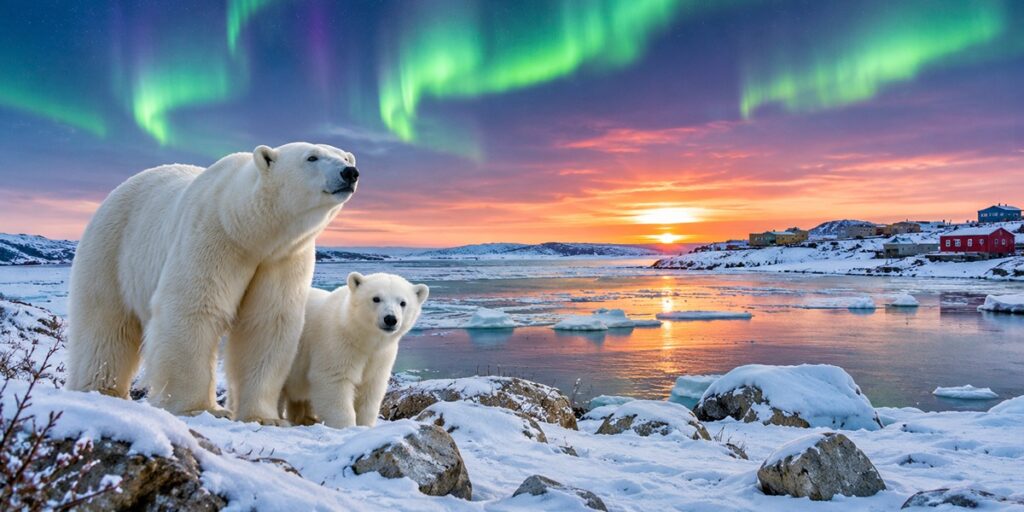
Churchill, Manitoba - It is Known globally as the polar bear capital of the world. Churchill is reachable mainly by a scenic multi-day train journey or a short flight, and it's one of the few places on earth where polar bear sightings are a realistic day-trip activity rather than a lottery.
Festivals, Food, and Culture Worth Building a Trip Around
A few of the events below are reason enough to time a trip around them, and several sit directly inside the regions already covered above.
Calgary Stampede (Alberta, July) - Billed as the greatest outdoor show on earth, this ten-day rodeo and Western heritage festival pairs chuckwagon races with a genuinely enormous midway of food stalls, where deep-fried novelty snacks and bison burgers sit alongside more traditional prairie fare. It's an easy add-on if Banff is already on the itinerary, since Calgary is the usual gateway airport into the Rockies.
Edmonton Fringe Festival (Alberta, August) - North America's oldest and largest fringe theatre festival turns the Old Strathcona neighbourhood into a sprawling open-air stage, with hundreds of independent productions running alongside street performers and pop-up food vendors.
Montreal International Jazz Festival (Quebec, late June–early July) - One of the largest jazz festivals in the world, drawing thousands of musicians into the heart of downtown Montreal across genres that stretch well past jazz into blues, funk, and soul. If Montreal is already on your route, this is worth checking against your dates.
Folklorama (Winnipeg, August) - One of the largest multicultural festivals in the world, with pavilions across the city each dedicated to a different culture's food, music, and performance.
Winter Carnaval (Quebec City, February) - The oldest and largest winter carnival in the world, built around ice sculptures, a giant snow slide, and canoe races across the frozen St. Lawrence — proof that Quebec City's cold season is a selling point rather than something to plan around.
Best Time to Visit Each Region
Western Canada (Banff, Vancouver, Vancouver Island): June through September for hiking and wildlife visibility, with December through March drawing skiers to Banff and Whistler specifically.
Ontario–Quebec Corridor: Late May through October covers the most comfortable weather; early October adds vivid fall foliage, especially around Quebec's countryside.
Atlantic Canada (PEI): July and August are the only genuinely warm-beach months, with the shoulder season turning cool quickly by September.
Churchill, Manitoba: Late September through November is peak polar bear migration season, while January through March brings the aurora borealis instead.
Why Staying Connected in Canada Costs More Than You'd Expect
Here's something most travel guides never mention: Canada has some of the most expensive mobile data pricing in the developed world. A few reasons this catches visitors off guard:
Consistently ranks near the top of international cost comparisons for mobile data, for both locals and visiting roamers.
A market with limited competition: just three major carriers dominate most of the country, with relatively little price pressure as a result.
Infrastructure costs run high given the sheer scale needed to cover such a geographically vast, sparsely populated country.
‘Americans especially get caught off guard, since domestic data just across the border tends to be noticeably cheaper.
GPS, translation, and last-minute changes matter more here than in a compact destination, given how spread out the regions covered in this guide really are.
Setting up an eSIM Canadaplan before departure sidesteps the issue entirely, giving you a fixed, predictable data cost regardless of which of Canada's expensive carrier networks you'd otherwise be roaming on.
Savour Wanderlust Through Every Season with an Airhub eSIM
In a country too large to rush, regions that don't naturally connect, and some of the priciest mobile data anywhere in the world the practical fix is simpler than it sounds. An Airhub eSIM activates the moment you land, meaning you're not relying on Wi-Fi at a rental car counter in Banff or hunting for a signal on the drive into Cavendish. If your route crosses into the US as well, which is common given how close Toronto, Vancouver, and Niagara Falls sit to the border, an eSIM North Americaplan covers both countries under one setup instead of juggling two separate purchases. Buy your Airhub eSIM before departure, and it's ready to go the moment your flight touches down, whichever region of Canada you land in first.
Quit Stalling When Canada comes Calling
The best places to visit in Canada were never really the problem as Banff, Toronto, and Quebec City show up on every list for good reason. The real planning challenge is accepting that this is a country best explored one region at a time rather than all at once. Pick a corner, whether it's the mountains out west, the corridor running through Ontario and Quebec, or the wilder edges further north and east, and you'll get a far better trip than trying to stretch one itinerary across a country the size of Europe.
FAQs
1. Can I realistically visit Banff and Toronto on the same trip?
Technically yes, but it means treating them as two separate legs rather than one flowing itinerary the flight between them takes around 4 hours, so most travellers are better off picking one region and doing it properly rather than splitting a short trip between both.
2. What's the best month to see the Northern Lights in Canada?
Late fall through early spring, roughly September to March, gives the best odds, with the Yukon and northern Manitoba (including Churchill) among the most reliable viewing spots away from city light pollution.
3. Is Canada more expensive to travel around than the US?
Day-to-day costs like food and accommodation are broadly comparable, but mobile data is one clear exception — Canadian carrier pricing tends to run noticeably higher, which is exactly why many visitors set up a data plan before arriving rather than buying one locally.
4. Do I need a car to see most of these places, or is public transport enough?
Cities like Toronto, Montreal, and Vancouver are very walkable and well connected by transit, but reaching Niagara Falls comfortably, exploring Banff's surrounding trails, or getting around Prince Edward Island generally requires a rental car.