









Ready to try eSIMs and change the way you stay connected?
Download the Airhub app to purchase, manage and top up your eSIMs anytime, anywhere!
App exclusive5% off at checkout
How much does a trip to Japan cost in 2026? See Japan travel costs by budget, plus tips to save on flights, hotels, food, and eSIMs.

Ask ten people whether Japan is expensive and you'll get ten different, oddly confident answers. Half of them will warn you off, tell you it's a once in a decade splurge trip. The other half, usually the ones who've actually been in the last year or two, will shrug and say they spent less than they did on a long weekend in Lisbon.
Neither camp is lying. They're just describing two different Japanese, separated mostly by exchange rate.
The yen has been sitting near multi decade lows against the dollar, the pound, the euro, and the Australian dollar for a while now, and that single fact is doing more to shape your 2026 travel budget than anything else in this article. Most guides mention it in passing. It deserves more than that.
So what does a trip to Japan actually cost? There isn't one number, because a backpacker stacking capsule hotel nights and a couple booking a ryokan with a private onsen are not having the same trip. A budget traveler can get by comfortably on $80 to $120 a day. Someone who wants a proper business hotel, real restaurant meals, and a Shinkansen ride or two should plan closer to $150 to $250. What follows is a category by category breakdown built around what people actually spend, not a rounded-off estimate someone pulled from a brochure.
Exchange rates used throughout this piece: $1 USD = ¥159.4, £1 GBP = ¥215.1, €1 EUR = ¥183.9, A$1 AUD = ¥110.5 — mid-market rates as of August 13, 2026. These move daily and sometimes by more than you'd expect, so treat the yen numbers below as a snapshot, not a guarantee, and check the current rate before you book anything.
Before getting into the weeds, it's worth zooming out. Here's roughly what a day in Japan runs across three common travel styles in 2026.
| Travel Style | Daily Budget (USD) | Daily Budget (JPY) | What's It For |
| Budget | $80 - $120/day | ¥12,750 - ¥19,100/day | Hostels, konbini meals, public transport |
| Mid-Range | $150 - $250/day | ¥23,900 - ¥39,850/day | Business hotels, restaurant meals, JR Pass |
| Luxury | $400+/day | ¥63,750+/day | Ryokans, fine dining, private tours |
Most international travelers end up somewhere in that mid-range band, and honestly, that's usually where the best value lives too. Japan isn't cheap the way Vietnam or Indonesia are cheap. But held up against what a comparable week in Paris, London, or New York would cost you right now, it starts looking like one of the better deals in international travel.
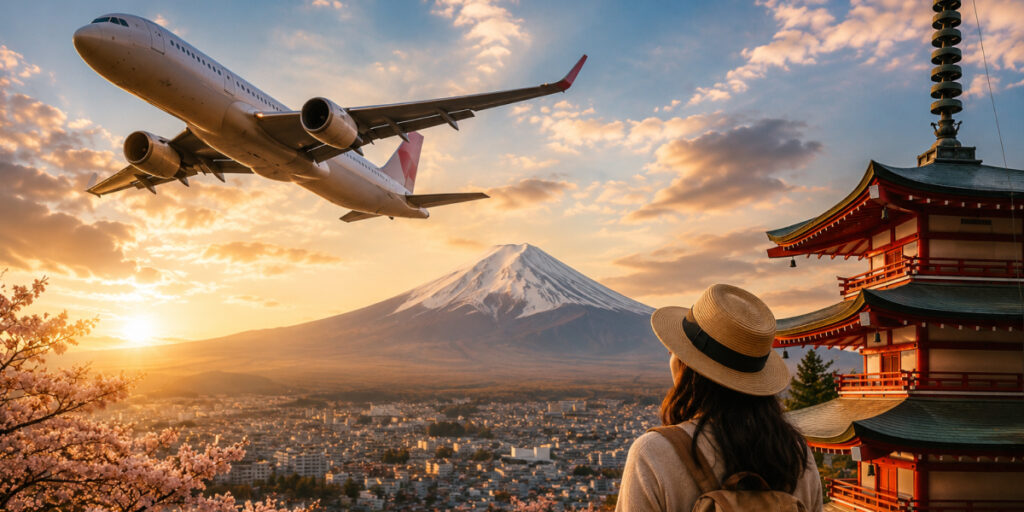
If one line item is going to decide whether your trip feels comfortable or stressful, it's this one. Flights are the biggest fixed cost by a wide margin, and unlike a hotel or a meal, there's no scaling it down once the ticket's bought.
| Departure | Estimated Round-Trip (Economy) | Estimated Round-Trip (JPY) |
| USA | $700 – $1,400 | ¥111,600 – ¥223,150 |
| UK | £900 – £1,500 | ¥193,600 – ¥322,650 |
| Australia | A$700 – A$1,200 | ¥77,350 – ¥132,600 |
| Europe | €800 – €1,400 | ¥147,100 – ¥257,450 |
Book four to six months out if your schedule allows it. And if you have any flexibility at all, stay away from cherry blossom season in late March and April, plus Golden Week in late April into early May. Fares climb during those windows, and so does everything else. Timing genuinely matters more in Japan than in most places people visit our full guide on the best time to visit Japan gets into the season by season trade-offs between weather, crowds, and cost.
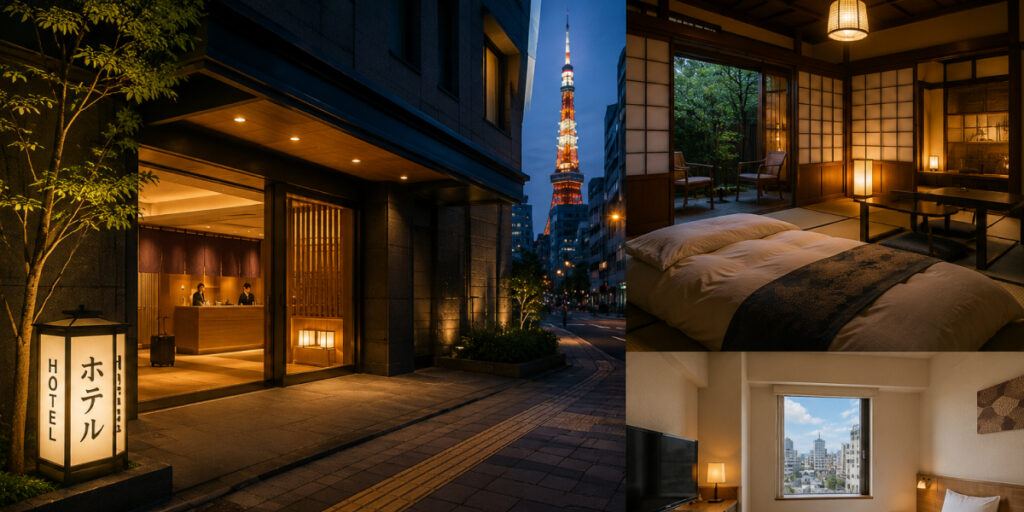
Japan is one of the rare countries where "budget" doesn't come with a catch. Even the cheapest capsule hotels tend to be spotless, safe, and better located than plenty of mid-range hotels you'd find elsewhere.
| Type | Nightly Cost (Per Person, USD) | Nightly Cost (Per Person, JPY) |
| Capsule hotel/hostel dorm | $25 – $50 | ¥3,985 – ¥7,970 |
| Business hotel (solo room) | $60 – $120 | ¥9,565 – ¥19,130 |
| Mid-range hotel (3-star) | $100 – $180 | ¥15,940 – ¥28,690 |
| Traditional ryokan | $150 – $400+ | ¥23,910 – ¥63,760+ |
| Luxury hotel | $300 – $1,000+ | ¥47,820 – ¥159,400+ |
Tokyo and Kyoto carry the steepest rates, unsurprisingly. Osaka, Hiroshima, and Fukuoka run noticeably cheaper for a similar standard of room, sometimes by a wide margin. If you're flexible about where you sleep, a trick worth stealing from frequent visitors: string together a few nights in a no-frills business hotel and save one night for a ryokan splurge. You get the cultural experience without paying ryokan prices for the whole week.
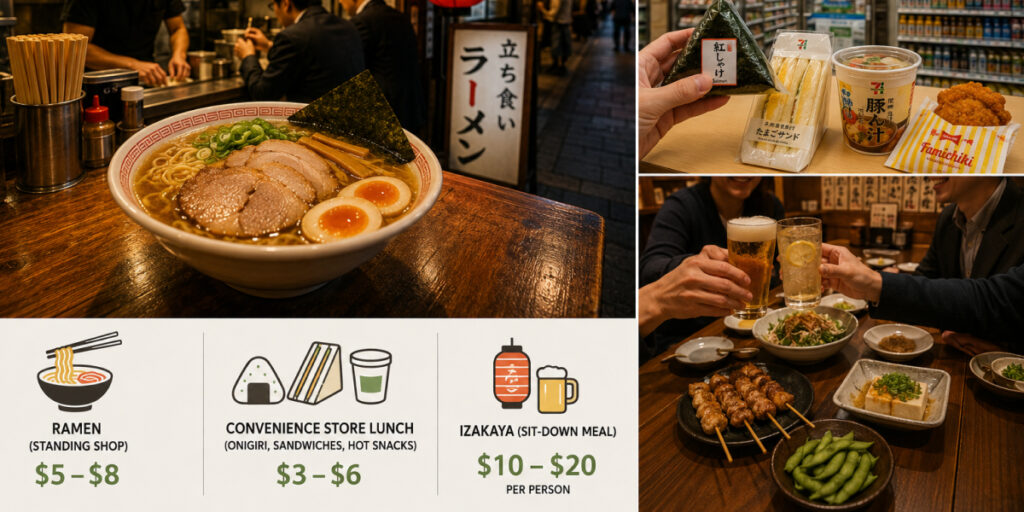
This is where Japan quietly wins against almost every other developed country I can think of. A proper bowl of ramen from a standing shop costs $5 to $8. A convenience store lunch onigiri, a sandwich, something hot from the counter runs $3 to $6 and is genuinely good, not just acceptable for the price. A casual izakaya dinner with a couple of drinks lands around $10 to $20 a person.
| Meal Type | Cost Per Person (USD) | Cost Per Person (JPY) |
| Convenience store meal | $3 – $6 | ¥480 – ¥955 |
| Ramen / soba / gyudon | $6 – $12 | ¥955 – ¥1,910 |
| Casual restaurant (lunch set) | $10 – $18 | ¥1,595 – ¥2,870 |
| Mid-range dinner | $20 – $40 | ¥3,190 – ¥6,375 |
| Fine dining / omakase | $80 – $300+ | ¥12,750 – ¥47,820+ |
If you want to keep food costs down without feeling like you're missing out on anything, it's simple: skip the restaurants clustered around major attractions, lean on convenience stores for breakfast, hit standing shops for lunch, and save the sit-down meal for dinner. You'll eat better than you expect on less than most guides claim you'll need.
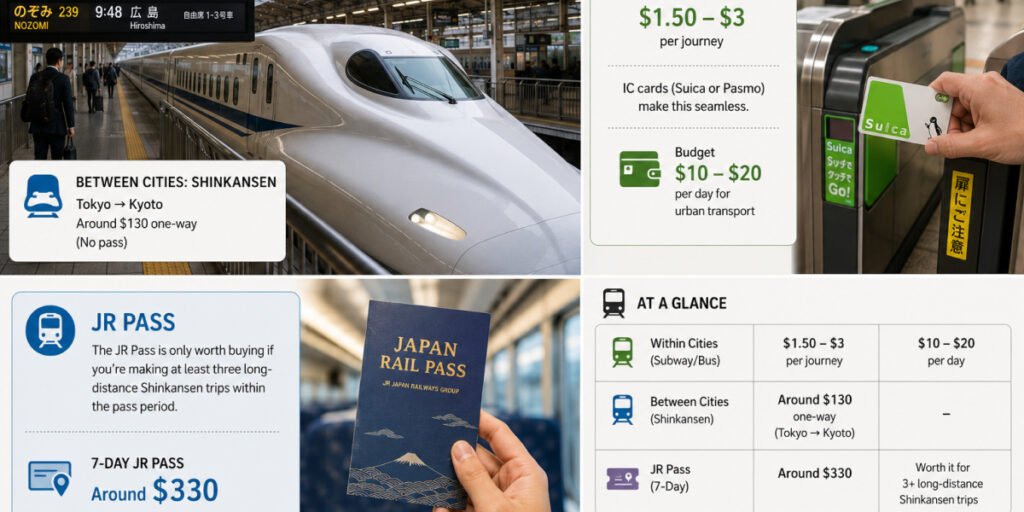
The transport system here is famously efficient, and famously easy to overspend on if you're not paying attention especially once the Shinkansen enters the picture.
Getting around within a city is cheap. Tokyo's subway runs $1.50 to $3 (¥240 to ¥480) per ride, and loading a Suica or Pasmo card removes almost all the friction. Figure on $10 to $20 (¥1,595 to ¥3,190) a day for local transport.
Between cities is where the real spending starts. The Shinkansen is the standard way to move between regions, and a one way Tokyo to Kyoto ride runs around $130, roughly ¥20,720, without a pass. That adds up quickly if your itinerary hops between three or four cities.
Which brings up the question nearly every first-timer asks: is the JR Pass worth it? Only if you're making at least three long-distance Shinkansen trips within the pass window a 7 day pass runs about $330, roughly ¥52,600. Do the actual math on your route before buying one. A lot of people grab it out of habit and barely come out ahead.
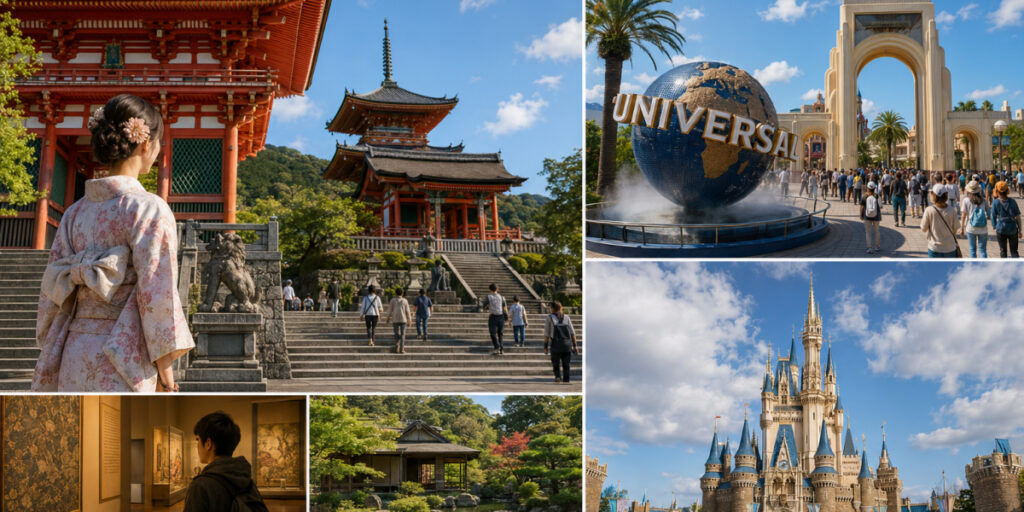
Temples and shrines are refreshingly cheap, most charging $3 to $5 (¥480 to ¥800) to get in, and plenty are free. Museums typically run $7 to $12 (¥1,115 to ¥1,910). The real outliers are the theme parks Universal Studios Japan and Tokyo Disneyland both charge $55 to $75 (¥8,770 to ¥11,955) for basic entry, more once you add an express pass.
Plan around $20 to $40 (¥3,190 to ¥6,375) a day for activities as a baseline. In practice, Tokyo and Kyoto have enough free content on offer gardens, neighborhood wandering, markets, shrine hopping to fill whole days without spending much of anything. It's worth reading up on etiquette in Japan before you go, too. Understanding the unwritten rules around temples and local spaces makes the whole experience richer, not just more polite.
Put it all together and here's a realistic total for a 7-day solo trip departing from the US.
| Category | Budget (USD) | Budget (JPY) | Mid-Range (USD) | Mid-Range (JPY) |
| Flights (round trip) | $800 | ¥127,500 | $1,000 | ¥159,400 |
| Accommodation (7 nights) | $350 | ¥55,780 | $840 | ¥133,900 |
| Food (7 days) | $175 | ¥27,890 | $420 | ¥66,950 |
| Transport | $250 | ¥39,850 | $400 | ¥63,760 |
| Activities | $80 | ¥12,750 | $200 | ¥31,880 |
| Misc/buffer | $100 | ¥15,940 | $150 | ¥23,910 |
| Total | ~$1,755 | ~¥279,750 | ~$3,010 | ~¥479,800 |
Worth pointing out: these numbers are for one person traveling alone. Split accommodation across two travelers and the per-person cost drops considerably, since a hotel room doesn't cost double for a second guest. If you're trying to push the number down even further, our budget Japan travel guide covers exactly how people manage the country for under $100 a day.
Rather than treating "is Japan expensive" as an abstract question, it helps to know exactly where the money goes, and where you actually have room to cut.
Flights sit at the top, the single biggest fixed cost and the one with the least flexibility once it's booked. Book early, avoid peak season if you can, and stay open to shifting your departure date by even a day. Those fare swings can be bigger than people expect.
Accommodation is next, and it's brutal during the wrong weeks. Tokyo and Kyoto prices can double during cherry blossom season and Golden Week. If you're traveling in either window, booking three to four months out isn't optional. It's the difference between a fair rate and scrambling for whatever's left.
Shinkansen travel deserves a mention too. Bouncing between cities every day or two racks up bullet train costs faster than people realize. Slowing down and staying longer in fewer places tends to make for a better trip anyway, not just a cheaper one.
Theme parks are entirely optional, and genuinely worth it if that's your thing. Universal Studios Japan and Tokyo Disney Sea are both excellent. Just know they'll add $70 to $100 or more (¥11,160 to ¥15,940+) per person, per day.
Roaming charges are the one nobody remembers to budget for, and it's the easiest cost on this whole list to avoid. A home SIM roaming internationally can run $10 to $15 (¥1,595 to ¥2,390) a day or more, and a Japan eSIM cuts that out almost entirely.
A few habits tend to separate people who blow through their budget by day four from people who come home with money left over.
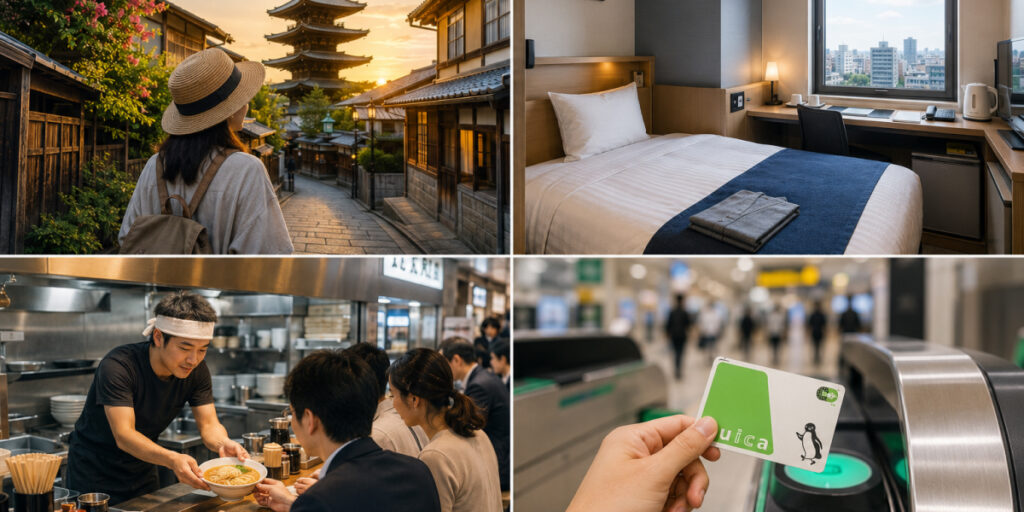
Travel shoulder season if your schedule allows it. May through June and September through October bring good weather, manageable crowds, and hotel prices that skip the peak-season markup. Stick to business hotel chains like Toyoko Inn, APA Hotel, or Dormy Inn, which are clean, well located near train stations, and typically run $60 to $90 (¥9,565 to ¥14,350) a night. That's a fraction of what a comparable Western hotel chain would charge for a similar location.
Eat the way locals actually eat rather than the way guidebooks suggest. Standing ramen shops, depachika (the food halls in department store basements), and lunch sets at sit down restaurants deliver food that rivals much pricier spots elsewhere, for a fraction of the cost. And load a Suica or Pasmo card for city transport instead of buying tickets at the gate every time. It's faster, and the savings genuinely add up over a week of subway rides.
This is the part most budget guides skip entirely, and it's worth understanding if you actually want to know what your money is doing once you land.
The exchange rate table above tells you what your dollars, pounds, or euros convert to in yen right now. What it doesn't tell you is how much you can actually buy with that money once you're on the ground. That's a different question, and it's the one Purchasing Power Parity, or PPP, is built to answer.
PPP conversion factors, published by the World Bank and used extensively by the IMF, measure how many units of a country's currency it takes to buy the same basket of goods and services that a dollar buys in the United States. Based on the most recent World Bank data, from 2024, the latest year available, Japan's PPP conversion factor works out to roughly ¥123 per international dollar. Compare that with a market exchange rate that's been sitting around ¥152 to ¥159 per US dollar over the same stretch.
That gap matters. Because the market rate sits well above the PPP rate, the yen is trading cheap relative to what it actually buys domestically. In plain terms, every nominal dollar you spend in Japan right now stretches roughly 20 to 30 percent further than the sticker price suggests, purely because of how weak the yen currently is against the dollar.
Applied to the daily budgets from earlier in this guide, it looks like this.
| Travel Style | Nominal Daily Budget (USD) | PPP-Adjusted Value (USD) | What This Means |
| Budget | $80 – $120 | ~$100 – $150 | Buys as much as $100-$150 would buy domestically in the US |
| Mid-Range | $150 – $250 | ~$188 – $313 | Buys as much as $188-$313 would buy domestically in the US |
| Luxury | $400+ | ~$500+ | Buys as much as $500+ would buy domestically in the US |
PPP-adjusted value here is calculated as nominal USD multiplied by the market exchange rate divided by the PPP conversion factor, working out to roughly a 1.25x multiplier based on ¥159 against ¥123.
One caveat worth taking seriously: PPP conversion factors come from a broad, economy wide basket, covering rent, healthcare, groceries, utilities, the whole spread of what a country's residents spend on day to day. It isn't a travel-specific basket of hotel nights, train tickets, and restaurant meals. Treat it as a directional signal, a rough answer to "does my money go further here overall," rather than a precise discount calculator for any single line item in this guide. For the specifics, the currency conversion numbers above are still the ones to trust.
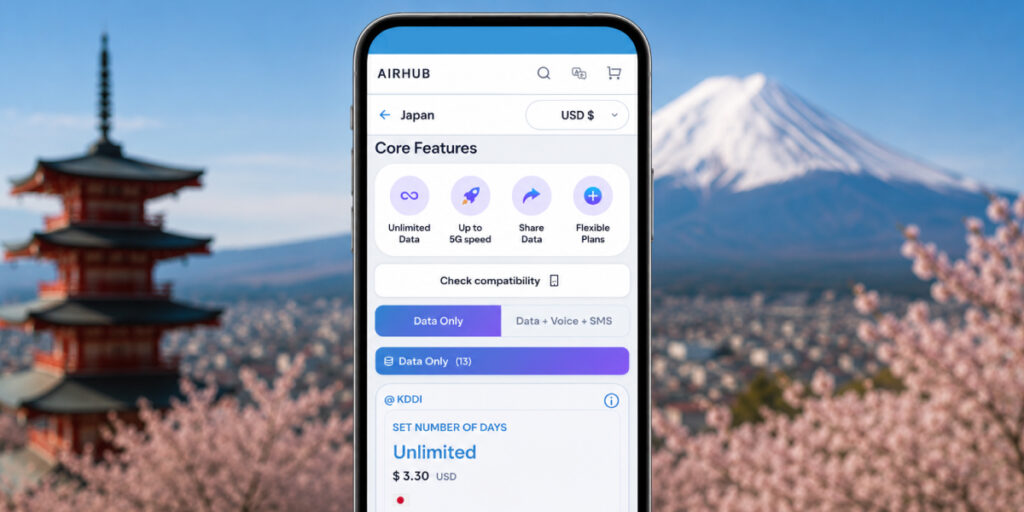
It's easy to nail down flights, hotels, and food, and still get blindsided by your phone bill. Roam on your home SIM and the charges creep up fast, often without anyone noticing until the bill shows up.
The fix is simple, though: get an eSIM for Japan from Airhub eSIM. You can buy eSIM online directly through Airhubapp in minutes. With hotspot support included, you can also share your connection with travel companions which means one plan can cover a whole group and split the cost further.
Japan has a reputation for being expensive, but in 2026 it's genuinely more affordable than a lot of Western cities of comparable quality. The weak yen has handed most international travelers something like a 25 to 30 percent discount on ground costs. Budget travelers can manage on $80 to $120 a day, mid-range travelers on $150 to $250.
Yes. $5,000 is a solid mid range budget for a 10-day solo trip from the US, covering flights, decent hotels, restaurant meals, Shinkansen travel, and activities, with some buffer left over.
For a mid-range solo traveler, figure on roughly $3,000 to $4,500 for 10 days all-in, flights from the US included. Strip out the flights and mid range travelers typically spend $150 to $250 a day on accommodation, food, transport, and activities combined.
For a solo traveler flying from the US, a realistic one week budget lands between $1,750 and $3,000 all-in, depending on travel style. Budget travelers can come in closer to $1,500 to $1,800. Accommodation is the biggest lever here choosing business hotels over mid-range options alone saves $50 to $80 a night.
Flights top the list by a wide margin, at $700 to $1,400 from the US. After that comes accommodation in Tokyo and Kyoto during peak season, long distance Shinkansen travel between cities, and theme park entry fees. International roaming charges are also a commonly overlooked cost, and one of the easiest to eliminate entirely with a Japan eSIM.
Get your Airhub eSIM in minutes and travel without roaming surprises.
Download the Airhub app to purchase, manage and top up your eSIMs anytime, anywhere!