









Ready to try eSIMs and change the way you stay connected?
Download the Airhub app to purchase, manage and top up your eSIMs anytime, anywhere!
App exclusive5% off at checkout
Explore France eSIM plans, prices, coverage, data needs, and installation steps. Find the best way to stay connected in France without fees.

A France eSIM starts at $4.50 for 1GB over seven days. That's the short answer, and for most people it's the whole reason they're here.
The longer answer decides whether you'll actually be happy with what you bought. Which French network you end up roaming on. What happens the moment your data runs out. Whether your handset supports eSIM in the first place. And a question this industry very rarely puts in writing: whether you need to buy anything at all.
Then there's a France specific quirk worth knowing before you commit. Getting hold of a prepaid SIM card once you've landed here is genuinely more awkward than almost anywhere else in Western Europe and that friction, far more than any convenience argument, is why so many visitors now sort their data before they leave home.
| Plan | Data | Validity | Price (USD) |
| France | 1GB | 7 days | $1.89 |
| France | 7GB | 30 days | $6.00 |
| France | 12GB | 30 days | $10.50 |
| Europe | 1GB | 7 days | $3.10 |
| Europe | 7GB | 30 days | $11.00 |
| Europe | 100GB | 30 days | $34.99 |
| Global | 10GB | 30 days | $26.00 |
| Global | 1GB | 7 days | $3.80 |
How that compares. Worth doing the arithmetic yourself rather than taking anyone's word for it ours included. Airalo, the biggest name in this market, currently lists France at $4.00 for 1GB over three days, and $9.50 for 5GB over seven. Airhub's 1GB costs fifty cents more and runs for seven days instead of three. The 5GB is fifty cents more and runs for a month instead of a week.
On validity per dollar, then, Airhub wins both comparisons. Not dramatically this is a crowded market and nobody is handing out bargains but the gap is real, and it widens the longer you're away. That's the defensible version of a claim the previous edition of this page simply asserted without showing any working.
Browse current esim data plans for other destinations, or head straight to the eSIM France plan page.
This single question determines your actual day-to-day experience, and it's precisely the one most providers go quiet about.
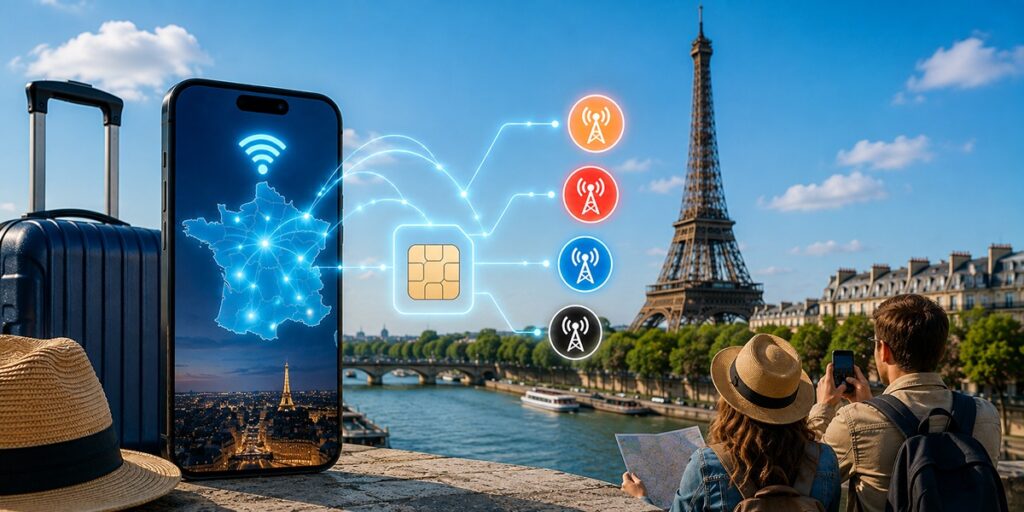
France runs four national networks: Orange, SFR, Bouygues Telecom and Free Mobile. Orange carries the broadest footprint, particularly once you leave the big cities, which is why most travel eSIM providers route to it. Airalo, Sim Local and esimfrance.com all name Orange openly. Sim Local lists Lycamobile as a second option.
So before buying any France eSIM ours or a competitor's find out what's behind it. A provider that won't tell you has told you something.
A word on coverage. All four networks perform well across Paris, Lyon, Marseille and the TGV corridors. Things thin out in the Alps, parts of rural Normandy and the Camargue but that's geography rather than any provider's failing, and it applies whichever eSIM you buy. Download offline maps before heading into the mountains and you'll never notice.
The previous version of this page informed readers that "only a few phones are currently compatible with eSIM technology." Roughly true in 2021. Emphatically false now and, more to the point, it was talking people out of a purchase they could perfectly well have made.
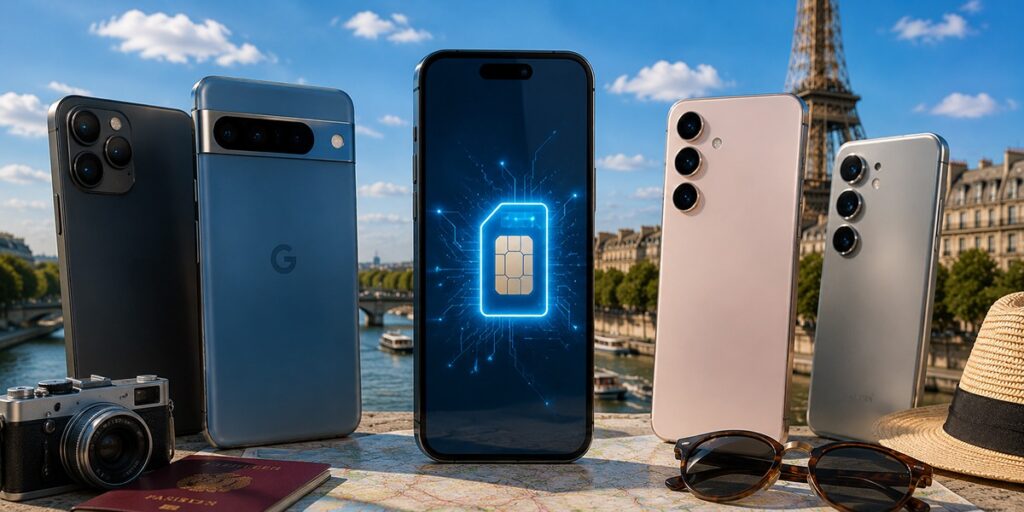
The accurate position in 2026 is the inverse: most modern smartphones support eSIM, and a minority don't. US iPhones have shipped eSIM-only since the iPhone 14, with no physical tray at all. Broadly you're fine on iPhone XS and newer, Google Pixel from the 3 onward, Samsung Galaxy S20 and later, plus most flagship Androids released since.
The exceptions are worth knowing, though. Plenty of mid-range and budget Android handsets still ship without eSIM support entirely. Some carrier-locked phones refuse third-party profiles. And certain models sold in mainland China have no eSIM at all, which occasionally surfaces in grey-market handsets sold elsewhere.
The ten-second check: dial *#06#. An EID number alongside your IMEI means you're covered. Our eSIM compatible devices list has the model-by-model detail if you'd rather look it up properly.
People overbuy constantly, and it happens because they misjudge where data actually goes.
Maps and messaging use far less than travellers assume. Google Maps navigation is surprisingly economical, especially if you download the Paris and regional map areas over hotel Wi-Fi before setting off. Translation apps barely register.
What really drains a plan is photo and video uploads. A week of Instagram posting or iCloud backups will outpace everything else on your phone put together and streaming sits in a category all its own.
Rough guide: 1GB handles a long weekend of maps, messaging and light browsing. 5GB covers a week or two of normal use with some social posting. 10GB and up makes sense if you're working remotely, streaming, or uploading video.
Better still, check your own numbers. Settings → Cellular on iPhone, or Settings → Network & Internet → Data usage on Android, will show a typical week at home. Adjust upward a little, because abroad you lean on maps more and Wi-Fi less than you think.
Worth understanding before you buy, because providers handle this very differently and none of them advertise it.
Fixed-data plans simply stop when the allowance is gone. You top up, you continue. Plans sold as unlimited are a different proposition: almost none are unlimited at full speed. The standard structure is a daily high-speed allowance, after which your connection carries on at a reduced rate. Nomad publishes 512kbps after its daily cap. esimfrance.com publishes 384kbps.
Those numbers tell you far more than the word "unlimited" ever will. At 512kbps you can navigate and message without much trouble. Video calls and uploads become an exercise in patience.
Most travel eSIMs sell data and nothing else, and for a great many trips that's genuinely enough. WhatsApp, FaceTime and iMessage all run over data, and between them they cover everyone you already know.
The gap opens when something French needs to reach you. A restaurant confirming the booking. A gîte owner calling with directions to a house that Google Maps has placed in a field. A rental car desk. Or an SMS verification code from a French service that flatly refuses international numbers.
If any of that sounds likely, you want voice and SMS rather than data alone. Some providers go further and issue a genuine French number esimfrance.com sells fixed data and calls plans at 15GB and 50GB aimed squarely at travelers who need one.
Fair question to answer honestly, given we sell them.

Here's the France specific detail that makes the case far better than any convenience pitch.
Buying a prepaid SIM card in France as a tourist is oddly difficult. Most phone shops won't sell prepaid cards to visitors directly they'll send you to a tabac or a convenience store instead. It's not impossible by any means. It just involves a detour, a language barrier, and a decent amount of standing about, which isn't how anyone wants to spend their first afternoon in Paris.
If you do want a physical SIM, the dependable places are Charles de Gaulle and Orly airports, plus the larger stations handling international arrivals. Orange remains the safest choice on coverage.
That friction not the technology, not the novelty of it is the real reason most visitors now arrange data before they fly.

Do this at home, on Wi-Fi. Installing at an airport, jet-lagged, on congested public Wi-Fi, is how people end up paying triple at a kiosk.
If the plan sits on "Activating…" before you travel, that's expected rather than broken it connects on arrival. Our how to install an eSIM guide handles the edge cases.
AirHub plans start at $4.50 for 1GB over 7 days, with 5GB for 30 days at $10 and 10GB for 30 days at $16. Prices correct as of July 2026.
France has four national networks Orange, SFR, Bouygues and Free Mobile and most travel eSIM providers route to Orange for its coverage.
Most modern smartphones support eSIM, though a minority of mid-range and budget Androids don't, and some carrier-locked handsets won't accept third-party profiles. Dial *#06# an EID next to your IMEI means you're covered.
No. France is in the EU, so Roam Like at Home means your domestic plan works at domestic rates. Travellers from outside the EU are the ones who benefit.
Around 5GB suits most travelers for a week or two of maps, messaging and some social posting. 1GB is enough for a long weekend of light use. Go higher if you're streaming or working remotely.
Some plans include voice and SMS with a local number; most travel eSIMs are data-only. Check the specific plan if you need to receive French calls or verification codes.
Fixed plans stop and can be topped up. Plans sold as unlimited usually throttle to a reduced speed after a daily allowance ask for that figure before buying, from any provider.
Generally yes across cities and main routes. It thins in the Alps, rural Normandy and the Camargue on every French network. Download offline maps before heading into the mountains.
Not usually a France plan covers France. If your trip crosses borders, a regional Europe plan normally works out cheaper than buying several country plans.
Charles de Gaulle and Orly airports, and larger international train stations. Most phone shops don't sell prepaid cards to tourists directly and will point you to a convenience store.
Check your phone supports eSIM. Work out how many days you actually need rather than how many you'd like. Find out which network you'll be on. And if you're an EU resident, keep your money.
For everyone else, install the eSIM France plan at home over Wi-Fi and you'll be connected before you reach the taxi rank.
Get your Airhub eSIM in minutes and travel without roaming surprises.
Download the Airhub app to purchase, manage and top up your eSIMs anytime, anywhere!