





Ready to try eSIMs and change the way you stay connected?
Download the Airhub app to purchase, manage and top up your eSIMs anytime, anywhere!
App exclusive5% off at checkout
Curious about the land of the midnight sun? Learn why some countries have 24-hour daylight in summer, where to see it, and how to plan.
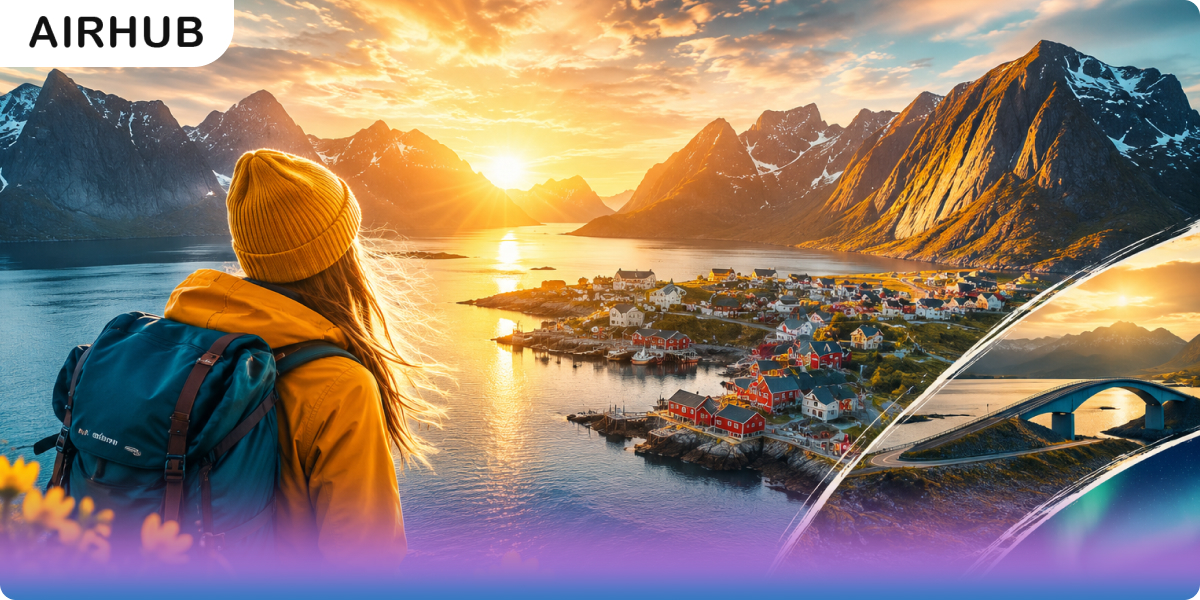
Midnight at the top of Norway, and you're wearing sunglasses. The sun hangs just above the sea, refusing to set, it slides sideways, brushes the horizon, and begins climbing again as if it never meant to leave. People fumble for the right word when they first see it. There isn't one. The closest we've got is the midnight sun, and the far-north stretch of the planet where it happens has earned a nickname that sticks: the land of the midnight sun.
In plain terms, that's any region high enough north that the sun stays above the horizon for a full 24 hours in summer. Norway wears the title most famously, but Fairbanks in Alaska, along with Greenland and a handful of other Arctic areas, has every right to it too.
What follows is the practical version: why it happens, where the light is best, the dates that actually matter, and how to keep your phone alive once you're past the reach of hotel Wi-Fi.
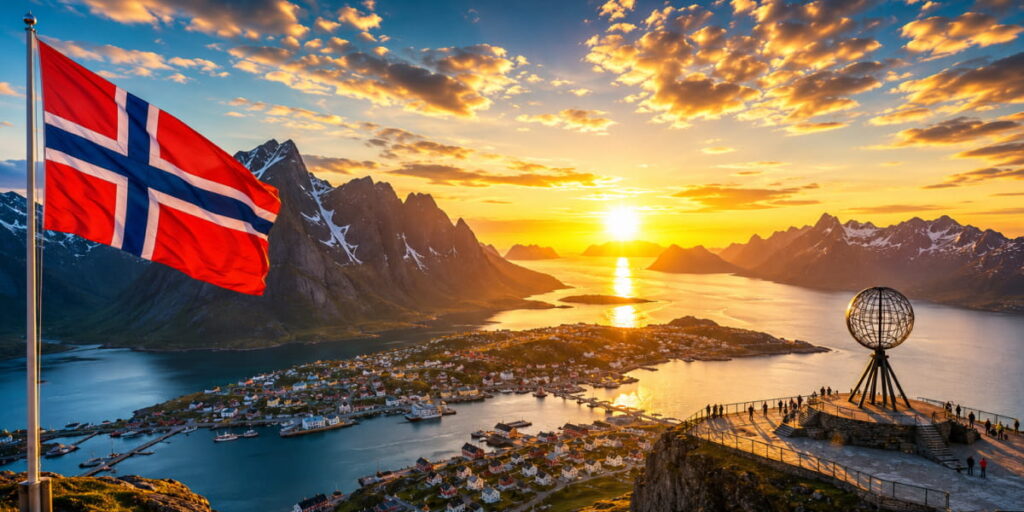
Astronomers call it polar day, which makes it sound like a scheduling quirk. It's more dramatic than that. For weeks each summer, above the Arctic Circle, the planet's tilt props the sun over the horizon even at midnight, and darkness just doesn't turn up.
The effect scales with latitude. Cross 66.5° N and the sun barely dips on a summer night. Keep going all the way to the North Pole and it stays up for roughly six months, one long, slow day.
Lots of countries own a corner of this: Sweden, Finland, Russia, Canada, Alaska, Iceland, Greenland, Norway. What sets Norway apart isn't the phenomenon itself, it's access. You can fly to Svalbard on a scheduled flight. Try that in most of the Arctic. That reachability, more than anything, is why northern Norway ended up branded "the Country of the Midnight Sun."
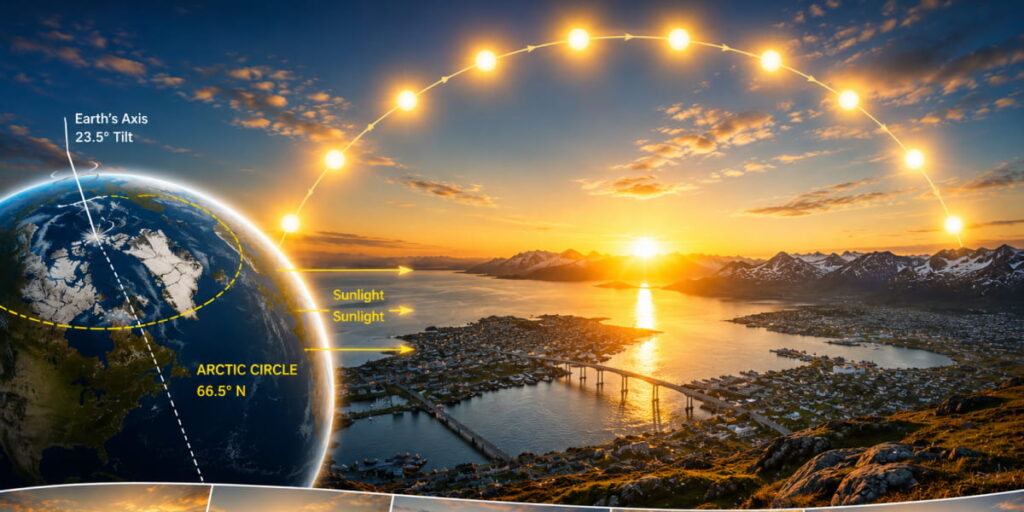
Above the Arctic Circle, but that line is a starting point, not a promise. Right at the edge, you might get a single night of true midnight sun around the solstice and nothing more. The real thing, the weeks-long version, lives farther up: Tromsø, Hammerfest, North Cape, Svalbard.
Iceland is the honorable mention. It sits just south of the circle, so it misses the full effect, but its "white nights" come close, a soft twilight that stretches and lingers rather than fading out.
One reason, really: tilt. As Earth loops the sun, one hemisphere leans toward it, and around the June solstice the northern half is tilted as far in as it gets. Above the Arctic Circle, that lean is enough to hold the sun up around the clock.
Which is why waiting for a midnight sunset is a fool's errand up there. The sun drops low, grazes the horizon, and climbs back, no dip below, no dusk, no dark. Latitude and tilt, doing all the work.
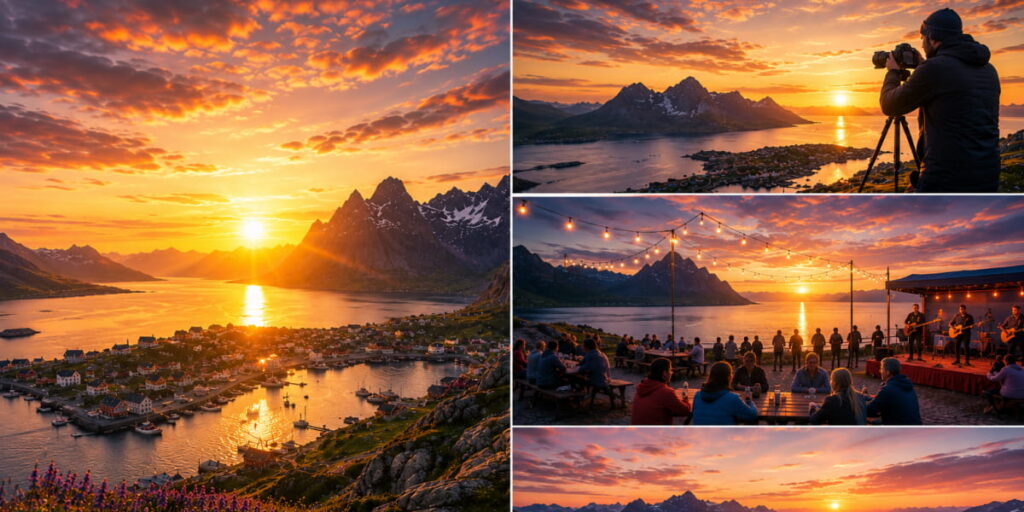
So which country is known as the land of the midnight sun? Norway takes the crown, and it's not really close. No other Arctic nation is as bound up with the phenomenon, and so much of the north sits above the Arctic Circle that summer here just means the sun keeps going. If a sunset in Norway already stops you in your tracks, the midnight sun is the version that ruins you for ordinary evenings, one of the Best places to go in the world to see it.
The far north is where the season runs longest and steadiest. Tromsø holds the light from roughly 20 May to 22 July. Up on Svalbard, Longyearbyen keeps it from late April into late August. North Cape, the very tip of mainland Europe, stretches mid-May to the end of July. One small thing that saves a lot of grief: set up your data before you fly, not after. An eSIM Norway plan means your maps are working the second you clear the gate.
Four places do the heavy lifting, and each suits a different kind of traveler.
Notice the through-line, the farther north you push, the longer the season lasts. The light and the landscape change from place to place, but the payoff is identical: the sun, still up, at midnight.
If you take one thing from this section, take the window: early June to mid-July. That's when everything lines up, longest days, kindest weather, and near-certain midnight sun across every big destination. Land near the solstice (around June 21) and the entire Arctic is lit around the clock.
For the precise version, here it is by destination. These are close approximations, not stopwatch times, except a few days' drift year to year.
| Destination | Approx. midnight sun dates | Rough length |
| Arctic Circle (southern edge) | 12 June – 1 July | ~3 weeks |
| Bodø | 4 June – 8 July | ~5 weeks |
| Lofoten Islands | 28 May – 14 July | ~7 weeks |
| Tromsø | 20 May – 22 July | ~9 weeks |
| North Cape (Nordkapp) | 14 May – 29 July | ~11 weeks |
| Svalbard (Longyearbyen) | 20 April – 22 August | ~4 months |
Sources: Visit Norway / Northern Norway tourism board and regional tourism authorities. Add one astronomical reference (e.g. timeanddate.com sun tables) as a second outbound citation for the dates/science.
There's nothing hard about it. There's just an order that keeps the trip from unraveling.
Start with the calendar collision, figure out when you can actually travel, then pick a latitude that delivers the midnight sun in that window (the table above is your cheat sheet; farther north buys you a longer, higher sun). Once you've got a destination, book earlier than instinct tells you to. Midsummer is the busy season up north, and the rorbuer cabins in Lofoten and the hotels in Tromsø and Svalbard are gone months in advance.
Then sort the logistics. Fly into Tromsø (TOS) or Bodø (BOO), both are well-connected hubs, or slow it down and take the Hurtigruten coastal ferry between Bergen and Kirkenes. On the ground, find a spot with a clean northern horizon: a cliff, a beach, a cable-car plateau, the rail of a boat. Pack layers (Arctic nights stay cool even in daylight), a sleep mask, sunglasses, and your camera. And handle your data before you leave, you can buy eSIM coverage that switches on in a couple of minutes, so navigation and translation still work when the signal thins out.
This is the part most guides skip, and it's a mistake. Norway is the headline, sure, but the Arctic Circle carves straight through Sweden, Finland, Greenland, Canada, and Alaska, so the "land of the midnight sun country" title is a shared one. If you're stitching together a bigger northern trip, keep these on the radar.
Finnish Lapland gets the light around Rovaniemi and north of it, roughly early June to early July, longer the higher you climb. Over the border, Swedish Lapland does the same from Abisko and Kiruna, late May into mid-July. Iceland's tiny island of Grímsey sits right on the Arctic Circle, while the rest of the country basks in near-24-hour twilight around the solstice.
Then there's the American claim. Fairbanks, Alaska has marketed itself as "the Land of the Midnight Sun" for decades, with a season stretching April 22 to August 20 and 70 unbroken days of sunlight from mid-May to late July. Farther afield, Inuvik in Canada's Northwest Territories holds the sun for 50-odd days each midsummer, and Greenland's Ilulissat runs late May into July against a backdrop of drifting icebergs.
Chaining a few of these together on one trip? A regional eSIM Europe plan spares you the border-by-border SIM shuffle.
The obvious draw is the light itself. Instead of the flat, punishing overhead sun you'd get down south at noon, this stays low and warm for hours, pinks, ambers, blues, even at two in the morning. There's simply no bad time to be outside, and that reshapes a trip more than you'd expect.
The culture reads the room accordingly. Arctic towns don't waste the light on sleep. You get midnight concerts, barbecues that start at 11 p.m., and events like Tromsø's Midnight Sun Marathon, which, no gimmick, fires the starting gun at midnight in full daylight. Norwegians even have a word for the whole outdoor-obsessed mindset, friluftsliv, and summer is when it runs hottest.
For photographers, the appeal is technical as much as emotional. That famous golden hour? Up here it's a golden night. A few habits pay off: keep your palette tight and let the warm tones do the talking instead of fighting them; anchor the frame with real foreground, a boulder, a boat, a person, so the endless horizon has something to measure itself against; and sit that horizon about a third of the way up the frame, with a graduated ND filter to keep a bright sky from blowing out a darker foreground.
Book early, and when you think you've booked early enough, book earlier. Midsummer is the single busiest stretch in the north, and if this trip is riding along with a wider budget Europe trip, understand that the remote Arctic towns are exactly where rooms vanish first.
Safety doesn't take the summer off just because it's bright out. Carry water, keep offline maps loaded in case the signal drops, and tell someone your route if you're heading out solo. Reindeer and moose don't check the clock, they'll wander onto a road at any hour, and under flat midnight light they're easy to miss until you're close.
Two details trip people up. First, Norwegian law requires headlights on at all times, 24-hour daylight included. Second, and travelers underrate this constantly, sleep. Full sun at 2 a.m. can quietly dismantle your body clock inside a couple of days, and no amount of willpower fixes it. Plan around it.
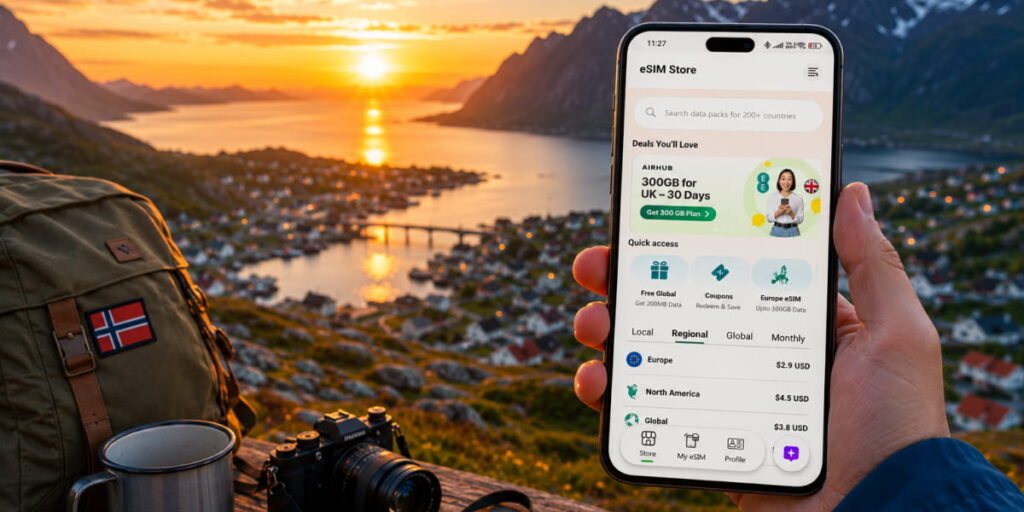
Out in the remote Arctic, hotel Wi-Fi is a coin flip and roaming fees stack up fast. The workaround is boring but effective: line up an international travel eSIM before you leave home, so you've got data for maps, translation, photos, and the odd emergency call, no chasing down a local SIM, no gut-punch on the bill later. And because the land of the midnight sun runs from northern Norway all the way to Greenland and Alaska, an eSIM Global plan earns its keep if your route crosses borders.
Getting set up takes minutes. You buy an eSIM online, a QR code lands in your inbox, you scan it, and you're on. Never done it before? Walk through how to activate an eSIM first.
A far-north region where, in summer, the sun never fully sets, it stays above the horizon around the clock. The midnight sun (or polar day) happens north of the Arctic Circle, where the Earth's tilt keeps the sun up even at local midnight.
Norway, most famously, thanks to its reachable Arctic north and long cultural tie to the phenomenon. But it's a shared title, Fairbanks in Alaska, plus Greenland, Sweden, Finland, Canada, and Iceland's far north, all lay claim to it.
Not easily, at first, light at 2 a.m. can scramble your body clock within a day or two. Most hotels in Arctic Norway come with blackout curtains (confirm "blackout curtains" or mørke gardiner when you book), and an eye mask is worth packing even when they swear the room is dark. Holding a steady bedtime helps you adjust faster.
Usually 5°C to 18°C up around Tromsø, nudging past 20°C on the warm days. Nights still bite a little thanks to Arctic wind, so bring layers.
In Norway: Tromsø, the Lofoten Islands, Nordkapp (North Cape), and Svalbard. Each one pairs 24-hour daylight with scenery you won't forget.
Late May to late July in the north, with June the standout for long, clear, luminous nights.
No, it's really a northern, above-the-Arctic-Circle thing. Southern Norway gets very long summer days, but not a genuine midnight sun.
Hiking, kayaking, fishing, road trips, midnight golf, whale safaris, and late-night photography, and plenty of people just camp and watch the wildlife under that bright, strange sky.
Get your Airhub eSIM in minutes and travel without roaming surprises.
Download the Airhub app to purchase, manage and top up your eSIMs anytime, anywhere!