








Ready to try eSIMs and change the way you stay connected?
Download the Airhub app to purchase, manage and top up your eSIMs anytime, anywhere!
App exclusive5% off at checkout
Learn how events like ICEF Dubai connect students with global opportunities and why career coaching services are valuable for future success.

Every February, a particular kind of migration happens in the Gulf. University reps, recruiters, scholarship administrators, and consultants fly into Dubai for a few intense days of back-to-back meetings and the partnerships struck in those hotel ballrooms quietly decide where thousands of students will study next year. ICEF Dubai sits at the center of it, and it earned that position the hard way: by putting the right people in the same room, year after year.
If you work in this field, you already feel the pull. Scholarship funding across the region runs deep, family demand keeps climbing, and the agents who actually control access to students don't hand out trust to a cold email. That's the real reason these events outperform any brochure or LinkedIn campaign they compress months of relationship-building into three days. Alongside ICEF Dubai, the ICEF World Student Scholarship Education Programme (WSSEP) turns the spotlight onto funding specifically, which is where a lot of the region's most consequential conversations happen.
There's a catch, though, and it's an unglamorous one: none of this works if you're offline. Which is exactly where a reliable Airhub UAE eSIM plan quietly earns its keep. More on that below first, the events themselves.

ICEF International Consultants for Education and Fairs has one job at its core: connecting the two halves of the recruitment world. Universities, colleges, and scholarship programs on one side; vetted agents and service providers on the other. It's matchmaking, essentially, but for institutions that can't afford to guess who's credible.
ICEF Dubai is its flagship gathering for the Middle East and North Africa. Held each February at Jumeirah Emirates Towers, it brings together screened student-recruitment agents and educators from across the MENA region for three days of pre-scheduled meetings, trend briefings, workshops, and the kind of hallway conversations that don't happen over video calls. For anyone serious about recruiting from this part of the world, it's less a nice-to-have and more a fixture on the calendar. (Dates shift slightly each year, so check the official ICEF Dubai page for the current edition before you book flights.)
The short answer: MENA is one of the most dynamic education markets going. A young, fast-growing population, high household incomes in the Gulf states, and governments willing to fund overseas study for their citizens that combination doesn't exist in many places at once.
The longer answer is about access. Educators come to ICEF Dubai to meet ICEF screened agents they can actually trust, build collaborations that last beyond a single intake, read where regional demand and funding are heading, and reach students through partners who already have local credibility. For study abroad consultants and overseas study consultants in particular, a few days of face-to-face meetings can seed a regional pipeline that would otherwise take a year of outreach to build and warm introductions here tend to convert far better than anything cold.

Think of WSSEP as ICEF Dubai's tightly focused companion. Same venue, and it runs right alongside the main event but instead of general recruitment, it's built around one theme: scholarships.
That focus is the point. WSSEP gathers scholarship organisations and educators, drawing providers from across the GCC Saudi Arabia, the UAE, Kuwait, Qatar, Bahrain, and Oman who manage substantial funding for international students. If your work touches funded programs, this is the room worth being in. It's where you learn how the region's scholarship systems really operate, where you can partner with career coaching services that guide students toward funded pathways, and where you start building trust with the bodies that approve applications and release money. For anyone in international student counseling, the funding side of the business gets a lot more tangible after two days here.
Here's the part nobody puts on the agenda. An event like this runs on your phone pre scheduled meetings you can't miss, ride-hailing between venues, a proposal you promised to send before dinner, WhatsApp threads with three agents at once. Lose a signal at the wrong moment and it costs you, not in data, but in a meeting that doesn't happen.
Airport Wi-Fi and hotel networks won't reliably carry you through a day like that, and international roaming has a way of turning a productive trip into an ugly bill. A travel eSIM Dubai plan solves it cleanly: you connect to a local UAE network for proper in-country coverage, with no roaming charges and nothing to physically swap.
A few reasons it fits event travel specifically:
For the apps you'll actually lean on WhatsApp, email, maps, the odd Zoom or Teams call a data plan carries all of it. (A note for planners: confirm your plan's calling setup and coverage details against the product page, since UAE networks handle voice and VoIP a little differently than you might expect at home.)
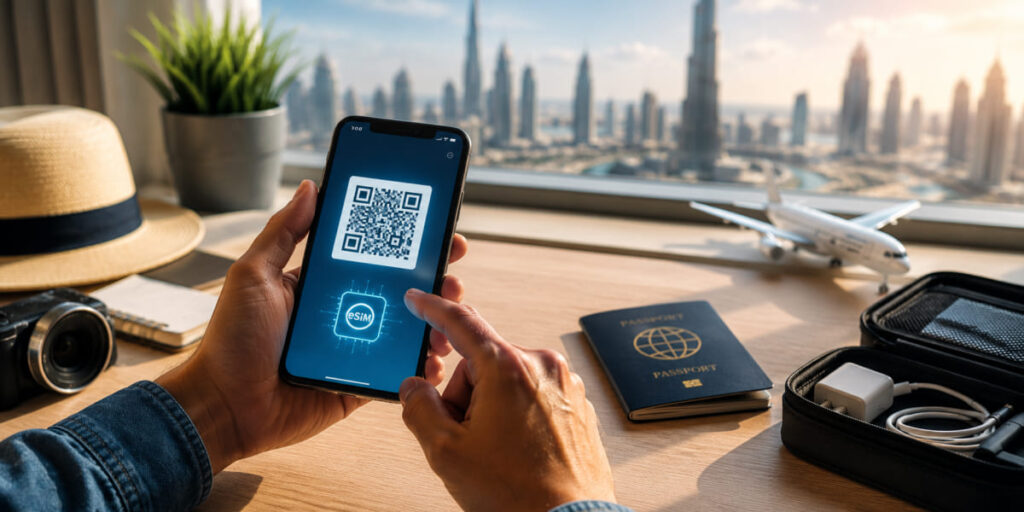
None of this takes long. You can activate your eSIM before you leave home:
One practical tip most first-timers miss: install the eSIM at home, but hold off switching it on until you land, so the validity window starts when you actually need it not while it's sitting in your bag. Keep your primary SIM in place and let AirHub's travel eSIM handle the data.

ICEF Dubai and WSSEP aren't box ticking exercises. They're where genuine partnerships in international education get made, the kind that outlast a single recruitment cycle. Show up prepared, follow up fast, and the few days pay for themselves many times over.
Just don't let something as basic as a dead signal undo the work. Sort your connectivity before you board, and spend your energy in the room instead of hunting for Wi-Fi. Your ideas deserve better than a spinning loading icon.
Once you've bought your plan, we email you a QR code. Open your phone settings, head to mobile or cellular data, choose "Add eSIM" or "Add Cellular Plan," and scan it your phone walks you through the rest.
Yes. Most newer phones let you add an eSIM as a second line in settings while your physical SIM stays put, so you keep your home number for calls and use AirHub purely for data.
You can. If your device supports eSIM, AirHub's plan installs and runs with no physical SIM in the phone at all.
Plenty of recent phones store several eSIM profiles and keep one or two active at a time. The exact number comes down to your specific model, so it's worth checking your device's specs.
Match it to how you'll use data and how many days you're there. Light use maps, messaging, a bit of email needs less; if you're tethering a laptop or taking video calls between sessions, size up. Check the current Dubai plans for the closest fit.
Yes. eSIMs are fully supported on UAE networks. You install a travel plan and connect to a local network the moment you arrive, no physical SIM required.
Get your Airhub eSIM in minutes and travel without roaming surprises.
Download the Airhub app to purchase, manage and top up your eSIMs anytime, anywhere!