








Ready to try eSIMs and change the way you stay connected?
Download the Airhub app to purchase, manage and top up your eSIMs anytime, anywhere!
App exclusive5% off at checkout
Explore the best ski resorts in the US with travel tips, vacation hacks, and everything you need for the perfect winter getaway.
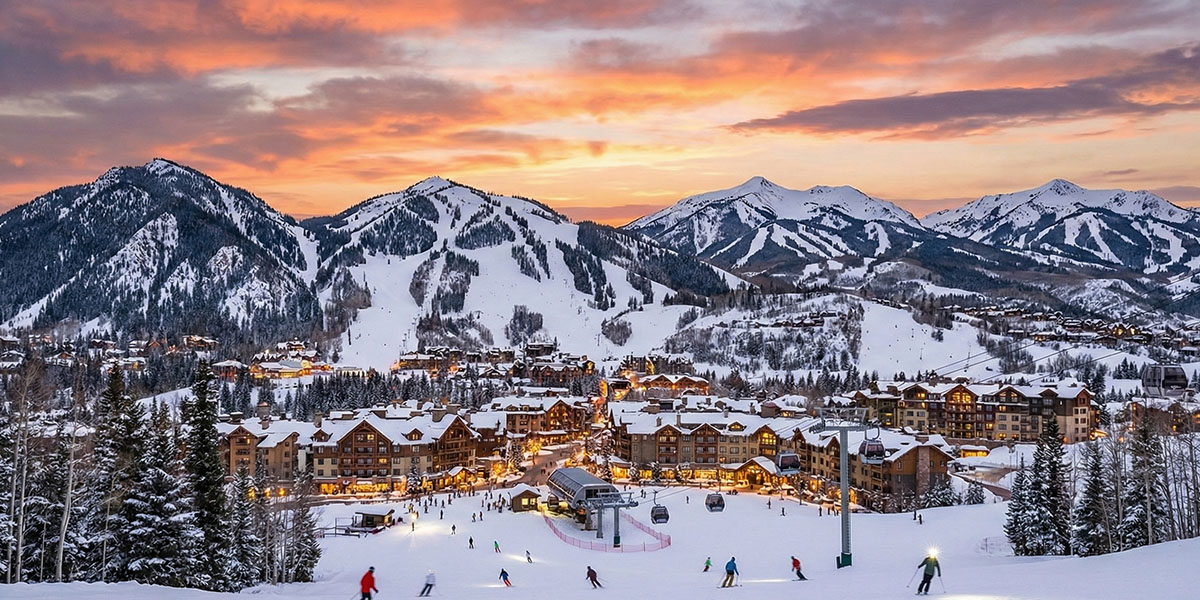
The US doesn't ski in halves. In one country, on one passport, you can drop into a two-mile vertical off a Wyoming ridgeline, carve groomers with Lake Tahoe glittering a few thousand feet below, or ski a Vermont village that looks lifted straight off a holiday card. Finding a good resort was never the problem. Choosing between them is and if you're flying in from overseas for a single week, that choice carries real weight.
This guide is built to make it easier. Below are 10 of the best ski places in the US, each with the numbers that actually decide a trip vertical, terrain, snowfall plus which pass gets you through the gate, what the town is like once your boots come off, and the detail almost every other guide leaves out: whether your phone will work up there at all. If you're travelling from abroad, hold that thought. It matters more than it sounds, and we'll get to it.
Want the numbers side by side before you read the write ups? Start here.
| Resort | State | Vertical | Skiable acres | Avg. snowfall | Pass | Best for |
| Aspen Snowmass | CO | 4,406 ft | 5,500+ (4 mtns) | ~300 in | Ikon | Variety + luxury |
| Vail | CO | 3,450 ft | ~5,300 | ~350 in | Epic | Big all-rounder |
| Breckenridge | CO | ~3,400 ft | ~2,900 | ~355 in | Epic | Value + families |
| Telluride | CO | ~4,400 ft | ~2,000 | ~280 in | Ikon | Scenery + no crowds |
| Jackson Hole | WY | 4,139 ft | 2,500 | ~458 in | Ikon | Experts + deep snow |
| Big Sky | MT | 4,350 ft | 5,850 | ~400 in | Ikon | Big terrain, short lines |
| Park City | UT | 3,100 ft | ~7,300 | ~365 in | Epic | Size + ski town |
| Heavenly | CA/NV | ~3,500 ft | 4,800 | ~360 in | Epic | Views + nightlife |
| Mammoth | CA | 3,100 ft | 3,500 | ~400 in | Ikon | Long late season |
| Stowe | VT | 2,360 ft | 545 | ~300 in | Epic | East Coast base |
Colorado is the beating heart of American skiing high, dry, and packed with famous names, most of them within a few hours of Denver.
Aspen Snowmass is really four mountains on one ticket Aspen Mountain, Snowmass, Buttermilk, and Highlands sharing one of the biggest verticals in the country at 4,406 ft, with a summit near 12,510 ft. You come for the expert-steep terrain, the deep Colorado powder, and a historic town that does luxury lodges and lively après as well as anywhere. The clever part: Buttermilk is a genuinely gentle beginner hill, which makes this one of the few marquee resorts that honestly works for every level. Pass: Ikon.
Vail is the big all rounder. Roughly 5,300 acres and a 3,450 ft vertical stretch from gentle groomers to the legendary Back Bowls, with 33 lifts feeding 277 trails. The European-style village at the base manages to feel grand without turning stuffy, and there's terrain for every ability under one lift map. If you want a single resort that does a bit of everything, and does it at scale, this is the one. Pass: Epic.
"Breck" is the value play among the Colorado heavyweights five peaks, 187 trails, and a base at 9,600 ft climbing to 12,998 ft, where the Imperial Super Chair holds the title of North America's highest chairlift (fair warning if you're prone to altitude sickness). It averages around 355 inches of dry powder, balances family-friendly greens against 34% expert terrain, and closes the day on a Victorian Main Street that's one of the best ski-town scenes in the state. Pass: Epic.
Tucked into a remote pocket of southwestern Colorado, Telluride is for skiers who want the San Juan Mountains' scenery without the lift-line scrum. Around 2,000 acres and 148 trails, 41% of them advanced, a rugged chic town, and famously quiet lifts. It cuts both ways nicely: the "Galloping Goose" run rambles 4.6 miles for cruisers, while the Plunge and Spiral Stairs give the thrill seekers their stomach drop. Pass: Ikon.
Bigger, wilder, and generally less crowded than Colorado this is where the terrain stops being polite.
Wyoming's Jackson Hole is the expert's benchmark, full stop. A 4,139 ft continuous vertical over two straight miles drops through 2,500 acres of steep chutes and bowls, past the infamous Corbet's Couloir off the summit. Roughly half the trails are expert-only, and it averages a staggering 458 inches of snow a year, among the deepest of any major US resort. Strong skiers: book this one. Everyone else: build up to it. Pass: Ikon.
Big Sky, Montana earns its name 5,850 acres and 320 runs make it one of the largest in North America, with Lone Mountain topping out at 11,166 ft above a 4,350 ft drop. About half the terrain skews advanced, but the groomers are plentiful. The trade against Colorado is simple: you give up the glitzy base town, and in return you get shorter lift lines, wide-open bowls, and, often, noticeably better value. Pass: Ikon.
Since merging with Canyons, Park City has become one of the largest ski areas in the country about 7,300 acres, a 3,100 ft vertical, and 348 trails. The Utah snow falls light and dry (around 365 inches), the terrain leans intermediate-friendly, and the day ends on a historic silver mining Main Street stacked with restaurants and bars. As a complete ski town package, few places top it. Pass: Epic.
California skiing trades the Rockies' altitude for something else entirely: enormous snow totals, long seasons, and sun.
Straddling the California Nevada line above South Lake Tahoe, Heavenly is the biggest resort in the Tahoe area 4,800 acres, about 3,400 ft of vertical, and, on runs like Ridge Run, the best lake views in the sport. Then the lifts close and South Lake Tahoe's casinos and nightlife are right there, which makes it that rare thing: a serious mountain with a genuine party at the bottom. Pass: Epic.
Out in the Eastern Sierra, Mammoth is the snow magnet 3,500 acres, 178 trails, a summit around 11,053 ft, and roughly 400 inches a winter. Its real trick is stamina: Mammoth routinely stays open through May and, in a big year, into July, which makes it the default for anyone chasing late-season turns long after the Rockies have closed. Base town Mammoth Lakes stays casual and refreshingly free of pretension. Pass: Ikon.
On the East Coast, Stowe is New England's crown jewel. It's small next to the western giants 545 acres across Mount Mansfield and Spruce Peak, with a 2,360 ft vertical but it punches hard: challenging bumps, a real ski resort atmosphere, and a Vermont village of boutiques and restaurants that few places out west can match for charm. For anyone based in the Northeast, this is the benchmark everything else gets measured against. Pass: Epic.
Short on time? Pick by whatever matters most to you:
Here's the call most first-time US-ski planners don't realize they're making: nearly all of these resorts sit on one of two big multi-resort passes, and buying the right one before you fly can save a genuinely serious amount over daily lift tickets which, at a marquee resort, can run north of $200 a day at the window.
The practical move: if you're hitting several resorts in one trip, choose the pass that covers the most of your shortlist rather than paying as you go. One caveat worth taking seriously verify the current line ups, access tiers, and blackout dates before you buy. Both passes reshuffle their rosters and rules every season, and the fine print is where trips get expensive.
Peak season runs December through early March, when most resorts hit their deepest, most dependable snow. Push into late March and April and you trade some of that depth for warmer, sunnier spring skiing and thinner crowds and if you're determined to ski into May or beyond, Mammoth is the safe bet thanks to that marathon season. One insider note on timing: the US holiday weeks (Christmas, Presidents' Week in February) bring the biggest crowds and the highest prices, so mid-week days and the quieter stretch in mid-January are where the value hides.
This is the part almost no ski guide bothers with, and it quietly matters especially if you're visiting the US from abroad. Coverage on a mountain is genuinely uneven: solid around base areas and villages, then unreliable the moment you drop into back bowls, tree runs, or anything approaching backcountry. That's not just about posting a powder shot. It's how you regroup when your group scatters across a run, pull up the resort app or a trail map, catch a weather or avalanche alert, or call for help when something goes wrong.
For an international visitor, the choice comes down to two paths: pay your home carrier's roaming rates expensive, and frequently throttled or set up a US data plan before you land. An eSIM is the low friction one. You buy it ahead, scan a QR code, and step off the plane already connected to a US network, with no airport SIM kiosk and no fishing out the card that holds your home number.
On a ski trip, where you're leaning on GPS, apps, and messaging from first chair to last, an eSIM usa with unlimited data plan from Airhub keeps you online without one eye on a data meter. Prefer to size the plan to the trip? Browse Airhub's eSIM data plans and pick what fits. Most recent iPhones and Android phones support eSIM, and many will run your home number alongside a travel plan check the compatibility list first, and if the format's new to you, here's the plain comparison of eSIM vs a physical SIM.
There's no single best resort here only the best one for you. Chase the deep steeps at Jackson Hole, the value and Main Street buzz at Breckenridge, the lake views at Heavenly, or a long late-season week at Mammoth. Match the mountain to your ability and your pass, book mid week if you can swing it, and sort your connectivity before you fly so the only thing you're tracking up there is the next run.
There's no outright winner it depends on what you're after. Jackson Hole and Big Sky lead for expert terrain and deep snow, Breckenridge and Big Sky for value, Park City and Aspen for the ski-town experience, and Vail for a big all rounder that suits every ability.
Big Sky (Montana) and Jackson Hole (Wyoming) sit at the top. Big Sky's Lone Peak has a 4,350 ft drop, just edging Jackson Hole's 4,139 ft continuous vertical and both give you long, uninterrupted runs from summit to base.
Jackson Hole is famous for it, averaging around 458 inches a year, with Mammoth close behind at roughly 400. As a rule, the Rockies and the Sierra get the deepest powder, while the East Coast and parts of Tahoe see less.
If you're skiing several of these resorts on one trip, almost certainly the right multi-resort pass usually beats buying lift tickets day by day. In short: Vail, Breckenridge, Park City, Heavenly, and Stowe run on Epic; Aspen, Jackson Hole, Big Sky, Mammoth, and Telluride on Ikon. Confirm the current line-ups before you buy, since they change each season.
December through early March is the peak season for the deepest snow. Late March and April bring spring conditions and smaller crowds, and Mammoth frequently runs into May or beyond for anyone chasing late season turns.
Skip the roaming charges and set up a US data plan before you go. An esim usa with unlimited data plan lets you land already connected, so GPS, resort apps, and messaging all work on the mountain. Coverage is strongest near base areas, so download offline trail maps for the back bowls and backcountry where any network can drop and check that your phone supports eSIM first.
Get your Airhub eSIM in minutes and travel without roaming surprises.
Download the Airhub app to purchase, manage and top up your eSIMs anytime, anywhere!