








Ready to try eSIMs and change the way you stay connected?
Download the Airhub app to purchase, manage and top up your eSIMs anytime, anywhere!
App exclusive5% off at checkout
Discover the best eSIM cards for seafarers in 2025. Stay connected at sea with global coverage, affordable plans, and reliable data options for maritime professionals.

A tourist buys one SIM for one country and forgets about it. A seafarer doesn't have that luxury. Over a single contract you might touch five, ten, or fifteen countries a few hours here, a couple of days there and a local SIM in each port is a losing game of queues, paperwork, and cards you'll never top up again.
That's the real connectivity problem at sea: not one country, but many, with very little time in each. An eSIM for seafarers is built for exactly that pattern. It's a digital SIM you install before you fly out, so you can carry data across multiple destinations without hunting for a shop every time you dock and without the roaming bill that turns a video call home into a small fortune.
This guide is written for that reality: merchant navy crew, cruise staff, offshore and maritime workers who move between ports on tight schedules. We'll cover what to look for, how short- and long-stay plans differ, what actually works at sea versus in port, and the mistakes that catch crew out.

There's no single "best" the right eSIM depends on your route and how long you're away. But the plans that work for crew tend to share the same traits. Look for:
Keep those in mind and the shortlist gets short fast. Now let's compare the actual options.

| Option | Best for | Advantages | Limitations |
| International / travel eSIM | Multi-country routes and shore leave | Install before you sail; no SIM swapping; one setup covers many ports | Needs an eSIM-compatible, unlocked phone; works on land networks, not mid-ocean |
| Local SIM (bought in port) | A long stay in one country | Often cheap at local rates; gives you a local number | New card in every country; queues and ID checks; usually can't top up online |
| Global physical SIM | Older phones without eSIM | Broad multi-country coverage on one card | Must be ordered and shipped in advance; less flexible to change |
| International roaming | Total convenience, short trips | Nothing to set up | Can be very expensive; easy to run up surprise charges |
| Ship Wi-Fi / onboard systems | Access while at sea | Works offshore where mobile networks can't reach | Availability, speed, and cost vary widely by vessel |
The takeaway: for crew crossing borders on a schedule, a travel eSIM usually wins on convenience, while ship Wi-Fi or satellite covers the gap while you're actually out on the water. They solve different problems more on that below.

Most connectivity advice optimises for price. For crew, the scarcer resource is time ashore and almost all of it now runs through your phone. The gap between "connected the moment I dock" and "still looking for Wi-Fi an hour later" is the difference between a good shore leave and a wasted one, and no data deal makes up for the hour you lose to a SIM queue.
In a typical port call, crew rely on data to:
This isn't a nice-to-have. Connectivity is now recognised as part of seafarer welfare: the 2022 amendments to the Maritime Labour Convention (MLC, 2006), which came into force on 23 December 2024, added guidance that shipowners should provide seafarers with social connectivity, including reasonable internet access on board and in port (ILO). Onboard provision is improving, but it's still uneven which is exactly why many crew carry their own plan as a reliable backup.

Most eSIM plans come in two broad shapes. Matching the plan to your schedule is the single biggest money-saver.
The right pick comes down to four things: how long you're away, how many countries you'll cross, how much data you use, and whether you'd rather buy once or top up as you go.

This is where seafarers differ most from ordinary travellers. Buying a fresh local SIM at every port sounds cheap until you actually do it, and the friction adds up quickly:
A single multi-country or global eSIM collapses all of that into one setup. You install it once before you sail, and it connects to a supported local network in each covered country as you arrive no new card, no new number, no queue. For a route that touches several countries, that's usually the difference between "online before I'm off the gangway" and "spent my shore leave in a phone shop."

Port time is tight, so do the setup work before you get there. A simple routine that holds up:
Do this once and every subsequent port becomes a case of stepping off the ship already online.
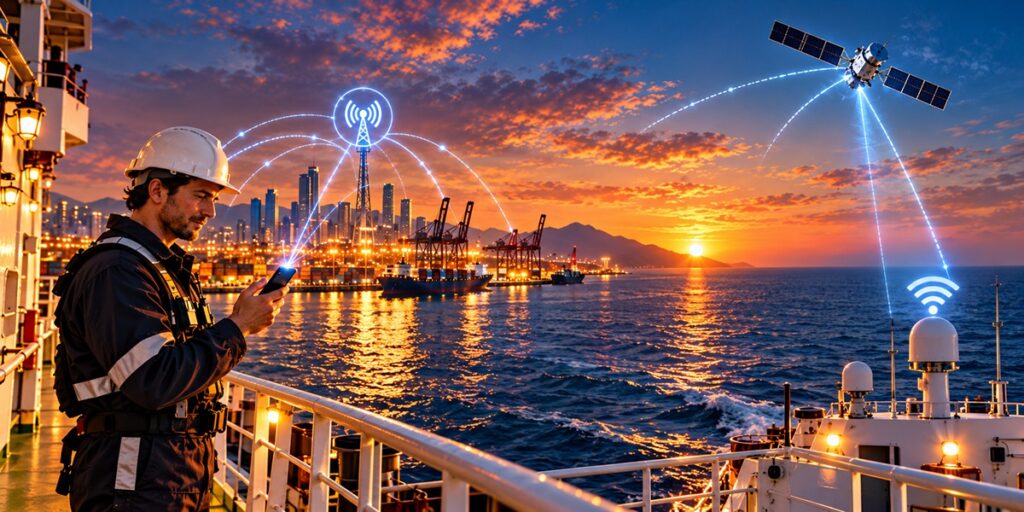
Short answer: not in the open ocean and any guide that says otherwise is misleading you.
A travel eSIM connects to land-based (terrestrial) mobile networks, the same towers your phone uses ashore. That means:
For genuine offshore connectivity you'll rely on ship Wi-Fi, VSAT, or maritime satellite services (increasingly Starlink Maritime on newer vessels) not a travel eSIM.
So think of a travel eSIM as your shore-and-port solution, and the ship's systems as your at-sea solution. They complement each other; one doesn't replace the other. Treating a normal eSIM as an offshore lifeline is a genuine safety mistake, not just an inconvenience.

This is the comparison most eSIM guides skew, so here's the honest version both still have a place.
The catches with local SIMs are real, though: you have to find a reseller each time, you may not be able to top up online once you sail, and a card bought for one country is dead weight at the next port. For most crew crossing borders, an eSIM is simpler but if you'll spend a whole contract in one country and want a local number, a local SIM is a fair choice. It's about your route, not a rule.

The brand on the plan matters less than whether it fits your route. Run any provider through the same checklist before you buy:
If a provider ticks these, the brand name matters far less than the fit to your route.

Once you know what you need, Airhub is one eSIM provider worth considering for crew who cross borders. It's built around the things this guide has been describing:
That's positioning, not a promise that it's the cheapest or the best for every route your itinerary decides that. Check that your ports are covered and your phone is compatible, and compare it against the checklist above like you would any provider.

Sort connectivity on shore, while you still have reliable Wi-Fi and time. Before you travel:
New to the process? Airhub's eSIM installation guide walks through the setup step by step.

Most connectivity headaches come down to a handful of avoidable errors:
For anyone working across borders and time zones, an eSIM for seafarers solves the exact problem local SIMs create: too many countries, too little time in each. Install it before you sail, use it in port and near the coast, lean on ship Wi-Fi or satellite while you're offshore, and keep your home number handy for calls and codes. Match the plan to your route and your data, and you'll step off the gangway already online which, on a short shore leave, is worth more than almost anything else in your bag.
The best one is the one that covers your actual route with enough data and validity. For crew crossing several countries, a multi-country or global eSIM usually beats buying a local SIM in each port. Match coverage, data, and validity to your itinerary before you buy.
Yes. A regional or global eSIM connects to a supported local network in each covered country automatically no new card or number when you dock. Just confirm every port's country is on your plan's coverage list.
Only within range of land-based mobile networks so in port and near the coast, not in the open ocean. Offshore, you'll need the ship's Wi-Fi, VSAT, or maritime satellite service. A travel eSIM is a shore-and-port tool, not an offshore one.
For multi-country routes, usually yes no swapping cards, and you can set it up before you sail. A local SIM can be cheaper for a long stay in one country and gives you a local number, but you'll re-buy it at each new port and often can't top up online.
Turn off roaming on your home SIM and use a travel eSIM for data instead, so you're paying plan rates rather than roaming rates. Set it up on Wi-Fi before departure so you're not tempted to switch roaming on when you land.
Yes that's the main advantage of a regional or global eSIM. One profile covers all the countries on its plan, so a single setup can carry you through an entire multi-port route.
Coverage for your exact ports, data allowance, validity, whether it's data-only, top-up options, and that your phone supports eSIM and is unlocked. Support quality matters too you want help available if activation fails on a tight schedule.
They work when the ship is in port or close enough to shore to reach a supported network. Out at sea, your phone may pick up the vessel's onboard "cellular at sea" system, which is expensive roaming keep mobile data off at sea and rely on ship Wi-Fi, then use your eSIM ashore.
Short-term plans suit a few days in a port or quick shore leave; long-term plans suit weeks or months across a route and often work out cheaper than repeatedly buying short ones. Pick based on your contract length, destinations, and data use.
Yes. WhatsApp, video calls, maps, and messaging all run over data, so a data eSIM handles them fine. WhatsApp stays linked to your existing number, so calls and messages keep working even when your data runs on the eSIM.
Get your Airhub eSIM in minutes and travel without roaming surprises.
Download the Airhub app to purchase, manage and top up your eSIMs anytime, anywhere!