











300GB eSIM Data Plan: Is It Enough for Long-Term Travel?

Travel long-term with a 300GB eSIM data plan. Compare usage, bundle sizes, and tips for choosing the right plan.
300GB eSIM Data Plan: Is It Enough for Long-Term Travel?

In this article

Staying connected abroad can be a real headache. Hunting for local SIM cards, paying roaming fees, and swapping chips at every border gets old fast. A travel eSIM fixes most of that by loading local data onto your phone before you even land.

But when you’re away for months, a big question comes up: is a 300gb data plan -140 (search volume) actually enough? With 300 gb of internet – 140, you can stream about 100 hours of HD video, video-call home every week, and upload all your travel photos without checking your usage once. Compare that to a typical data bundle of 5 to 20GB, which can disappear in a few days if you stream or use your phone as a hotspot.
Unpacking 300GB: What's Inside Your Plan

300GB eSIM data plan usage guide for travelers

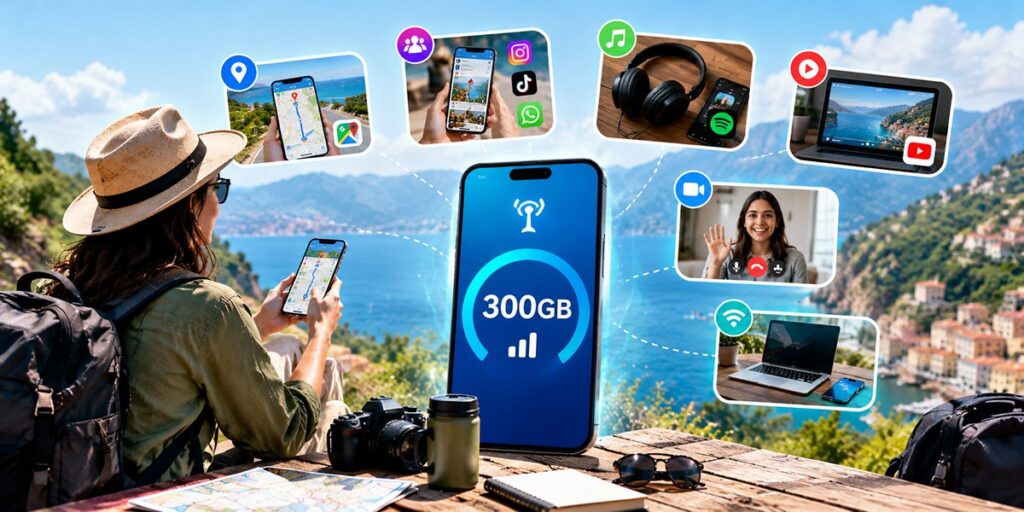
Just how much can you actually do with a 300GB eSIM data plan? Let’s break it down into common activities:
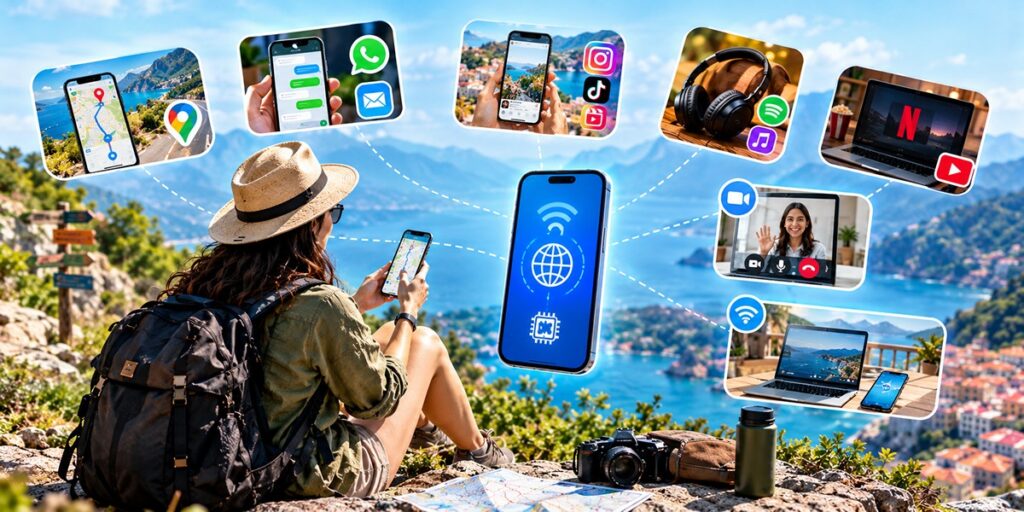
  • Navigation & Email: Apps like Google Maps might use ~10–15MB per hour. Email and messaging (text-only) are tiny in comparison (think a few MB for dozens of messages). Even full days of navigation and emails barely dent your data.
  • Social Media & Browsing: Scrolling Instagram or TikTok can use 100–500MB per hour (videos eat data quickly, images and text less so). Casual browsing or WhatsApp texting is light too. An afternoon of social media and web surfing might be a couple of gigabytes.
  • Music & Video: Streaming music (high quality) is ~70–100MB/hour, so even weeks of music playback won’t hit 300GB. Video is heavier: standard YouTube HD (~720p) is ~1.5GB/hour, 1080p ~3GB/hour. So 300GB could handle roughly 100–150 hours of HD video, or about 30–40 hours of 4K video.
  • Video Calls & Tethering: A Zoom or FaceTime call averages ~500MB–1GB/hour. Not huge unless you’re on calls all day. Hotspot tethering can amplify use: streaming on a laptop or gaming can draw significant data. Remember, how much data does hotspot use – 1600 is really up to the connected devices

Mapping Your Data Usage on the Go

Travel data usage for maps, social media, music, and video streaming

Let’s look at a typical long trip and see where data goes. Travelers often ask, “How much data do you use while travelling?” The answer varies, but here are common uses (on a daily or weekly basis):
  • Maps & Navigation: Using Google Maps or GPS for an hour might use only 10–15MB. For a week of daily driving or sightseeing, that’s maybe 100MB total.
  • Messaging & Email: Apps like WhatsApp or email consume very little. A few hundred texts a day and email checking might use under 1GB per week.
  • Social Media: Scrolling feeds with images/videos can consume a couple of hundred MB per hour. Say 1–2GB for several hours of Instagram or TikTok browsing over a trip. You’ll burn more if autoplay videos are on high res.
  • Music & Podcasts: Streaming music at high quality is about 70–100MB/hour. An hour a day of music for a week is ~0.7 GB. Downloading podcasts on Wi-Fi and listening later uses essentially 0 GB of mobile.
  • Video Streaming: This is the heavy hitter. One hour of Netflix or YouTube at 1080p is ~3GB. Even watching two movies (4–6 hours) could consume 10–18GB. On a week-long trip, casual movie-watching and YouTube could easily reach 20–30GB if you’re not careful.
  • Video Calls: A one-hour Zoom or FaceTime call is around 0.5–1GB. So if you do two video calls a day, that’s ~1–2GB daily – say 15GB in a week. Overall, many travelers fall into these categories:

300GB on the Road: Enough or Not?

300GB data plan comparison for monthly and long-term travel usage

Now, the big question: Is 300GB enough for long-term travel? Let’s break it down:
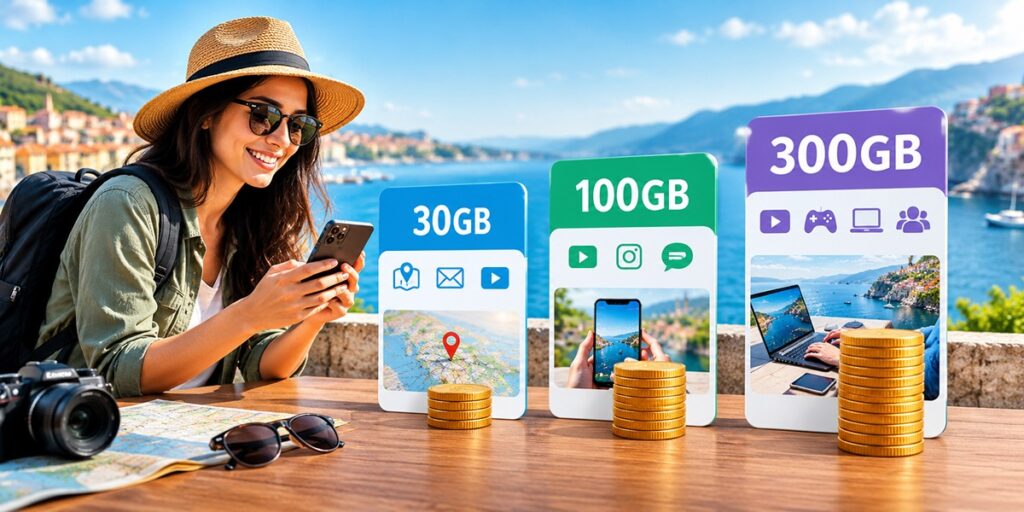
  • One Month (30 days): For almost everyone, yes. Even at 6–10GB per day (which is a lot of usage), that’s 180–300GB. You would have to be pushing your connection 24/7 to really hit 300GB in a month. Typical travel use (maps, chat, a bit of streaming) is often under 50GB.
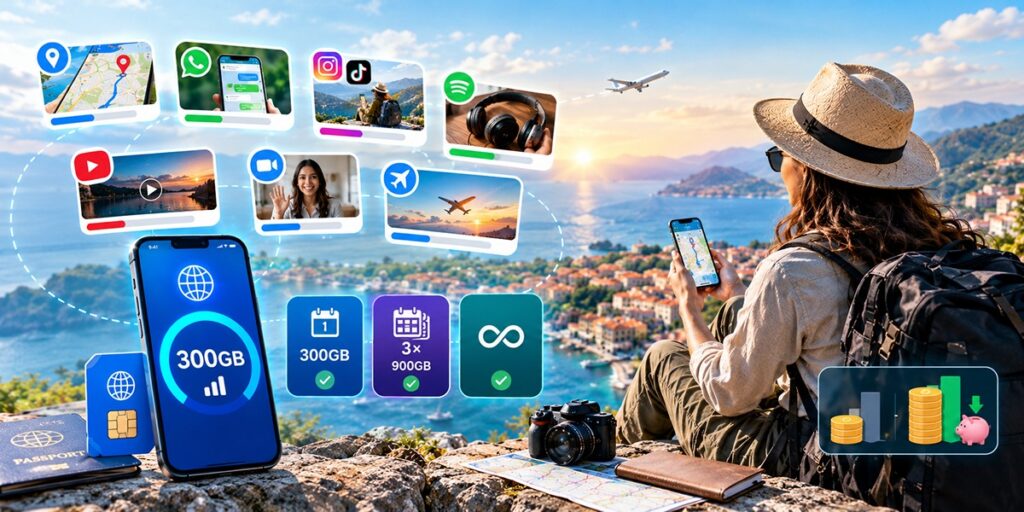
  • Multi-Month Trips: A single 300GB package usually covers 30 days. For 3 months of travel, you could either buy multiple 300GB plans or top up. In practice, three back-to-back 30-day 300GB plans give you 900GB total. That’s enough for years of moderate use. However, you’d pay each time (there’s no auto-renew). For very long stays, it may be more cost-effective to buy new monthly plans or consider unlimited data options.
  • Comparison to Unlimited: Some eSIM providers offer eSIM with unlimited data – often in the form of short-term passes (like “unlimited day pass”) or plans that throttle after a limit. These are great if you need absolutely unlimited high-speed data for a short period. However, unlimited plans often cost more per day, so if you truly use less than unlimited daily, 300GB plans can be cheaper overall.
  • Budget Considerations: A 300GB plan usually costs more upfront than a smaller plan, but it’s the best bang-for-buck per gigabyte. For example, a 30GB plan might cost 40(~1.33/GB), whereas 300GB could be around 37(0.13/GB) in some markets. That’s a huge saving per gig. If you’re unsure about your use, it might make sense to start with 300GB to avoid any overage (and avoid surprise roaming fees).

Size Matters: 300GB vs. Smaller Bundles

300GB data bundle comparison with smaller eSIM plans and pricing for travelers

Choosing the right data bundle- 8100 ( search volume) is about cost and use case. Here’s a quick comparison (using typical pricing examples):

Data Bundle (30 days)Approx Price (USD)Cost per GBBest For
30 GB~$42.00~$1.40Light use (maps, email, a few videos)
100 GB~$30.99~$0.31Medium use (regular streaming, social media)
300 GB~$37.99~$0.13Heavy use (HD video, multiple devices)

In the example above, the 300GB plan is a much better value per gigabyte. Bigger bundles often give you more for each dollar. A 30GB pack might cost more per gig, so if you truly need 100GB+, jumping to 300GB saves money. Even if 300GB seems like more data than you’ll use, the overall price can be similar to smaller packs.

Of course, smaller bundles can make sense if you’re on a tight budget or only traveling a week or two. But for long trips, a big plan avoids running out mid-trip and needing multiple purchases.
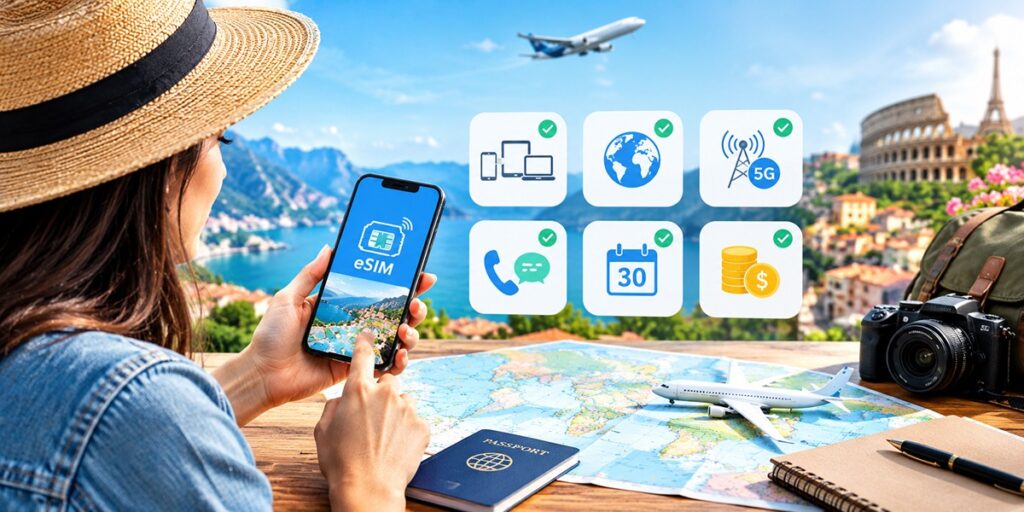
Before You Buy: 300GB eSIM Checklist

300GB eSIM checklist covering compatibility, coverage, speed, validity, and pricing

If you decide a 300GB plan is worth it, consider these factors before purchase:
  • Device Compatibility: Ensure your phone is unlocked and supports eSIM. Most newer iPhones, Google Pixels, and Samsung Galaxy models do.
  • Country Coverage: Check that the eSIM works in all the countries on your itinerary. Some plans are country-specific (like USA or Europe), while “Global” plans cover many regions.
  • Network & Speed: Look at the carrier network (e.g., T-Mobile, Vodafone) and if it’s 4G/5G. A 300GB plan on 4G is already great, but 5G makes it future-proof.
  • Voice/SMS Needs: Some plans are data-only. If you need a local number or call/SMS capability, see if there’s a voice-inclusive version or a separate cheap local option.
  • Validity Period: 300GB often comes with 30-day validity (some shorter, like 10 days for global). Make sure it matches your trip length or know if you need to top up.
  • Price & Value: Compare prices per GB. As we saw, bigger bundles usually win on cost-per-GB. Also watch for deals: for example, Airhub often offers promotions (like free trial MB or bundle discounts) that can sweeten the purchase.

Stay Connected with Airhub

Ready to hit the road with worry-free data? Try Airhub’s travel eSIM. Airhub offers global data plans (including 300GB bundles) delivered instantly via QR code – no waiting for a physical SIM. Just install the eSIM on your phone, and you’re online the moment you land.

Airhub’s app (iOS and Android) makes it easy: browse plans by country, pay securely, and manage your eSIM in one place. You even get free 200MB of data to try it out risk-free. If your trip changes, top-up or switch plans on the fly without reinstalling. They cover 190+ countries with 4G/5G networks and provide 24/7 customer support.

Ready to Travel Without Data Worries?

A 300GB data plan is a powerhouse for travelers. It covers everyday navigation and messaging, plenty of streaming and calls, plus hotspot sharing,  all in one package. For a one-month trip, it’s usually more than enough, and even across several months it provides headroom to spare. In practice, paying a bit more upfront for 300GB often saves money per gig and avoids mid-trip data scrambling.

If you want peace of mind, consider a 300GB travel eSIM. And remember the tips above: check that your device is eSIM-ready, verify coverage in your destinations, and choose a reputable provider. With those bases covered, 300GB of internet can be your travel companion, streaming every sunset and video calling home without a second thought.

FAQs

1. Is 300GB of internet enough for a month?

For most travelers, yes. Even heavy use (maps, social media, streaming) often stays under 100–150GB/month. A 300GB plan gives you a comfortable buffer for a full month of travel.

2. What is the difference between a 300GB data plan and an unlimited data plan?

A 300GB plan has a fixed cap of 300 gigabytes. Unlimited plans (often daily or short-term passes) have no set cap, but may throttle speeds after a threshold or have other limits. Unlimited options are good for short bursts of heavy use, while 300GB packs more data at a lower cost overall.

3. Is a 300GB data plan enough for streaming and gaming?

Absolutely. Streaming HD video (~3GB/hr) or gaming (varies, but usually much less) is covered easily. 300GB can handle many hours of streaming each day. Just keep an eye on usage if you’re doing long gaming sessions or multiple HD streams at once.

4. How long does a 300GB data plan last?

Typically, it’s valid for 30 days once activated. That means the 300GB must be used within that month. For travel over multiple months, you’d buy another plan or top up after 30 days.

5. Can I use a 300GB data plan for hotspot tethering?

Yes, most travel eSIMs (including 300GB plans) allow hotspot or tethering. Any data your laptop or tablet uses via the hotspot will count against the 300GB. It’s included, so you can share connectivity with your devices if needed.

6. Is a 300GB data plan suitable for a laptop?

Yes. A laptop’s internet consumption (streaming, downloads, browsing) can easily reach dozens of GB, and 300GB should cover a month of moderate laptop use. Just ensure your phone is connected and the hotspot is enabled.

Most Popular eSIM Countries

Ready to Stay Connected?

Get your Airhub eSIM in minutes and travel without roaming surprises.

You might also like

Ready to try eSIMs and change the way you stay connected?

Download the Airhub app to purchase, manage and top up your eSIMs anytime, anywhere!

App exclusive5% off at checkout
Get it on Google PlayDownload on the App Store