







Ready to try eSIMs and change the way you stay connected?
Download the Airhub app to purchase, manage and top up your eSIMs anytime, anywhere!
App exclusive5% off at checkout
Dates, highlights and train routes for Europe's 14 best Christmas markets in 2026, from Nuremberg and Vienna to Edinburgh, plus tips to beat the crowds.
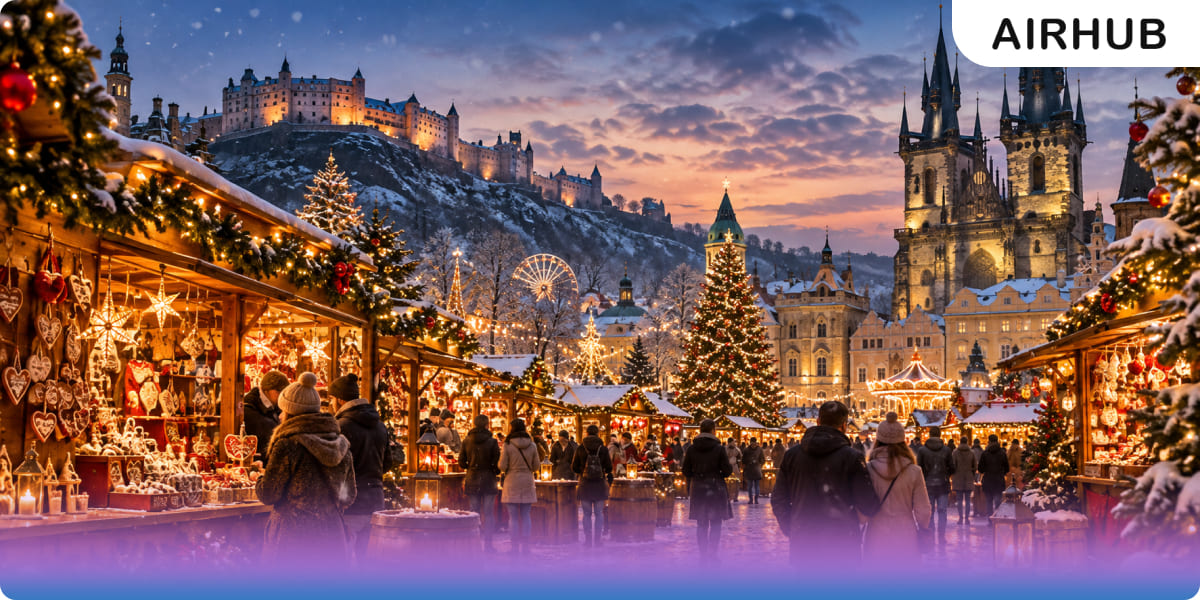
The first Sunday of Advent falls on 29 November 2026, and most of Europe's big Christmas markets open in the fortnight before it. Vienna and Cologne start mid-November, Nuremberg waits until 27 November, and Edinburgh, Vienna's smaller squares and Zagreb keep going into January.
This guide covers the best Christmas markets in Europe for 2026: confirmed dates for each, what to eat or buy, and which ones pair easily by train. Use the dates table to shortlist, then the itinerary section to build the trip.
Vienna and Budapest open first, on 13 November; Zagreb closes last, on 7 January 2027. Dates are from each organiser's official site as of 10 October 2026, sorted by opening day.
| Market | Country | 2026 dates | Open after Christmas? |
| Vienna, Rathausplatz | Austria | 13 Nov – 26 Dec | Yes, to 26 Dec |
| Budapest, St Stephen's Basilica | Hungary | 13 Nov – 1 Jan 2027 | Yes |
| Edinburgh, East Princes Street Gardens | UK | 14 Nov – 3 Jan 2027 | Yes |
| Cologne, Cathedral market | Germany | 16 Nov – 23 Dec (closed 22 Nov) | No |
| Salzburg, Domplatz | Austria | 19 Nov – 1 Jan 2027 | Yes |
| Munich, Marienplatz | Germany | 20 Nov – 24 Dec | No |
| Colmar | France | 23 Nov – 29 Dec | Yes, to 29 Dec |
| Dresden, Striezelmarkt | Germany | 25 Nov – 24 Dec | No |
| Basel | Switzerland | 26 Nov – 23 Dec | No |
| Nuremberg, Christkindlesmarkt | Germany | 27 Nov – 24 Dec | No |
| Brussels, Winter Wonders | Belgium | 27 Nov – 3 Jan 2027 | Yes |
| Prague, Old Town Square | Czechia | 28 Nov – 6 Jan 2027 (expected) | Yes |
| Zagreb, Advent u Zagrebu | Croatia | 28 Nov – 7 Jan 2027 | Yes |
| Strasbourg, Christkindelsmärik | France | Not yet announced (2025: 26 Nov – 24 Dec) | Usually no |
Berlin is left out of the table because each of its 60-plus markets sets its own dates. Strasbourg and Prague had not published final 2026 dates on their official sites at the time of writing, so check before booking.
Why the dates cluster: the first Sunday of Advent is 29 November 2026, and most markets open in the week before it. German markets that open early, like Cologne, close on Sunday 22 November for Totensonntag, a day of remembrance.
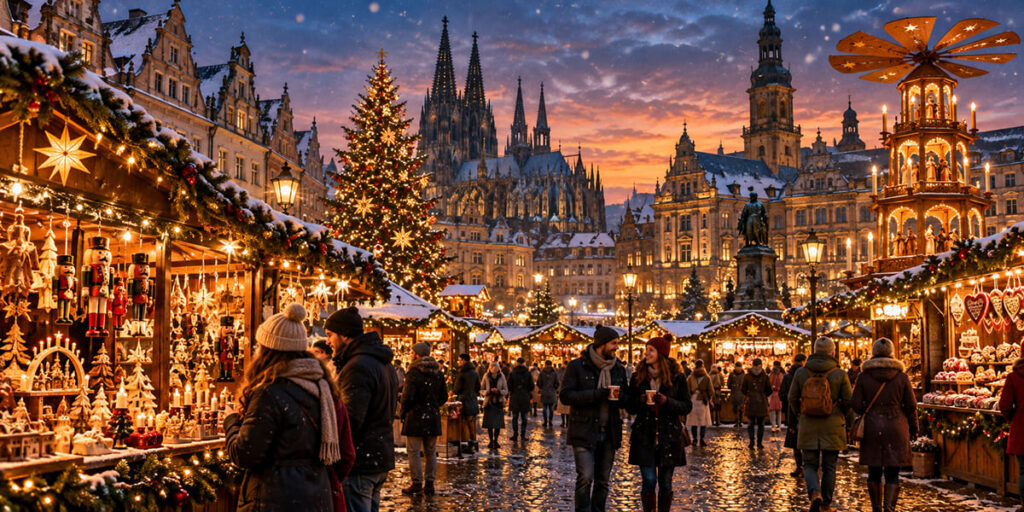
Germany is where the Christmas market tradition took shape, and its big four still set the benchmark. For a deeper dive, see our full guide to Christmas markets in Germany.
Up to 180 stalls with red-and-white striped roofs fill the Hauptmarkt in front of the Frauenkirche, drawing more than two million visitors a year. The city keeps the stock traditional: wooden toys, prune-figure "Zwetschgenmännle" and handmade ornaments.
First documented in 1434, the Striezelmarkt is Germany's oldest recorded Christmas market, and 2026 is its 592nd edition. It fills the Altmarkt with more than 200 stalls and a 14-metre wooden Christmas pyramid.
Munich's market dates back to the 14th century and fills Marienplatz and Rindermarkt with about 130 stalls under the neo-Gothic town hall. In 2026 it opens a week earlier than usual, on the Friday before Totensonntag.
Cologne runs six or seven themed markets at once, so it suits travellers who want several markets without changing hotel. The flagship sits on Roncalliplatz beneath Cologne Cathedral; Heinzels Wintermärchen fills Alter Markt and Heumarkt, and the Harbour market sits on the Rhine by the Chocolate Museum.
Berlin has more than 60 markets spread across its neighbourhoods rather than one centrepiece, so it's the pick for variety over tradition. Gendarmenmarkt (WeihnachtsZauber) charges a small entry fee for a polished setting, while Charlottenburg Palace and Alexanderplatz are free.
Which German market for you? Nuremberg for tradition, Dresden for history, Munich for Bavarian atmosphere, Cologne for market-hopping in one city, and Berlin for choice.
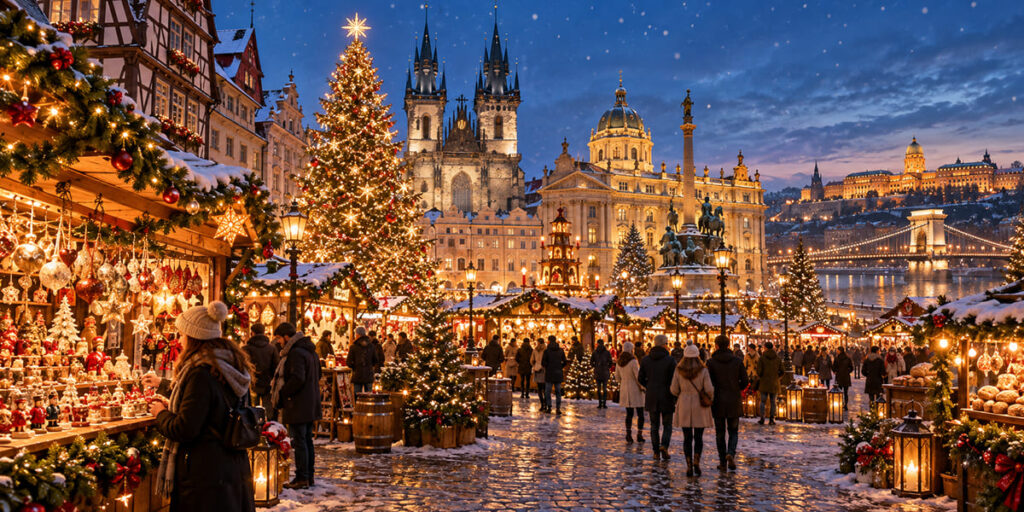
Germany's neighbours run markets that rival or beat the originals, and several stay open past Christmas Day.
Strasbourg has held its Christkindelsmärik since 1570, making it France's oldest Christmas market, and it bills itself as the "Capitale de Noël". More than 300 chalets spread across about a dozen squares on the UNESCO-listed Grande Île, with the main market on Place Broglie and the giant Grand Sapin tree on Place Kléber.
Colmar's medieval centre is small enough to cross on foot, and its markets are spread over several squares, so the whole old town becomes the venue. It runs five days past Christmas, later than most of its Alsatian and German neighbours.
The Wiener Christkindlmarkt on Rathausplatz sits in front of the floodlit neo-Gothic City Hall, with an ice trail of around 3,000 m² winding through the park behind it. Opening hours are 10am to 10pm daily, with an early 6.30pm close on 24 December.
With roots in a market first held in 1491, the Salzburger Christkindlmarkt fills Domplatz and Residenzplatz with about 100 stalls in front of the cathedral, inside the UNESCO-listed old town. It runs through New Year's Eve and closes on 1 January.
Prague's two main markets fill Old Town Square and Wenceslas Square, a ten-minute walk apart. Old Town Square has the astronomical clock, the Gothic Týn Church and a towering spruce lit on opening day.
The Advent Feast in front of St Stephen's Basilica has been voted Europe's best Christmas market several times, with nightly light projections on the basilica façade and an ice rink around the tree. The Vörösmarty Square market, a short walk away, runs to the same dates and focuses on Hungarian crafts.
Brussels' Winter Wonders stretches about two kilometres from the Grand-Place to the old fish market (Vismet), with 238 chalets, a Ferris wheel and an ice rink. The sound-and-light show on the Grand-Place guild houses is the highlight.
Basel splits its market between Barfüsserplatz and Münsterplatz in front of the cathedral, open daily from 11am to 8.30pm. It's one of the calmest big-city markets on this list.
Advent u Zagrebu spreads across the main square, parks and the Upper Town, and is closer to a city-wide winter festival than a single market. It has won the European Best Destinations Christmas market vote several times and runs later than anywhere else here.
Edinburgh's Christmas runs for seven weeks across three sites, with the main market in East Princes Street Gardens beneath the castle and beside the Scott Monument. Around 70 free-to-enter stalls sell handmade gifts, Scottish food and mulled wine.
Edinburgh doesn't pair easily with continental markets in a single trip, so treat it as its own city break. Most visitors outside the UK and Ireland now need an Electronic Travel Authorisation (ETA) before arriving, so apply in advance.
A few practical details make the difference between a magical evening and a frustrating one.
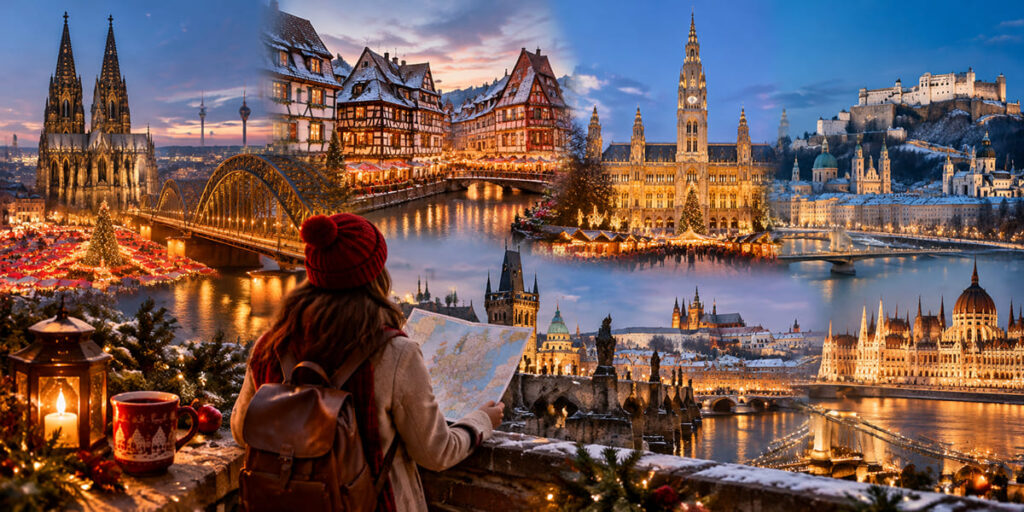
Pairing markets by train is the easiest way to see three or four in a week without flying. These routes are all direct or near-direct; times are typical fastest journeys.
| Route | Train time | Best for |
| Strasbourg – Colmar | About 30 min | A two-market Alsace weekend |
| Colmar – Basel | About 45 min | Adding Switzerland to Alsace |
| Cologne – Brussels | About 1 h 50 min | Germany + Belgium in one trip |
| Salzburg – Munich | About 1 h 30 min | An Austria–Bavaria loop |
| Vienna – Salzburg | About 2 h 30 min | Two Austrian classics |
| Dresden – Prague | About 2 h 15 min | History and Gothic spires |
| Munich – Nuremberg | About 1 h 10 min | Two Bavarian benchmarks |
| Vienna – Budapest | About 2 h 40 min | The best-value pairing |
Three ready-made routes:
Book rail tickets early for December weekends, especially Munich–Nuremberg and Cologne–Brussels, which fill up during market season.
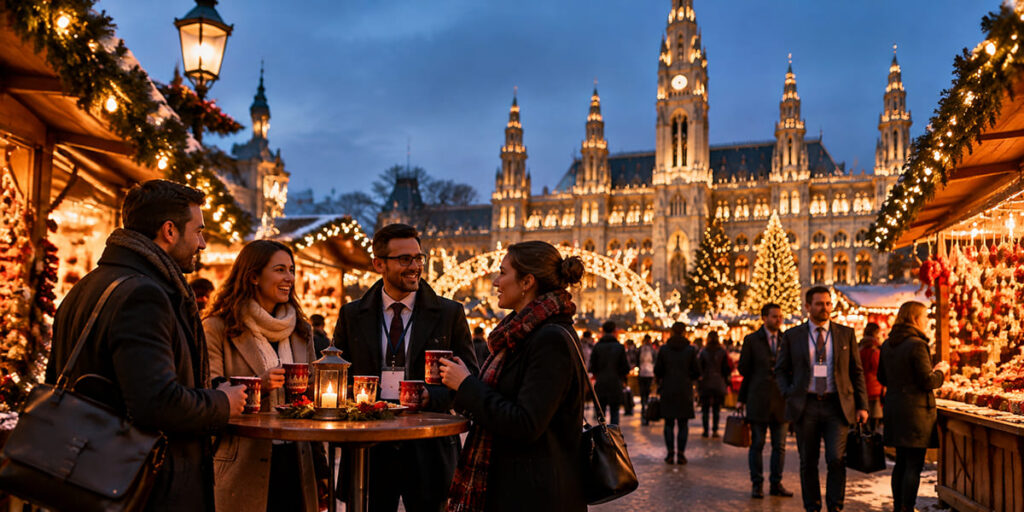
The Christmas market season isn't purely a leisure story anymore. November and December line up directly with a dense stretch of the European conference and client-visit calendar, and a growing number of companies are building end-of-year offsites, client entertainment evenings, and team trips around cities that happen to double as some of the best Christmas markets in Europe; Vienna, Cologne, and Edinburgh in particular see a real bump in corporate bookings through this period. It's an easy internal sell: a team offsite in Strasbourg or a client dinner near Vienna's Rathausplatz does double duty as a business trip and a genuinely memorable experience. The planning challenge is a familiar one for any team crossing multiple countries in a short window, and it's rarely the market dates that trip people up.
A multi-country market trip means crossing borders every day or two, and that's where mobile data gets complicated. EU roaming rules cover travel between EU countries for EU-based SIMs, but Switzerland and the UK sit outside that zone, and travellers from outside Europe pay roaming on every leg.
You'll lean on data more than you expect: live train times, maps between squares after dark, translating menus and booking last-minute rooms when Colmar sells out.
Sorting data before departure leaves one less thing to deal with in a crowded square. Browse Airhub eSIM plans for your route.
Pick a region, check the dates table, and build the route around realistic train times. Book accommodation early: the best-located hotels in Nuremberg, Colmar and Strasbourg fill months ahead.
Nuremberg, Strasbourg, Vienna, Prague, Cologne, and Edinburgh consistently top most rankings for 2026, each for a different reason: tradition, atmosphere, scale, photogenic settings, or sheer size.
Most open between 13 and 28 November 2026. Vienna and Budapest open first on 13 November, and Nuremberg opens on 27 November, the Friday before the first Sunday of Advent.
Zagreb (to 7 January), Prague (to 6 January), Edinburgh and Brussels (to 3 January), Salzburg and Budapest (to 1 January), Colmar (to 29 December) and Vienna's Rathausplatz (to 26 December). Most German markets close on 23 or 24 December.
It runs from 14 November 2026 to 3 January 2027 in East Princes Street Gardens, with the ice rink on George Street.
Nuremberg's Christkindlesmarkt, Dresden's Striezelmarkt, Munich's Christkindlmarkt and Cologne's cathedral market are the country's most famous.
Nearly all are free. A few special venues, such as Berlin's Gendarmenmarkt, charge a small entry fee.
No. A multi-country travel eSIM covers several European destinations under one plan. Check coverage for non-EU stops like Switzerland and the UK.
Get your Airhub eSIM in minutes and travel without roaming surprises.
Download the Airhub app to purchase, manage and top up your eSIMs anytime, anywhere!