









Ready to try eSIMs and change the way you stay connected?
Download the Airhub app to purchase, manage and top up your eSIMs anytime, anywhere!
App exclusive5% off at checkout
Discover the best Christmas markets in Europe for 2026 from Germany's classics to Edinburgh's castle backdrop with dates, food and travel tips.
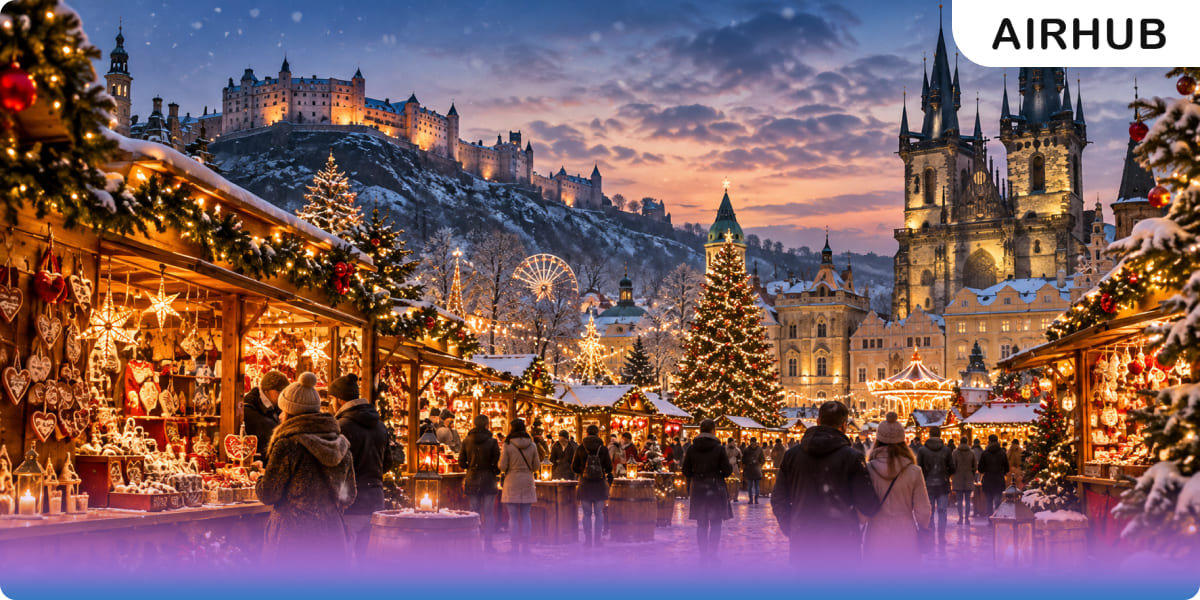
Every November, a continent quietly rearranges itself around mulled wine and wooden chalets, with quaint local traditions cumulating together to provide a festive display larger than life. Somewhere between the first frost and the first Glühwein stand going up in a town square, the best Christmas markets in Europe start pulling travellers across borders in numbers that rival the summer season, and for 2026, the race to pick the right ones to visit is more crowded than ever. The diversity and reach of these emerging markets have spent the last few years proving that tradition isn't locked to a single continent at all, and just like the Christmas spirit, it is all-encompassing.
This guide rounds up the best Christmas markets in Europe worth building a trip around in 2026, grouped the way an actual itinerary would group them, with the practical details such as crowds, cash, and logistics things that most other roundups mention in passing, if at all. Which markets you pair together and when you actually show up matters almost as much as which ones you pick, so it's worth reading the whole thing through before you start booking anything.
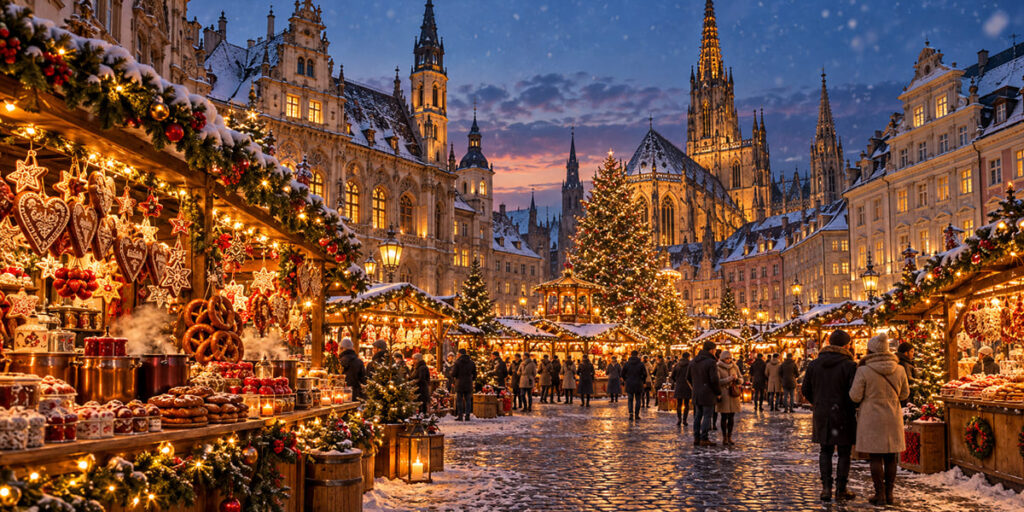
Ask ten travellers what separates a good Christmas market from a forgettable one, and ten answers will circle the same handful of things: a setting that doesn't need the decorations to look magical, a food scene that goes beyond a single stall of roasted chestnuts, and a sense the market has been doing this for centuries rather than since last spring's tourism board meeting. The genuinely famous Christmas markets in Europe, namely Nuremberg, Strasbourg, and Vienna, tend to have all three. Newer entrants on lists like this one earn their spot a different way, usually through scale, lighting design, or a backdrop distinctive enough to photograph itself. Germany has been known to set the standards for European Christmas markets.
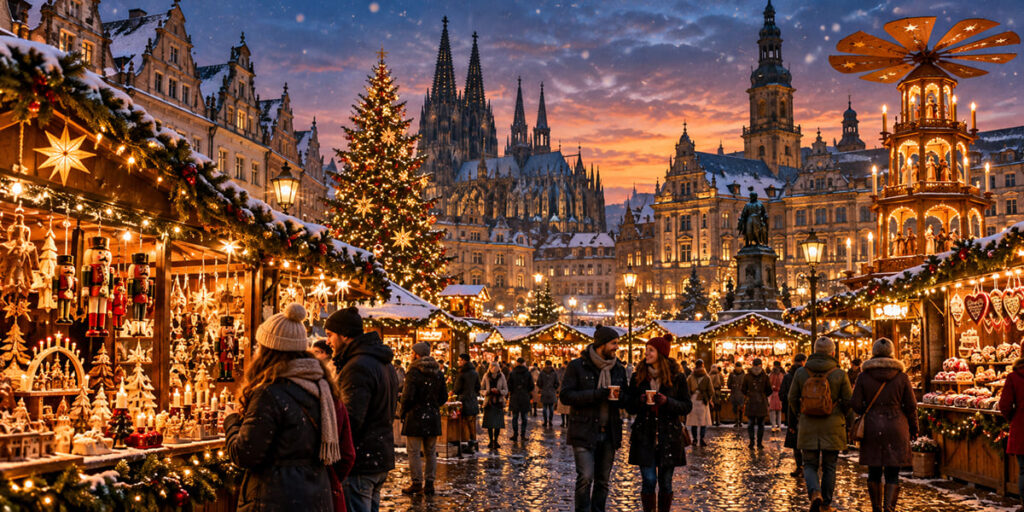
Germany is where the modern Christmas market was essentially invented, and Christmas markets in Germany are still the benchmark everyone else gets measured against.
Among the best German Christmas markets, the honest advice is to pick based on what you actually want from the trip: Nuremberg for tradition, Cologne for market-hopping within one city, Dresden for history, and Berlin for choice.
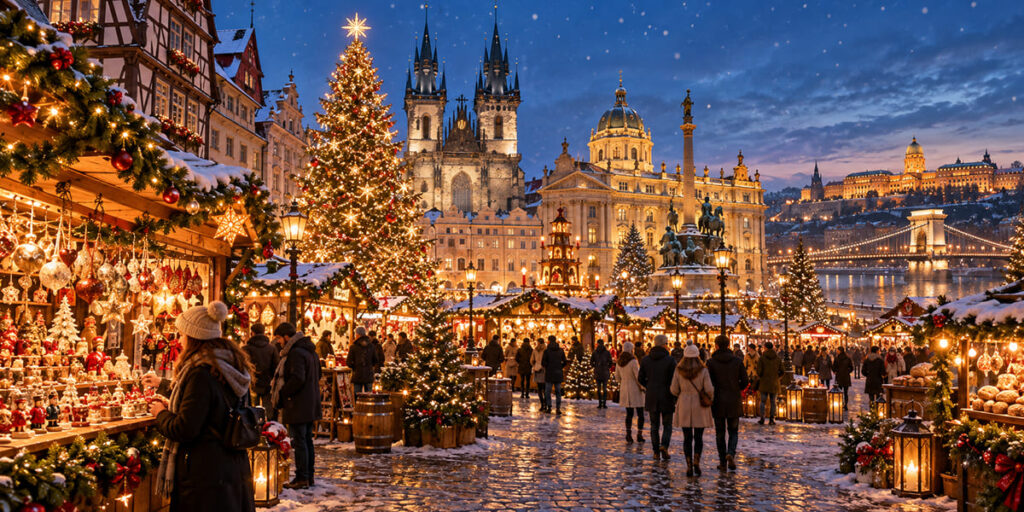
Germany's neighbours have spent decades building their own serious contenders.
These four alone could anchor a two-week European Christmas trip, and several sit close enough together that a single rail pass covers most of the route.
No roundup of the best Christmas markets in Europe is complete without Edinburgh, which has quietly become one of the most visited in the UK. The 2026 Edinburgh Christmas Market runs from 14 November through to 3 January, set in East Princes Street Gardens with Edinburgh Castle looming over the whole scene, a backdrop that genuinely rivals anything Germany or Austria can offer.
This is where most guides either go quiet or bury the detail in paragraph eleven, and it's usually what trips people up more than the market itself.
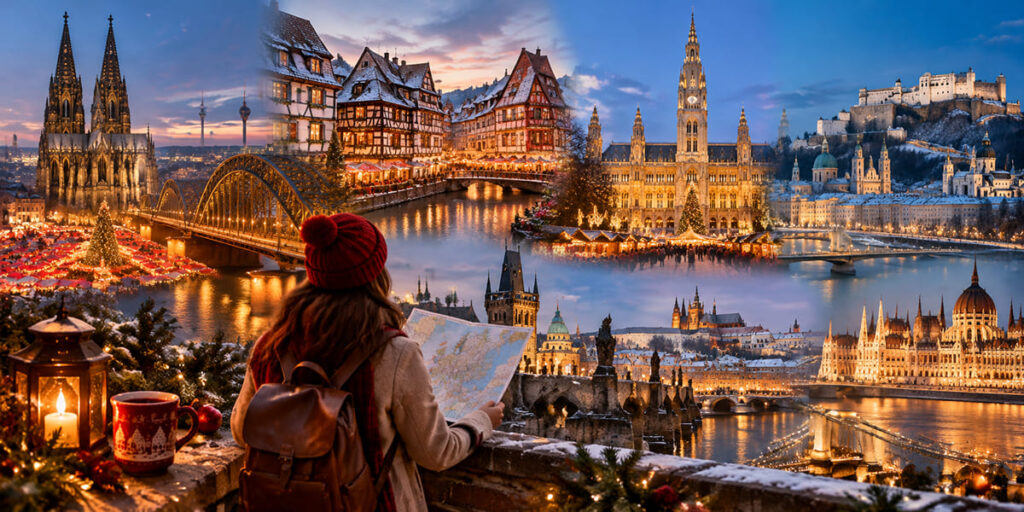
Distance is the detail almost every list skips, and it's arguably the most useful one for actually building an itinerary.
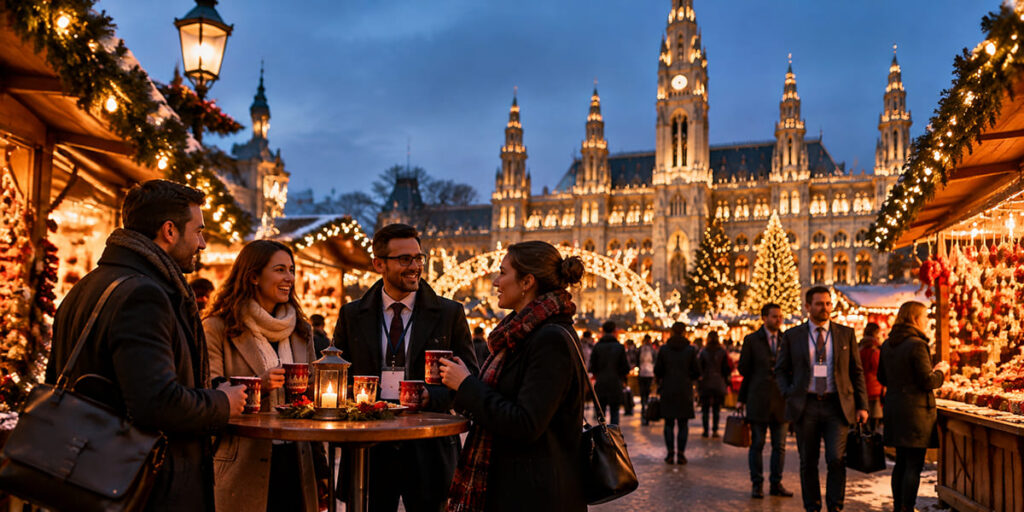
The Christmas market season isn't purely a leisure story anymore. November and December line up directly with a dense stretch of the European conference and client-visit calendar, and a growing number of companies are building end-of-year offsites, client entertainment evenings, and team trips around cities that happen to double as some of the best Christmas markets in Europe; Vienna, Cologne, and Edinburgh in particular see a real bump in corporate bookings through this period. It's an easy internal sell: a team offsite in Strasbourg or a client dinner near Vienna's Rathausplatz does double duty as a business trip and a genuinely memorable experience. The planning challenge is a familiar one for any team crossing multiple countries in a short window, and it's rarely the market dates that trip people up.
Whether it's a family hopping between Strasbourg and Colmar or a sales team moving from Cologne to Brussels between meetings, the same problem tends to show up every time a European Christmas market trip crosses a border: mobile data. Roaming between EU member states is generally manageable, but stepping outside the EU zone, the UK, Switzerland, or further east, costs climb drastically, usually right when you need maps, translation, or a connection to confirm a train time from a crowded market square. It's the same signal strain that causes those card readers mentioned earlier to freeze up in the first place.
Set it up before the trip starts, and the only thing left to plan is which market to hit first. Get your Airhub eSIM sorted now and skip the roaming guesswork entirely.
The best Christmas markets in Europe aren't going anywhere in 2026, as Nuremberg, Strasbourg, and Vienna will keep doing what they've done for centuries, and Edinburgh has firmly earned its place in the same conversation. What actually changes year to year has less to do with which markets deserve the trip and more to do with how well the trip gets planned: which cities pair together sensibly, how much time each one deserves, when to show up to dodge the crowds, and whether the practical stuff gets sorted before departure instead of scrambled together once you land. Pick a region, build the itinerary around realistic train times and enjoy the cathartic experience carefree through the virtue of travel eSIMs
Nuremberg, Strasbourg, Vienna, Prague, Cologne, and Edinburgh consistently top most rankings for 2026, each for a different reason: tradition, atmosphere, scale, photogenic settings, or sheer size.
Nuremberg's Christkindlesmarkt, Dresden's Striezelmarkt, Cologne's cluster of themed markets, and Berlin's neighbourhood-spread celebrations are generally considered the country's strongest.
It runs from 14 November to 3 January 2027, set in East Princes Street Gardens beneath Edinburgh Castle.
It depends heavily on the country. Most German markets close on the 23rd or 24th, while markets in Austria, Switzerland, and parts of Central Europe often continue into early January, so check this before planning a late-December visit.
Not necessarily. A multi-country travel eSIM plan, like those offered by Airhub, covers several European destinations under one setup, which tends to be simpler and more predictable than switching local SIM cards or relying on standard roaming at every border.
Get your Airhub eSIM in minutes and travel without roaming surprises.
Download the Airhub app to purchase, manage and top up your eSIMs anytime, anywhere!