
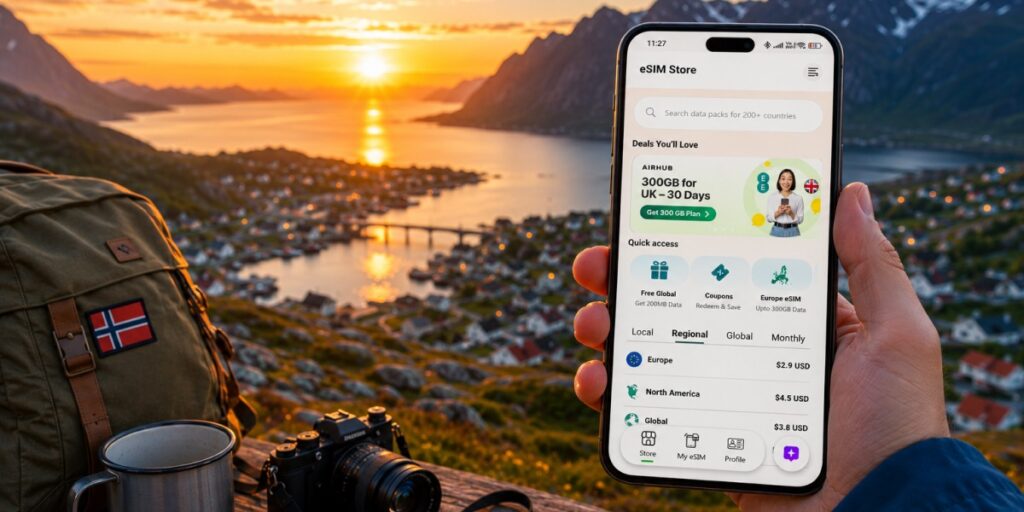
You are on a plane in a foreign country and instantly have internet on your phone—no searching for a local SIM card or fumbling with tiny SIM trays. An eSIM is a digital version of a SIM card. You don’t need to insert anything into your phone — it’s all done online.
If you’re traveling, using an eSIM hotspot is super easy. Once your eSIM is set up and your data plan is active, you can turn on the hotspot on your phone and share internet with other devices, just like using Wi-Fi. This means sharing your connection with your laptop or friends’ devices as easily as a few taps in your settings. In short, an eSIM turns your smartphone into a pocket Wi-Fi router, making it simple to stay online while on the go.
Table of contents
- Turning Your Phone into a Wi-Fi Hub
- Sharing Internet on the Go: How Tethering Works
- Step-by-Step Hotspot Settings for iOS and Android
- Why Airhub Makes It Easy
- FAQs
Turning Your Phone into a Wi-Fi Hub
Once your eSIM plan is installed, setting up that eSIM hotspot is remarkably straightforward. Think of it just like using a regular SIM card. Your phone’s eSIM “works like a physical SIM card, and turns your device into a Wi-Fi hotspot”. After you finish the initial activation, simply open your phone’s hotspot or tethering settings and switch it on. Then, other gadgets (such as laptops, tablets, or friends’ phones) can connect to that network, providing them with internet access anywhere. This is perfect for travelers who want to share one data plan across multiple devices while roaming. Your mobile hotspot is now powered by the eSIM inside your phone.
Sharing Internet on the Go: How Tethering Works
Data tethering is the tech that makes your phone a portable hotspot. In practice, tethering means sharing your phone’s internet with other devices. Below are ways to do it:
- Wi-Fi Hotspot: Your phone creates a Wi-Fi network. Other devices join it just like any Wi-Fi, using the phone’s data. It is one of the easiest and common methods to connect to a network.
- Bluetooth Tethering: You pair your phone via Bluetooth to another device and share the internet that way. It's slower but saves battery.
- USB Tethering: Switch on the computer or laptop and connect the phone through a cable. This also helps to charge the phone and save time.
Each method shares data from the same eSIM plan, so connected devices consume your data allowance. You’ll find these options in your phone’s hotspot settings. Any of these methods will allow you to use your mobile hotspot as a router to jump from one webpage to another.
Step-by-Step Hotspot Settings for iOS and Android
Here’s how to actually turn on your eSIM hotspot after the eSIM setup is done. Make sure your eSIM plan is activated first, then follow these steps for your device:
On iPhone:
- Click on Settings and open the Mobile Data.
- Make sure the eSIM line is in use and chosen for data.
- Select Personal Hotspot.
- Set a Wi-Fi password if prompted.
Your iPhone will now broadcast a Wi-Fi network. To connect to the network, use the password that is generated.
On Android (most devices):
- Open and click on Connections to join the Network.
- Tap Hotspot & tethering (or Portable Hotspot).
- Tap Wi-Fi Hotspot.
- Toggle the hotspot switch to On.
Your phone is now a mobile hotspot. Using the password, connect more devices.
That’s it – you’re sharing internet from your eSIM plan! These hotspot settings are similar on most iPhones and Android phones, though menu names can vary slightly by model. Once enabled, any device within range can join your hotspot just like a public Wi-Fi (but it uses your cellular data).
Why Airhub Makes It Easy
Looking for an eSIM provider that “just works” when you travel? Airhub eSIM stands out for its simplicity. With Airhub, buying and activating an eSIM plan is done through an app or website – no store visit, no waiting. In practice, this means once you install your Airhub eSIM, the data starts working immediately (no fiddling with tricky codes) and you can quickly jump into your hotspot settings.
Key Takeaways
Travelers love eSIM hotspots because they make sharing data on the road a breeze. After finishing your eSIM setup, just pop open your hotspot or tethering hotspot settings and flick the switch. Your phone acts as a mobile hotspot, letting everyone on your trip grab fast internet from one plan. The key points to remember: eSIMs are embedded SIM cards that you activate digitally, and once active, they support hotspot sharing just like normal SIMs. Whether you use Airhub or another eSIM provider, it’s never been easier to stay connected abroad – you get a reliable mobile hotspot without juggling physical SIMs.
FAQs
1. Is a mobile hotspot workable with eSIM?
Once your eSIM supports your device, you can surely use it as a mobile hotspot.
2. How do I set up a hotspot using an eSIM?
First, make sure your eSIM plan is installed and active on your phone. Then go into your phone’s settings. For iOS, firstly go to settings, from there open Mobile Data, and then enable Personal Hotspot. On Android, open settings, connect your device to the network, then press on hotspot option and activate it. Set a network name and password if needed. In short, it’s the same process as with any SIM – your phone will broadcast a Wi-Fi hotspot using the eSIM’s data.
3. Why isn’t my eSIM hotspot working?
There could be a few reasons. In many cases, the issue is that the carrier or plan doesn’t allow hotspot use. Check that your eSIM plan includes tethering. Other common fixes are restarting your phone or resetting the network settings. Essentially, confirm your plan supports sharing data and try basic fixes (reboot, reset network) to get the hotspot working.
4. Is hotspot sharing allowed on all eSIM plans?
Not necessarily – it depends on the provider and plan. It is crucial to analyse before buying from any provider, as some plans may block the network.
5. Does using a hotspot with eSIM consume more data?
Using a hotspot itself doesn’t use extra “overhead” data – it’s just sharing the same pool. As multiple devices will be online, you’ll naturally use more data in total. In short, your eSIM data is consumed by whatever each device does online. So monitor usage on each device or set limits to avoid surprises.

