











Ready to try eSIMs and change the way you stay connected?
Download the Airhub app to purchase, manage and top up your eSIMs anytime, anywhere!
App exclusive5% off at checkout
Find out if WhatsApp works in China in 2026, why it’s blocked, and how travelers can access it and stay connected.


Yes. The country's internet filtering system the Great Firewall blocks it on standard Chinese networks. The clampdown dates to 2017, when the authorities moved from quietly throttling WhatsApp's calls and media to shutting the service down more or less entirely.
Here's a nuance most guides skip, and it's worth being straight about: the block isn't always total. People living in China will tell you that plain text messages often still slip through if WhatsApp is already installed on your phone it's the calls, voice notes, photos, and video that reliably fail. So "WhatsApp is completely dead in China" isn't quite accurate. What is accurate: don't stake your trip on patchy text. If you need WhatsApp to genuinely work, you need a proper workaround.
The quick picture for mainland China:
| Service | On a local Chinese network | With a working workaround (Firewall-bypassing eSIM or VPN) |
|---|---|---|
| WhatsApp text | Sometimes works, unreliable | Works |
| WhatsApp calls & media | Usually blocked | Works |
| Works | Works | |
| Google, Gmail, Maps | Blocked | Works |
| Facebook, Instagram, X | Blocked | Works |
Hong Kong and Macau are the major exception. Under "one country, two systems," neither sits behind the Great Firewall, so WhatsApp and every other Western app work normally there no VPN, no eSIM tricks. Cross into the mainland, though, and the wall goes up.
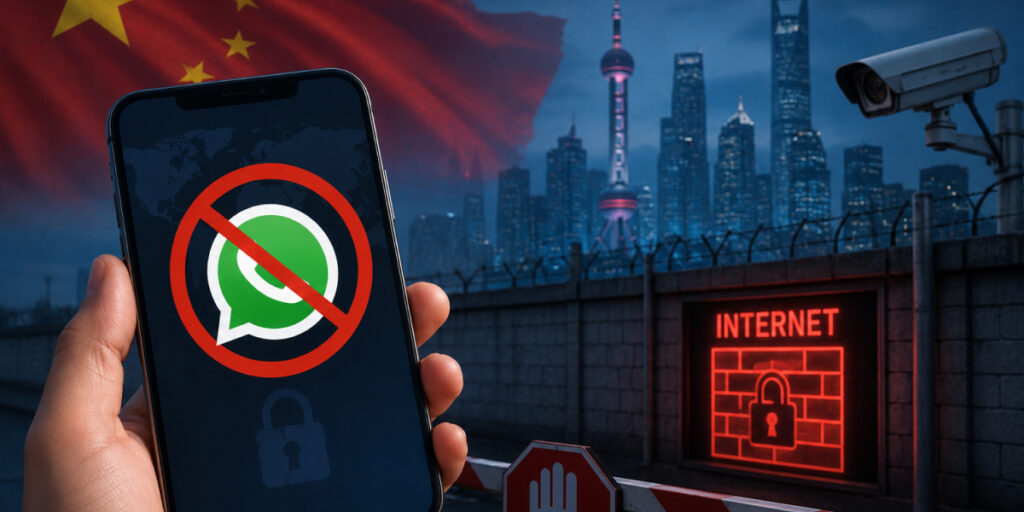
China runs one of the most thorough internet-control systems anywhere. The Great Firewall screens traffic moving in and out of the country and shuts out foreign platforms that won't operate under local data and oversight rules which is why Facebook, Instagram, X, Telegram, and Google's services are walled off right alongside WhatsApp.
WhatsApp's encryption is a big part of why it made the list. Because messages are end-to-end encrypted, authorities can't read them, and an app that can't be monitored generally doesn't get to operate. Reporting at the time of the 2017 clampdown described the disruption beginning with China's own filters, hitting images and video first before the fuller block took hold.
Two methods reliably keep WhatsApp alive in China, and it genuinely helps to understand how each one slips past the Firewall because that's where most of the confusion, and a lot of bad advice, lives.
This is the route most travellers reach for now, but the detail that matters is how the eSIM connects. Some travel eSIMs carry your data through networks or servers outside China, so your traffic never meets the Great Firewall the way a local connection does which means WhatsApp, Google, and the rest can work, sometimes without a VPN at all. An eSIM that connects through a local Chinese network is a different story: it sits behind the Firewall exactly like a local SIM, so you'd still need a VPN on top. Same "eSIM" label, opposite outcom which is exactly why you should never assume. Before you rely on any China eSIM for WhatsApp, confirm with the provider how it actually routes.
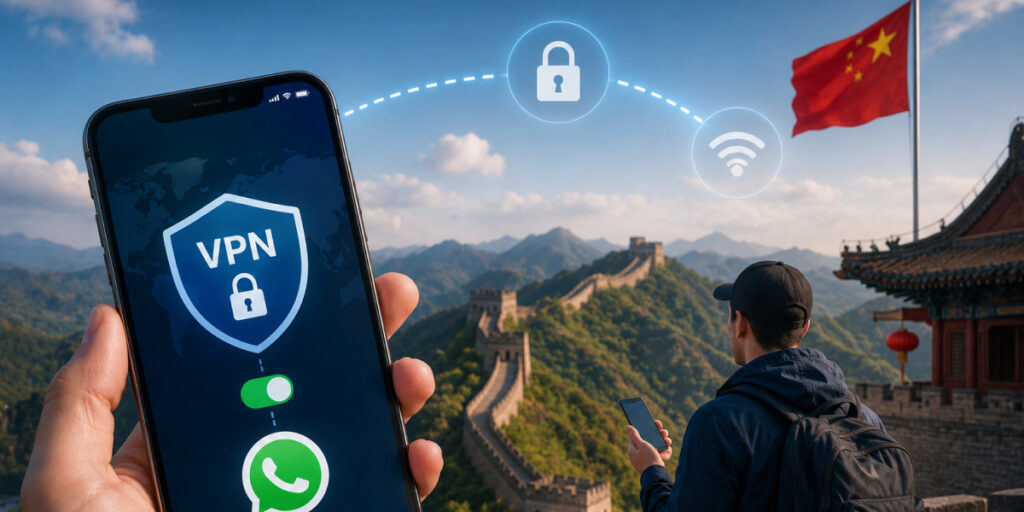
A VPN reroutes your traffic through a server in another country, so it looks as though you're online from somewhere else entirely, and blocked apps like WhatsApp open up again. Two honest caveats. VPNs sit in a legal grey area in China enforcement leans lighter on tourists than on residents, but "lighter" isn't "risk-free." And, the part people forget, you have to download and set it up before you arrive, because the VPN app stores and websites are themselves blocked once you're inside the wall.
Nearly every WhatsApp-in-China horror story traces back to something that could only have been fixed at home. Handle these three before you go and you've dodged most of them.
A few smaller moves pay off too. Clear your big WhatsApp catch-ups at the airport before departure. Drop your contacts a note that you may be slow to reply, or reachable on WeChat. And pull down offline maps, since Google Maps is walled off as well.
One myth worth putting to bed: falling back on your home SIM and roaming does not sneak you past the Firewall. Roaming traffic inside China still runs through it, so WhatsApp stays blocked and you'll pay a premium for the privilege. A Firewall-bypassing eSIM or a VPN is what actually gets you through.
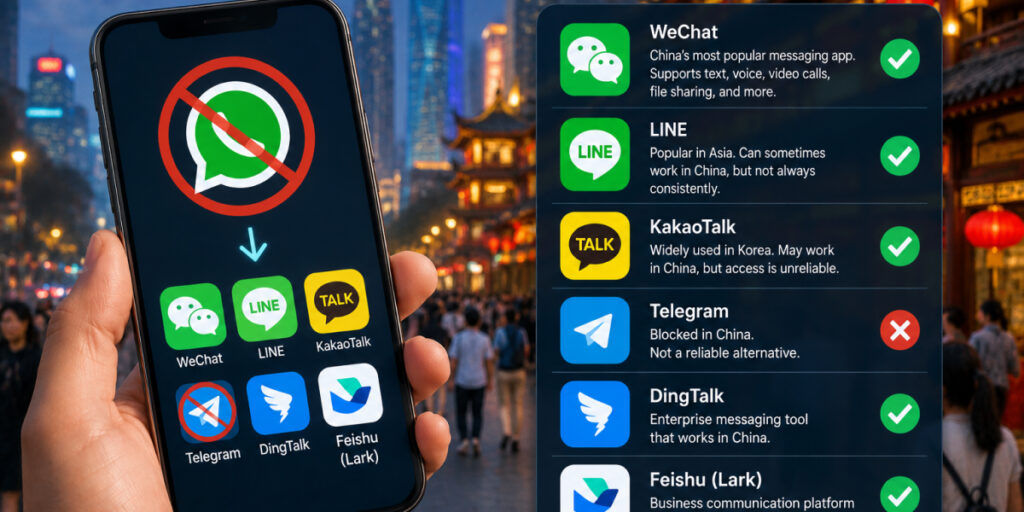
If you'd rather sidestep workarounds altogether, a few apps run natively behind the wall.
For most travellers the winning combination is simple: WeChat for the people around you, and a Firewall-bypassing eSIM or a VPN for WhatsApp with everyone back home. If you're curious how an eSIM keeps your connection secure on the road, our guide on eSIM security for travellers digs into it. (Messages not landing when you're not in China? That's a separate puzzle here's how to tell if someone blocked you on WhatsApp.)

Getting online is the part of a China trip most people underestimate until they're standing in the arrivals hall with a dead phone. Picking up a local SIM as a foreigner can mean paperwork, a language barrier, and a queue you didn't budget for an eSIM skips the whole ordeal. With Airhub, you set up a China plan before you board, scan a QR code, and you're on a data connection the moment you land, with no physical SIM to swap. You can set up your China eSIM plan online in minutes before you travel, and if you'll need local calls as well as data, choose a plan that includes voice rather than a data-only one.
One thing to be clear-eyed about, because it's where travellers get caught out: getting a data connection and getting WhatsApp to work are two separate problems. Whether WhatsApp opens comes down to how your eSIM routes a plan that carries your traffic through a network outside China can slip past the Great Firewall, while one that runs on local Chinese networks sits behind it and still needs a VPN for WhatsApp. So confirm how any China eSIM routes before you depend on it for messaging, and if it uses local networks, set up a VPN at home as your backup. That way you land connected either way.
Not on a normal Chinese network it's been blocked by the Great Firewall since 2017. Basic text sometimes slips through if the app is already installed, but calls and media generally don't. To use it properly, you'll want either an eSIM that routes outside China or a VPN, both set up before you arrive.
Yes, in mainland China. It's blocked because its end-to-end encryption prevents the monitoring China requires of apps operating there, and it's caught up in a wider block on foreign platforms. It works normally in Hong Kong and Macau.
Yes a VPN routes your traffic outside China, so WhatsApp opens up again. Just remember VPNs are a legal grey area and not risk-free, and you must download and configure one before you arrive, since the app stores are blocked inside China.
It depends entirely on the eSIM. One that routes your data through a foreign network can bypass the Firewall sometimes with no VPN needed while one that runs on a local Chinese network is stuck behind it and still needs a VPN. Always check how a provider's China eSIM routes before you rely on it.
Yes. Apple removed WhatsApp from the China App Store in 2024, so install it and log in before you travel. Once you're there, you may not be able to download it at all.
Yes. Both sit outside the Great Firewall under "one country, two systems," so WhatsApp and other Western apps work normally there no VPN or eSIM workaround required.
Get your Airhub eSIM in minutes and travel without roaming surprises.
Download the Airhub app to purchase, manage and top up your eSIMs anytime, anywhere!