











Ready to try eSIMs and change the way you stay connected?
Download the Airhub app to purchase, manage and top up your eSIMs anytime, anywhere!
App exclusive5% off at checkout
Best eSIM for gaming in 2026. Compare data needs, reduce lag, and stay connected with unlimited eSIM plans on the go.
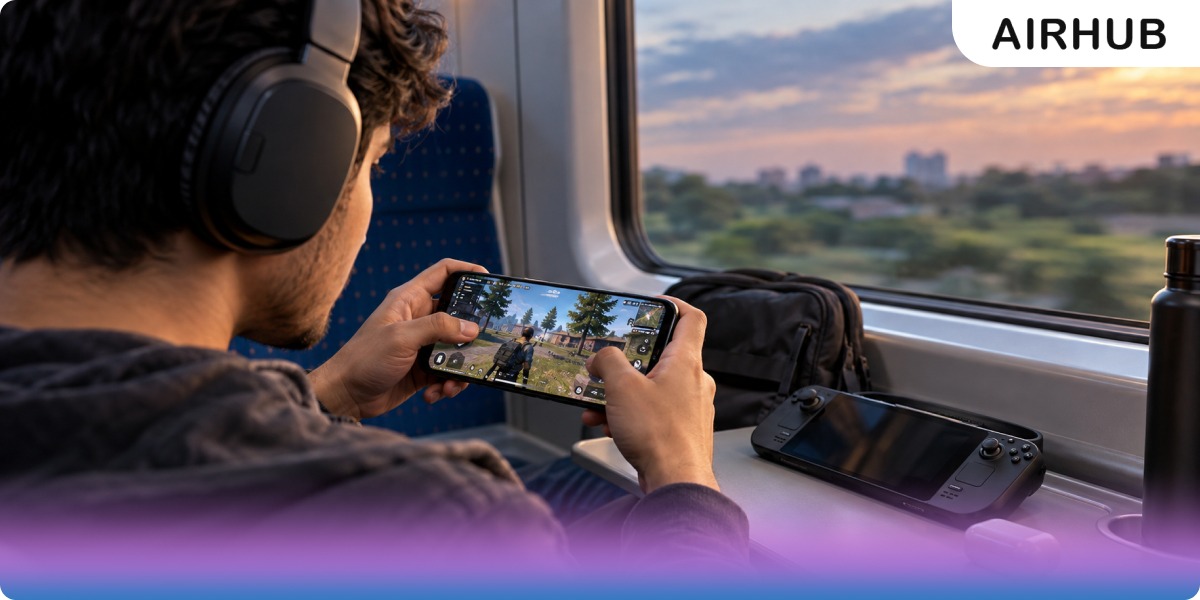
Here's the honest version most gaming connectivity articles won't give you: if you're playing ranked shooters from a fixed desk at home, the best internet provider for gaming is a wired fibre line over Ethernet. Nothing mobile touches it for raw, stable ping, and any eSIM company telling you otherwise is selling you something. But that setup is only half the story now. The other half happens on a phone on the train, a Steam Deck in a hotel room, or a cloud stream through GeForce NOW or Xbox Cloud on whatever signal is in range and that's exactly where a good unlimited-data eSIM quietly turns into the right tool for the job.
This guide is about that second half. What actually matters when you're gaming on the move, how much data games really burn through, when mobile data is the smart call and when it isn't, and how to keep your ping down when you're playing off cellular. No hype just what holds up in practice.
Three things decide whether a connection can hold a game together. Speed gets all the marketing, but it's usually the least important of the three.
The takeaway worth remembering: a stable, low-latency connection beats a blisteringly fast but erratic one every single time.
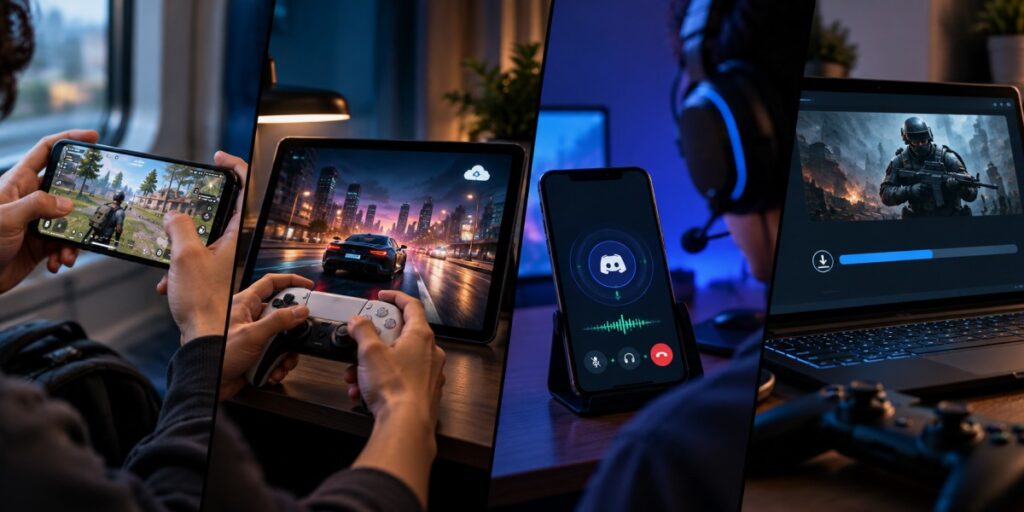
This is where mobile gamers get caught out and it's never the matches that get them. Playing online is surprisingly light on data. Downloading and streaming is where the gigabytes quietly disappear.
| Activity | Rough data use |
| Online multiplayer (mobile) — Fortnite, CoD Mobile, PUBG | ~100–500 MB/hour |
| Cloud gaming (GeForce NOW, Xbox Cloud) | ~2–5 GB/hour |
| Voice chat during play (Discord, party chat) | ~50–100 MB/hour |
| Game downloads / patches | ~1–5 GB+ each (big titles can top 100 GB) |
Add it up and you can see how even a casual mobile gamer clears 100 GB in a month once downloads and cloud streaming enter the picture. And here's the trap: a capped plan or an "unlimited" one that quietly throttles past some unpublished limit is precisely what turns a smooth session into a laggy one halfway through. That's the real argument for genuinely unlimited, unthrottled data, as opposed to the word "unlimited" on a marketing page.
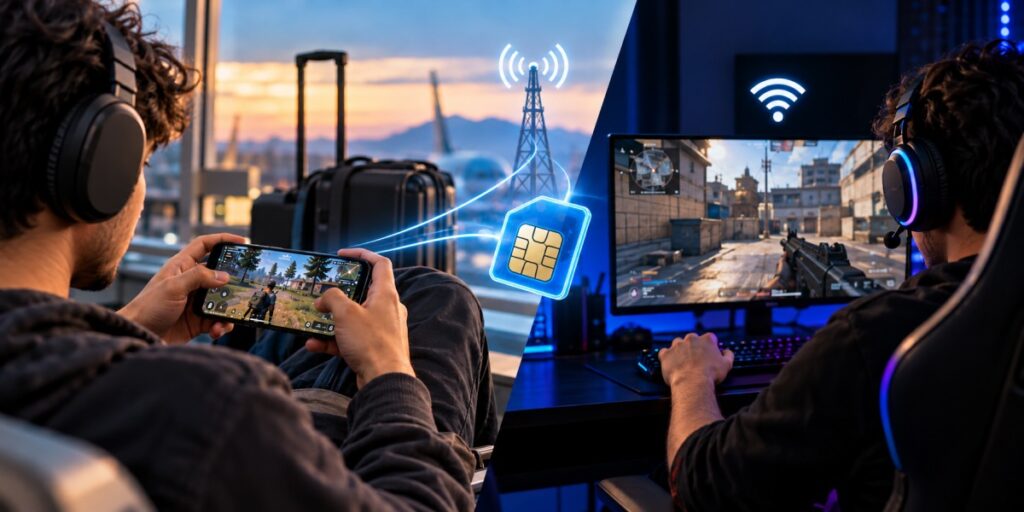
Straight answer: it depends entirely on how and where you play.
So if you landed here after searching "best internet provider for gaming," hoping an eSIM would quietly replace your home fiber for ranked play it won't, and pretending otherwise would just waste your money. But for the fast-growing share of gaming that happens away from that desk, a solid unlimited-data eSIM is often the best connection you can physically carry with you.
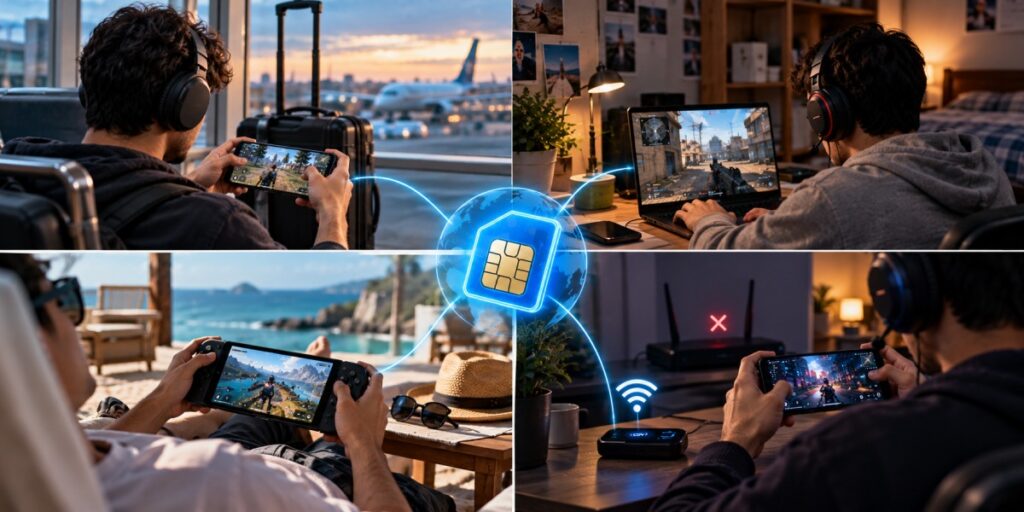
Mobile data earns its keep in more situations than people give it credit for. An eSIM makes real sense if you're:
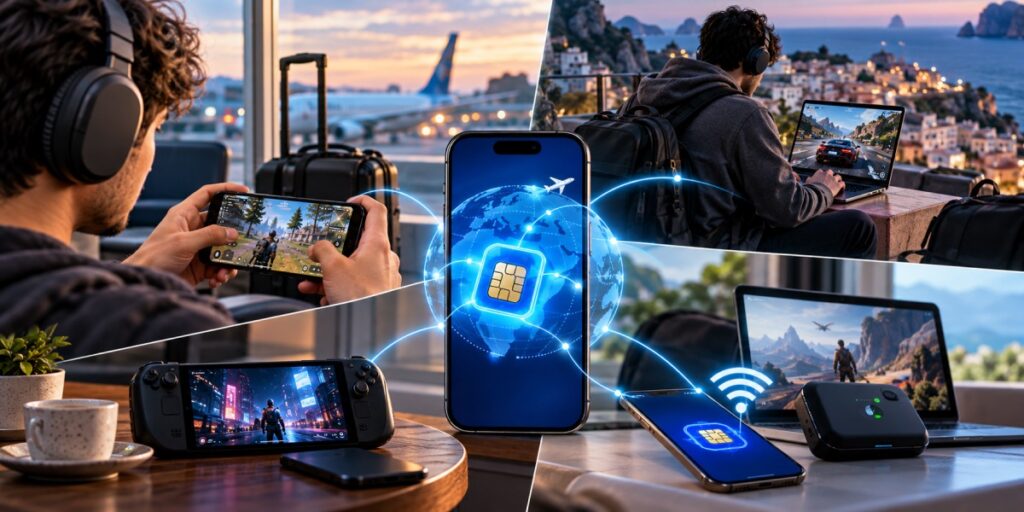
For gaming on the move specifically, Airhub is built around the things that actually move the needle:
Browse the esim data plans to match one to how much you actually game, and check that your phone supports eSIM first. If the format's new to you, here's the plain comparison of eSIM vs a physical SIM.
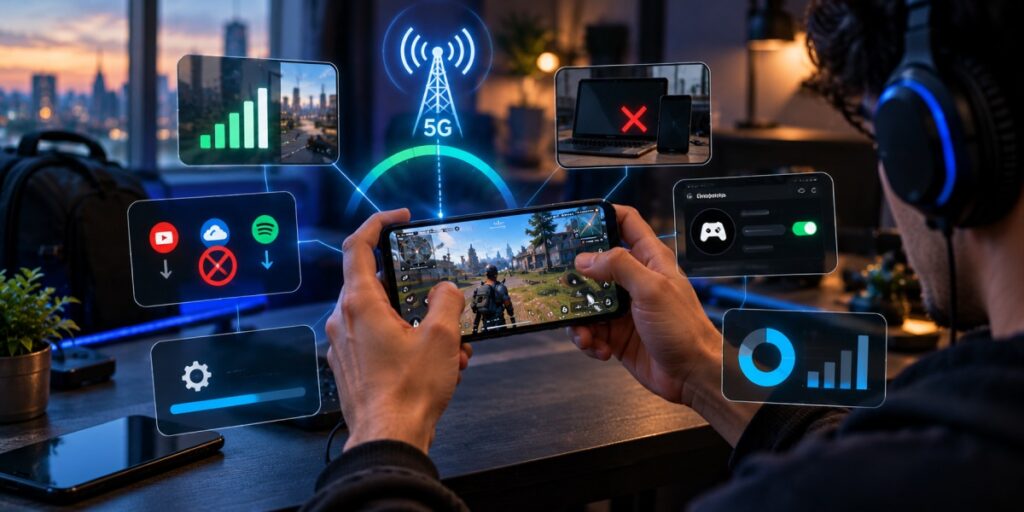
If you're gaming off cellular, a handful of habits keep your ping as low as the network will allow:
For a fixed home rig and serious competitive play, wired fibre is still the best internet for gaming no argument. But for mobile gaming, cloud gaming, travel, dorm life, and backup, an unlimited-data eSIM is frequently the smarter, more flexible choice, and it's the only one you can slip in your pocket. Match the tool to the way you actually play, and you'll spend less time fighting the connection and a lot more time in the game.
Most online games play smoothly on around 15–25 Mbps down and 5 Mbps up — the match itself is fairly light. The bigger speed demands come from downloading games and streaming your gameplay, not from playing. And low, stable latency matters more than raw speed every time.
Playing multiplayer is modest roughly 100–500 MB an hour on mobile. Cloud gaming is the heavy one at 2–5 GB an hour, and downloads and patches run to several gigabytes apiece, with big titles topping 100 GB. Together, that's how regular mobile gamers clear 100 GB+ a month.
For mobile games, cloud gaming, and gaming while travelling, yes modern 5G handles them comfortably, and an unlimited-data eSIM sidesteps caps and roaming. For stationary, high-stakes competitive play, a wired fibre connection is still the more consistent choice.
Indirectly, by tethering the device to your phone's connection over a hotspot. That works well for casual and cloud gaming; for latency-critical competitive sessions, a wired connection to a router is better, since tethering adds a little delay.
Not for a serious stationary setup wired fibre wins there, full stop. Where an eSIM shines is as a backup when the home Wi-Fi drops, and as the best option for gaming on the move.
That's its sweet spot. Airhub runs eSIM plans across 190+ countries, so you can keep gaming without roaming charges or swapping SIMs at every stop. Just check that your device supports eSIM first.
Get your Airhub eSIM in minutes and travel without roaming surprises.
Download the Airhub app to purchase, manage and top up your eSIMs anytime, anywhere!