










Ready to try eSIMs and change the way you stay connected?
Download the Airhub app to purchase, manage and top up your eSIMs anytime, anywhere!
App exclusive5% off at checkout
uk-esim-plans-unlimited-data-calls-for-travelers
Every UK network supports eSIM now. EE, O2, Vodafone and Three all offer it, and behind them sits a growing crowd of smaller providers and travel specific services, ours included. So the interesting question was never whether to use one it's which type fits your trip, what you'll pay, and which network you actually end up connected to.
That last one deserves more attention than it usually gets. No eSIM provider owns a network. What you're buying is resold access to one of the big four, and that arrangement determines whether you have signal on the Tube, in rural Wales, or halfway up a Scottish glen. A provider that won't tell you which network sits behind the plan has told you something anyway.
What follows covers our own UK plans and prices, plus the checks worth making whoever you buy from: device compatibility, carrier locking, coverage, and whether European visitors need to buy anything at all now that Brexit roaming fees have quietly reappeared.
| Plan | Data | Validity | Calls included | Price |
| Short trip | 1GB | 7 days | No | $2.85 |
| Standard | 10GB | 30 days | No | $7.75 |
| Heavy use | 15GB | 30 days | No | $11.20 |
| Maximum data | 100GB | 30 days | No | $40.00 |
| Unlimited weekly | Unlimited* | 7 days | Yes | $23.50 |
| Unlimited monthly | Unlimited* | 30 days | Yes | $29.50 |
Prices are correct as of July 2026 and may change. Please check the latest Airhub plans page before purchasing.
Unlimited plans may be subject to a fair-use policy. Check the plan details for any high-speed data limits, speed reductions and reset periods.
Very little sold as unlimited in this category actually runs at full speed indefinitely and that includes ours. The standard structure is a daily high-speed allowance followed by a throttled rate, typically somewhere between 384kbps and 1Mbps. That's perfectly serviceable for maps and messaging, and genuinely painful for a video call.
Which means that when you're weighing an eSIM UK unlimited data plan against a fixed data one, the word "unlimited" tells you almost nothing useful. The daily cap and the speed underneath it tell you everything. Ask any provider for both figures before you pay.
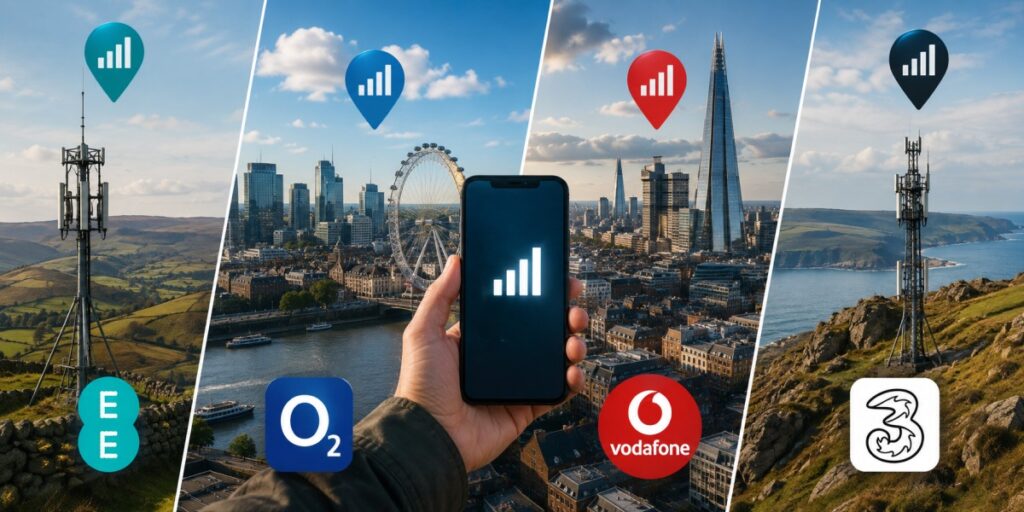
Four national networks serve the UK: EE, O2, Vodafone and Three. Every travel eSIM sold here roams on one or more of them, and that choice shapes your daily experience far more than whatever branding sits on the app.
Broadly speaking, EE holds the strongest above-ground coverage nationally. Vodafone has exclusive Wifi calling arrangements on some London Underground lines. O2 and Three both perform solidly in cities and less consistently once you're out in the country. None of this is marketing copy it's the difference between having a signal on a Highland road and not having one.
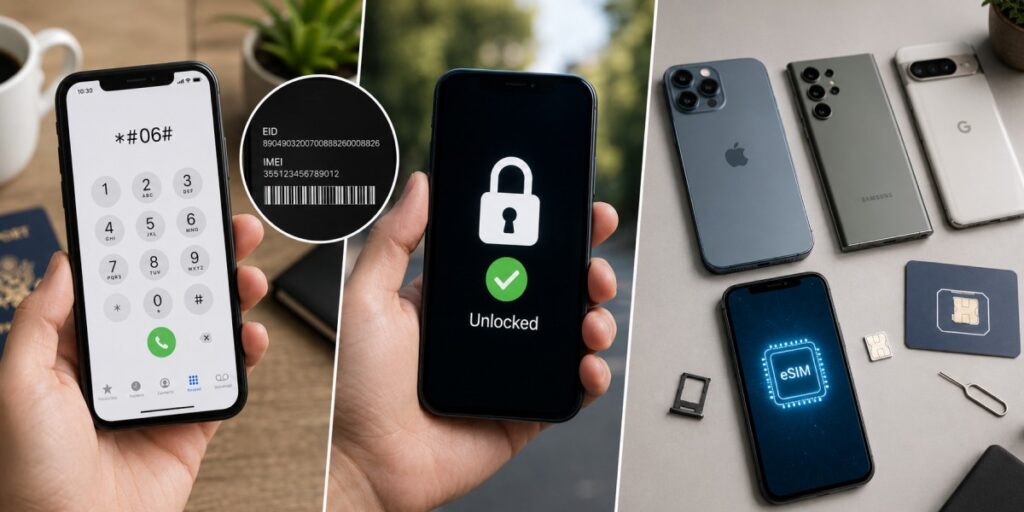
Two checks here, and the second one catches more people than the first.
Does your handset support eSIM? Dial *#06#. If an EID number shows up alongside your IMEI, you're covered. Broadly that means every iPhone from the XS onwards, Samsung Galaxy S20 and later, Google Pixel 3 and later, and most flagship Androids since. What it doesn't cover is a substantial number of mid-range and budget Android handsets, which still ship with no eSIM support whatsoever.
Is your phone carrier-locked? Here's the UK specific trap. A handset bought directly from EE, O2, Vodafone or Three especially on a contract may be locked to that network, and a locked phone will only accept eSIM profiles from that same carrier. Perfectly compatible hardware, completely blocked. Ring your network to get it unlocked, ideally while you're still at home rather than standing at a departure gate.
Our eSIM compatible devices list has the model-by-model breakdown if you'd rather check properly than dial a code.
And on the eSIM only question, since a lot is being written about it: the direction of travel is genuinely clear. Apple has shipped eSIM only iPhones in several markets, all four UK networks are pushing adoption, and physical SIMs will be phased out eventually. They just haven't been yet. Android flagships including the Galaxy S26 Ultra and Pixel 11 Pro still ship with SIM trays here, and physical cards remain easy to find. Treat it as a trend rather than a finished transition some guides are running well ahead of the evidence.
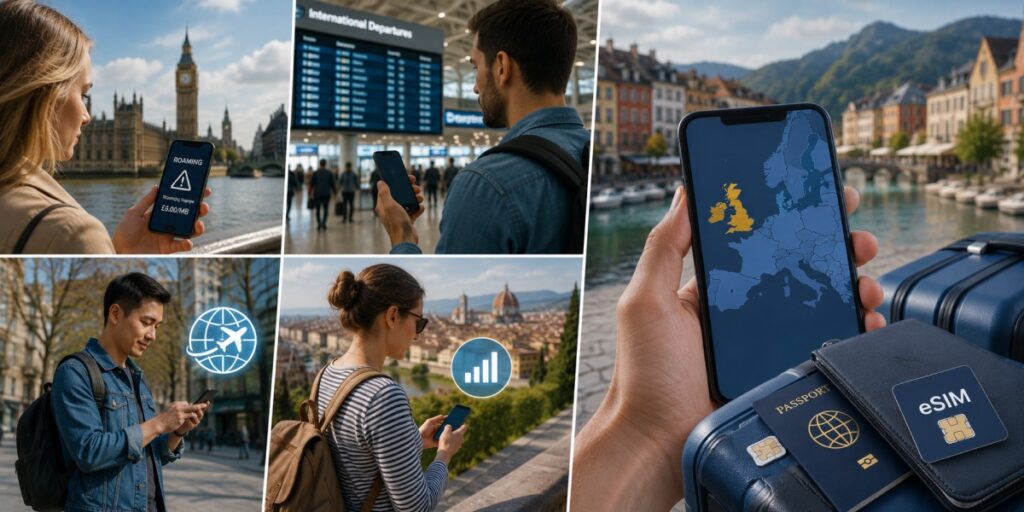
Worth answering honestly, because the answer changed and plenty of people haven't caught up.
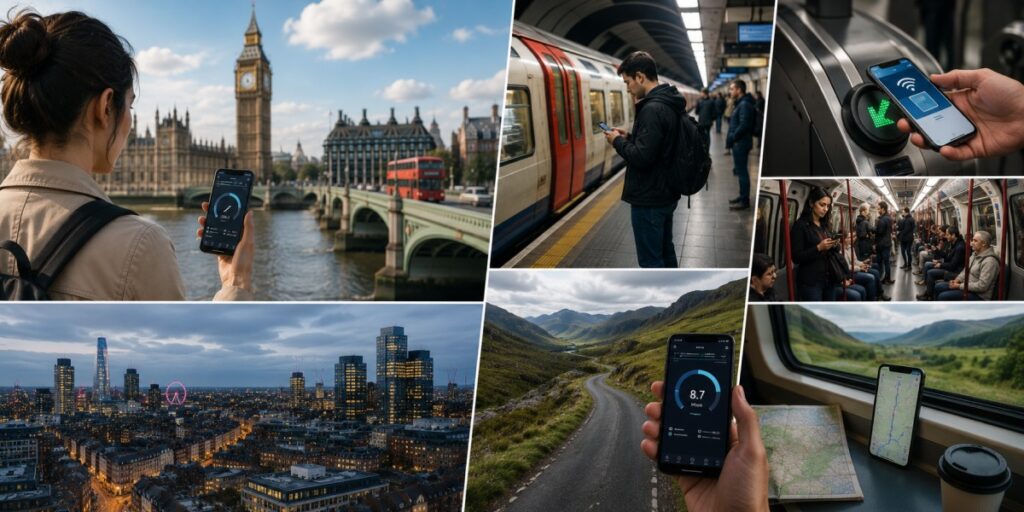
London, Manchester, Birmingham, Edinburgh and the main rail corridors are all well served across the four networks. It's the exceptions that are worth knowing about.
The London Underground catches visitors out more than anything else. Contactless payment on the Tube and buses runs through Apple Pay and Google Pay, and both need a working data connection at the barrier. A phone with no signal and no backup payment method is a phone that doesn't open the gate with a queue forming behind it and no graceful way out. Underground connectivity has improved a lot, but it's still patchy by line and by station, and Vodafone's Wifi calling arrangement doesn't reach everywhere.
The fix is unglamorous and works: get an Oyster card, or keep a contactless bank card on you, and don't make your phone the only thing standing between you and the platform.
Rural coverage thins out across the Scottish Highlands, mid Wales, parts of Cornwall and the Lake District. That's terrain rather than any provider failing, and it applies whichever eSIM you're carrying. Download offline maps before you leave a city and it stops being a problem.

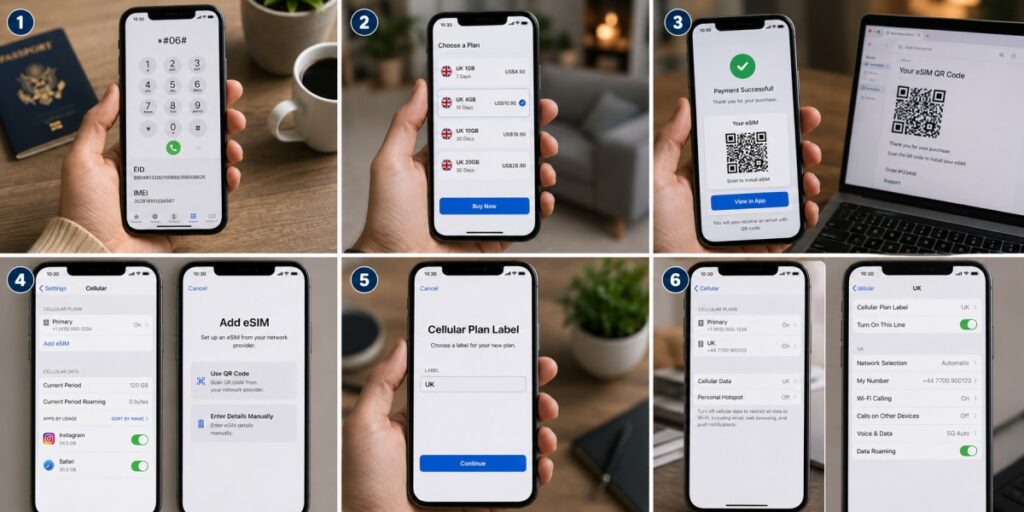
Do this at home on Wi-Fi, not in an arrivals hall.
Leave it switched off until you land. Our how to install an eSIM guide covers what to do if a QR code refuses to scan.
Once you're running, the app handles data monitoring, top-ups and support.
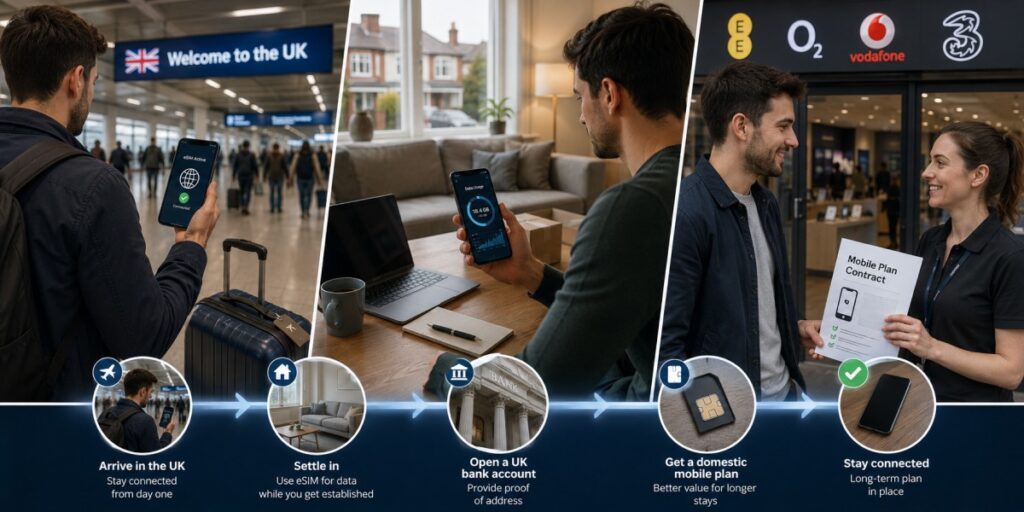
If you're moving here rather than visiting, the maths shifts and our answer changes with it.
A domestic postpaid contract from EE, O2, Vodafone or Three will almost certainly beat any travel plan on cost per gigabyte though usually on a 12-month commitment. The obstacle is sequencing: you need a UK bank account, which needs proof of address, which takes a few weeks to establish. Nobody hands you a contract on day one.
A travel eSIM bridges that gap sensibly. It covers your first month while the paperwork resolves, and you walk away from it with nothing to cancel. That's a considerably smaller sale than a year-long plan, and it's still the right recommendation.
All four national networks EE, O2, Vodafone and Three plus a growing number of smaller providers. Travel eSIM services roam on one or more of these rather than running networks of their own.
Airhub UK eSIMs connect to supported UK partner networks, depending on the selected plan.
Yes. You can set it up before arriving. No UK address, bank account or ID registration is required, unlike most domestic contracts.
The cost depends on the data allowance and plan validity. Check the pricing table above for the latest plans and prices.
Probably. Post-Brexit, the UK isn't covered by EU Roam Like at Home, and many European carriers have reinstated UK roaming charges. Check your own carrier's rates rather than assuming you're still covered.
Not always at full speed. Many unlimited plans operate under fair-use policies. Check the plan details for any high speed data limits, speed reductions and reset periods before purchasing.
If it supports eSIM and isn't carrier-locked. Dial *#06#. An EID number next to your IMEI confirms eSIM support. Phones bought on UK contracts may be carrier-locked and could require unlocking before they can use third party eSIM profiles.
Sometimes, depending on the line and station. It matters more than you'd expect, because contactless payment and mobile services may require a connection. Carry an Oyster card or a contactless bank card as a backup.
That's the direction, not the current position. Networks are encouraging eSIM adoption, but physical SIMs remain widely available and many Android phones still include SIM trays.
A domestic UK contract will likely work out cheaper per gigabyte, but it usually requires a UK bank account and address. A travel eSIM is a practical option for your first few weeks or month.
Confirm your phone supports eSIM and isn't locked to a UK carrier. Count the days you actually need. If you're buying unlimited, get the fair-use figure in writing. And if you're travelling from the EU, look up your carrier's UK roaming rate rather than assuming Brexit didn't change anything because for a lot of carriers, it did.
When you're ready, Buy eSIM and install it at home. You'll be connected before you're through the airport.
Get your Airhub eSIM in minutes and travel without roaming surprises.
Download the Airhub app to purchase, manage and top up your eSIMs anytime, anywhere!