

You've landed in a new country. The signs are in a language you don't speak. The taxi driver doesn't understand you. You pull out your phone to use a translation app, and there's no internet.
That's a situation every traveler has been in at least once, and it's genuinely stressful. The good news is it's completely avoidable. With the right connectivity in place before you land, your phone becomes one of the most powerful travel tools you have, especially when it comes to breaking language barriers.
This is where eSIM technology and real-time translation apps work together to make global communication while traveling a lot less intimidating.
Table of contents
- The Language Barrier Is Still a Real Problem
- What Are Real-Time Translation Apps?
- Why Translation Apps Need Internet Connectivity
- The Best Translation Apps for Travelers
- How eSIM Makes All of This Actually Work
- Real Situations Where This Combination Saves You
- Travel Accessibility Is for Everyone
- Don't Let a Language Barrier Ruin a Good Trip
- FAQs
The Language Barrier Is Still a Real Problem

English gets you pretty far in most tourist-heavy cities, but step slightly off the beaten path and things change quickly. Rural Japan, small-town Morocco, a local market in rural Mexico, these are places where hand gestures and hopeful smiles only get you so far.
Language barriers don't just cause awkward moments. They can genuinely affect your safety, your ability to navigate, and your overall travel experience. Missing a bus because you couldn't read the timetable, ordering food you're allergic to, or not understanding directions from a local, these things happen all the time.
The solution isn't to only visit English-speaking countries. It's to travel smarter.
What Are Real-Time Translation Apps?
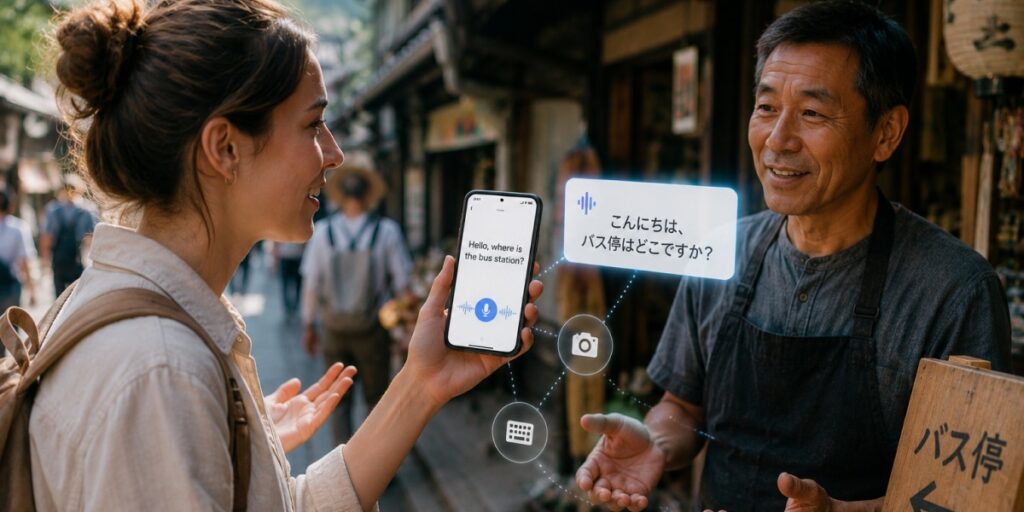
Real time translation apps are exactly what they sound like; tools that translate spoken or written language almost instantly, right from your phone. You speak into your phone in English, and it plays back the translated version in the local language. Or you point your camera at a sign, and the text gets translated on your screen in seconds.
The technology has come a long way. A few years ago these apps were clunky and often inaccurate. Today, the best ones are genuinely impressive, accurate enough for real conversations, fast enough to feel natural, and smart enough to handle context.
But here's the catch: most of them need a live internet connection to work properly.
Why Translation Apps Need Internet Connectivity
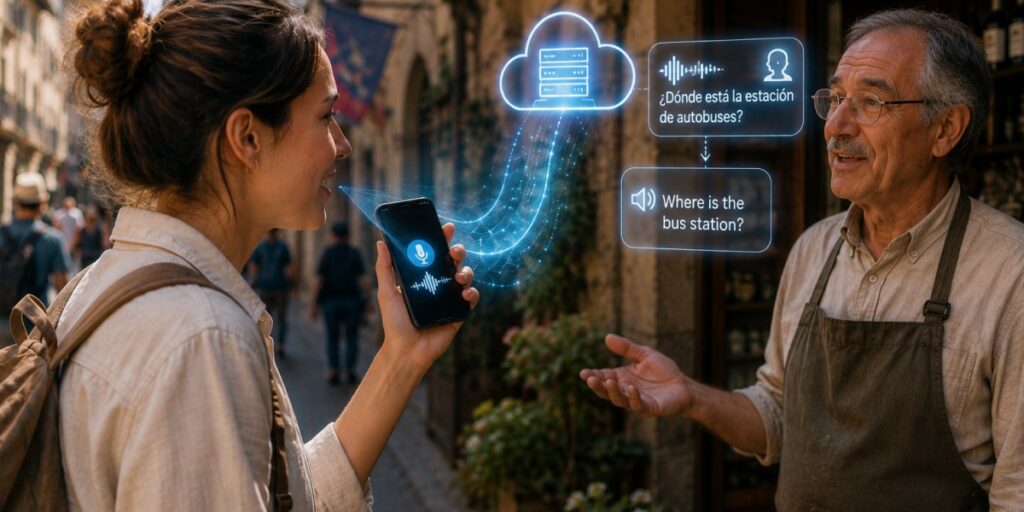
Most of the heavy lifting in real-time translation happens on remote servers, not on your phone. When you speak into a translation app, your voice gets sent to a server, processed, translated, and sent back, all in a matter of seconds. Without the internet, that process simply can't happen, or it falls back to a much more limited offline mode.
This is exactly why travel connectivity matters so much. A translation app without reliable internet is like a car without fuel. It looks useful, but it isn't going anywhere. Good connectivity helps you translate speech in real time without any issue.
Best Travel Translation Apps
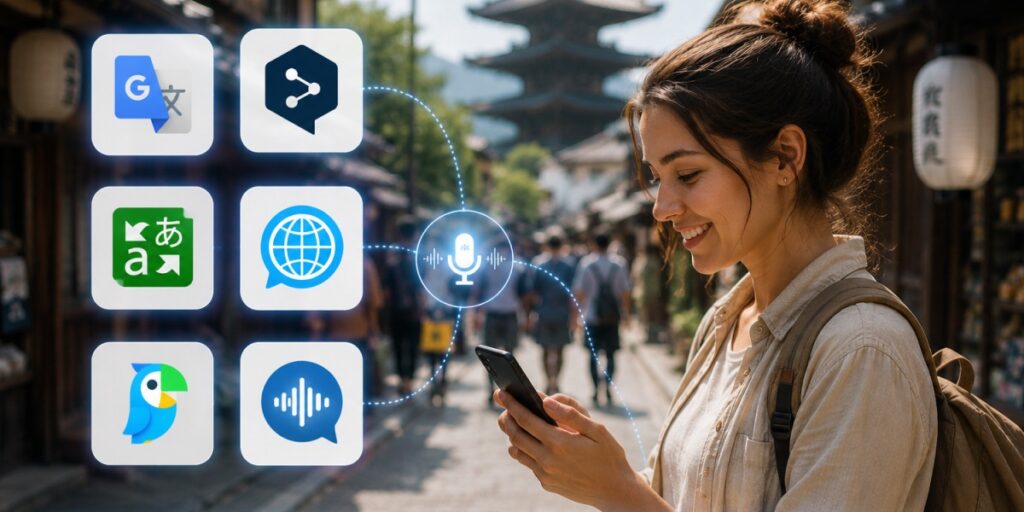
Before we get into connectivity, here are the translation apps genuinely worth having on your phone:
1. Google Translate: The one everyone already has, and honestly there's a reason for that. It covers 130+ languages, lets you point your camera at a sign and get an instant translation on screen, and has a conversation mode where two people can just talk back and forth in different languages. Some languages work offline in a pinch, but the good stuff; the camera mode, the real-time conversation, needs the internet to run properly.
2. DeepL: If you've ever used Google Translate and thought "that doesn't sound quite right", DeepL is your answer. It doesn't just translate words, it actually understands what you're trying to say and translates the meaning. Especially strong with European languages. Particularly useful when you need to translate something important, a contract, a medical form, a formal email — and getting it slightly wrong isn't an option.
3. Microsoft Translator: A solid all-rounder with one standout feature, it supports group conversations, meaning multiple people with the app can have a real-time multilingual conversation together. Genuinely useful for group travel.
4. iTranslate: Nothing fancy, nothing complicated, iTranslate just works. It handles voice translation smoothly and has a basic offline mode for emergencies, but if you want the full experience, you'll want a live connection. Good one to have as a backup even if you use other apps as your main.
5. Papago: If Asia is on your itinerary, download this one before anything else. Google Translate is fine for European languages, but when it comes to Korean, Japanese, or Chinese, Papago is genuinely in a different league. It's built by Naver and was specifically designed with Asian languages in mind, and it shows. Locals in those regions actually use it themselves, which tells you everything.
6. SayHi: A simple, no-fuss app built specifically for spoken translation. You speak, it translates, the other person speaks back. It's great for quick back-and-forth conversations with locals.
How eSIM Makes All of This Actually Work
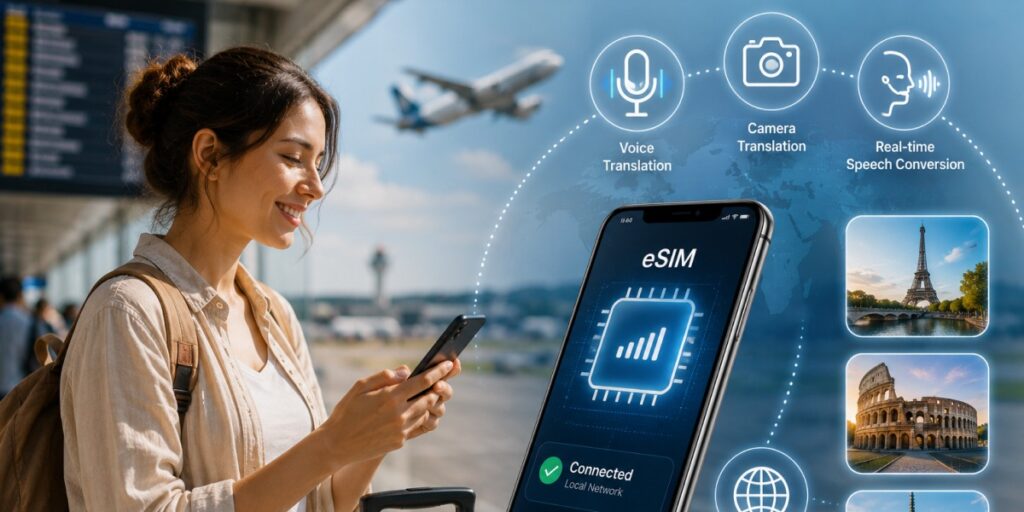
Here's where it all ties together. An eSIM, a digital SIM card built into your phone, lets you connect to a local mobile network the moment you land in a new country, without swapping physical SIM cards or hunting for a Wi-Fi connection.
You buy your plan before you leave, activate it on your phone, and by the time your flight lands you're already online. No airport queues. No expensive roaming charges from your home carrier. Not depending on spotty hotel Wi-Fi.
For translation apps, this is a game changer. Every feature works at full capacity; voice translation, camera translation, real-time speech conversion, from the second you step off the plane.
Traveling across multiple countries? A global eSIM covers you across regions without needing to buy a new plan every time you cross a border. One plan, continuous connectivity, translation apps working everywhere.
Real Situations Where This Combination Saves You
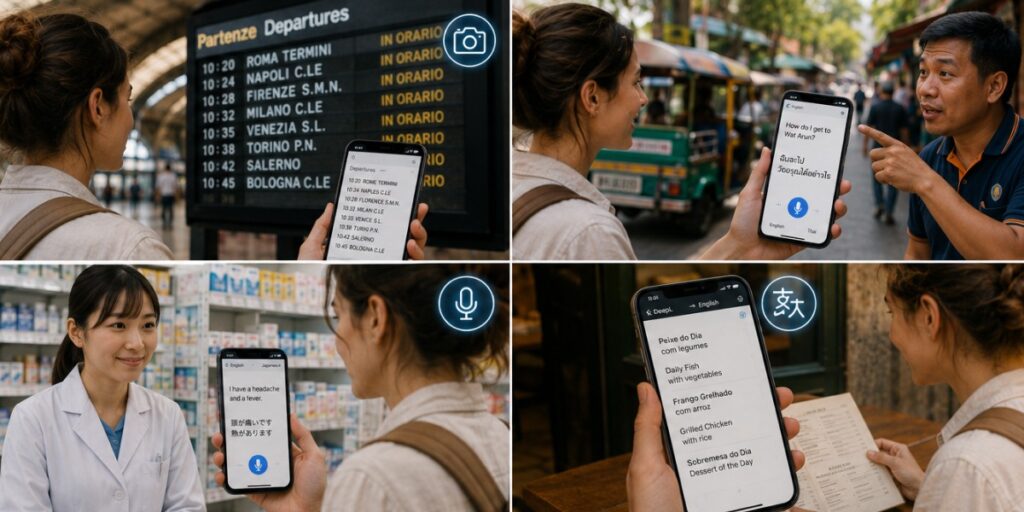
- You're at a train station in rural Italy and the departure board is only in Italian. You point your camera at it with Google Translate, done.
- A local in Thailand is giving you directions but you can't follow. You open Microsoft Translator's conversation mode and suddenly you're having a proper exchange.
- You're at a pharmacy in Japan and need to explain a medical issue. SayHi lets you speak in English and plays back Japanese to the pharmacist.
- You're ordering at a restaurant in Portugal with no English menu. DeepL translates the whole thing in seconds.
None of these scenarios work without the internet. All of them work perfectly with an eSIM active on your phone.
Travel Accessibility Is for Everyone
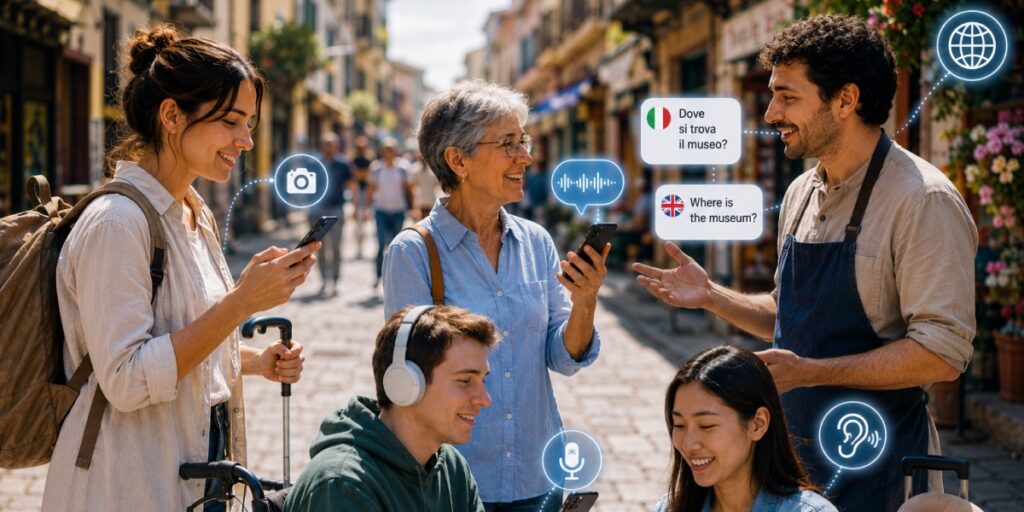
One thing worth saying: language barriers don't just affect people who haven't traveled much. Even seasoned travelers hit walls. And for people with additional accessibility needs, hearing difficulties, speech differences, cognitive challenges, reliable translation tools can make the difference between a trip feeling manageable and feeling overwhelming.
Global connectivity isn't a luxury anymore. It's a genuine travel essential, in the same category as travel insurance or a good pair of walking shoes. The world is more accessible than ever when your phone is actually connected to it.
Don't Let a Language Barrier Ruin a Good Trip
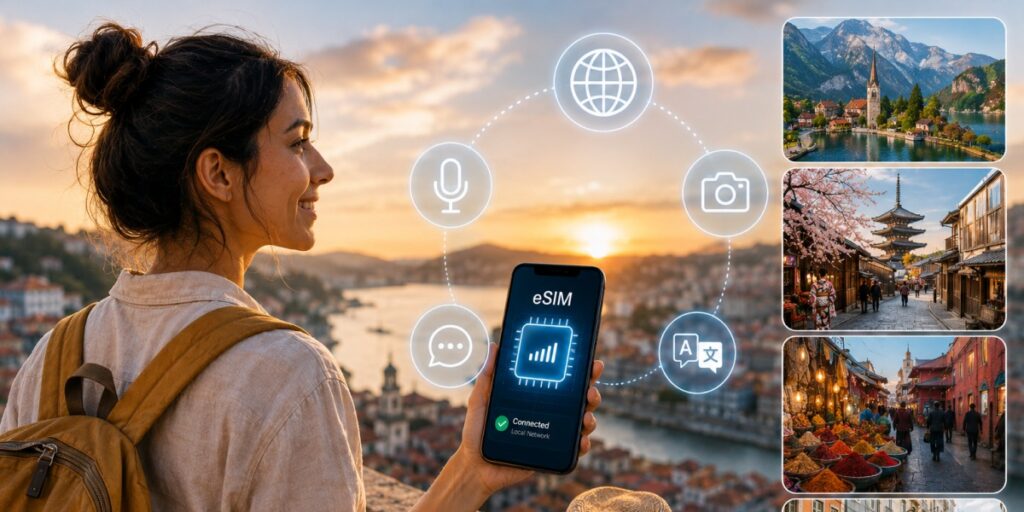
A translation app without the internet is just a fancy offline dictionary. But pair it with reliable mobile data through an eSIM, and suddenly the entire world feels a lot more approachable.
Whether you're backpacking through Southeast Asia, on a business trip in Europe, or ticking off the best places to go in the world from your bucket list, staying connected isn't optional anymore. It's what makes the difference between a trip that's stressful and one that's genuinely enjoyable.
Buy your eSIM online before your next trip and travel with the confidence of knowing your phone will actually work when you need global comminuation.
FAQs
1. What are real-time translation apps?
They're apps that translate languages on the spot without waiting and typing full sentences. You either speak into your phone or point your camera at something written, and it translates within seconds. Google Translate, DeepL, and Microsoft Translator are the most well known, but there are several good options depending on where you're headed.
2. Which translation apps work best while traveling?
It depends on where you're going. Google Translate is the most versatile for general travel. Papago is better for Asia. DeepL is best for accuracy with European languages. Microsoft Translator is great for group travel. Having two or three installed is always a smart move.
3. Why do translation apps need internet connectivity?
Most translation apps process language on remote servers rather than on your device. Without the internet, they either don't work or fall back to a very limited offline mode that covers only the basics. Real-time speech and camera translation almost always need a live connection.
4. Can eSIM help travelers translate speech in real time?
Absolutely. An eSIM gives you instant mobile data when you land in a new country, which means your translation apps are fully functional from the moment you arrive; no Wi-Fi needed, no SIM swapping, no delays.
5. What is the benefit of global connectivity while traveling?
It goes way beyond just translation. When you're connected, your maps work, you can reach people back home, pull up your bookings, and handle anything unexpected on the go. Travel throws surprises at you, having internet just means those surprises don't turn into disasters.

