

Ever heard of the land of the midnight sun? It’s not a theme park, it’s a nickname for far-north places where summer days go on forever. In regions above the Arctic Circle (think northern Norway, Finland, Alaska, etc.), summer brings 24-hour daylight. This blog explains the science behind the midnight sun, highlights the top midnight sun places to visit (especially in Norway), and shares travel tips to make the most of those endless summer nights.
Table of conetnts
- Land of Midnight Sun: The Arctic’s 24-Hour Daylight
- Where Does the Sun Never Set?
- Norway – Country of the Midnight Sun
- Where to See the Midnight Sun
- When to See the Midnight Sun
- Why Midnight Sun is Special
- Travel Tips for Visiting Midnight Sun Places
- Stay Connected Under Endless Daylight
- eSIM for Your Midnight Sun Adventure
- FAQs
Land of Midnight Sun: The Arctic’s 24-Hour Daylight
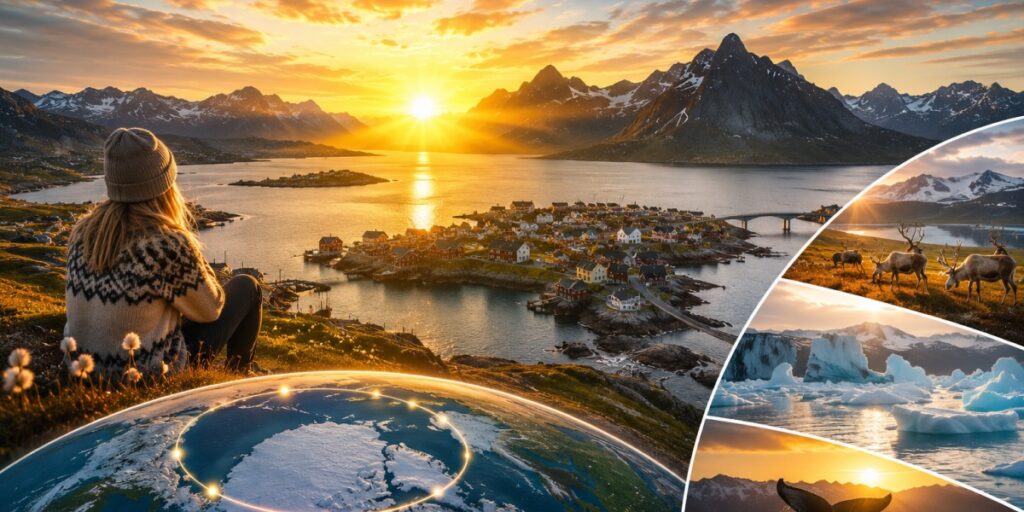
The “midnight sun” (also called polar day) is a real natural phenomenon: during summer months north of the Arctic Circle, the Earth’s tilt keeps the sun visible at local midnight. In other words, some northern areas never get full darkness in summer. If you want to experience multiple views, you need to get an eSIM Global because the land of the midnight sun is from northern Norway to Alaska, and Greenland falls into this category. For example, above 66.5° N latitude, the sun dips only slightly below the horizon (or not at all) on summer nights. Even as far north as the North Pole, the sun stays up for about six months. In practice, any country with territory in the Arctic (Norway, Sweden, Finland, Canada, Russia, Alaska, Iceland, Greenland) can claim a bit of the land of the midnight sun. In fact, Norway’s Arctic regions are often called “the Country of the Midnight Sun” due to these long summer days.
Where Does the Sun Never Set?
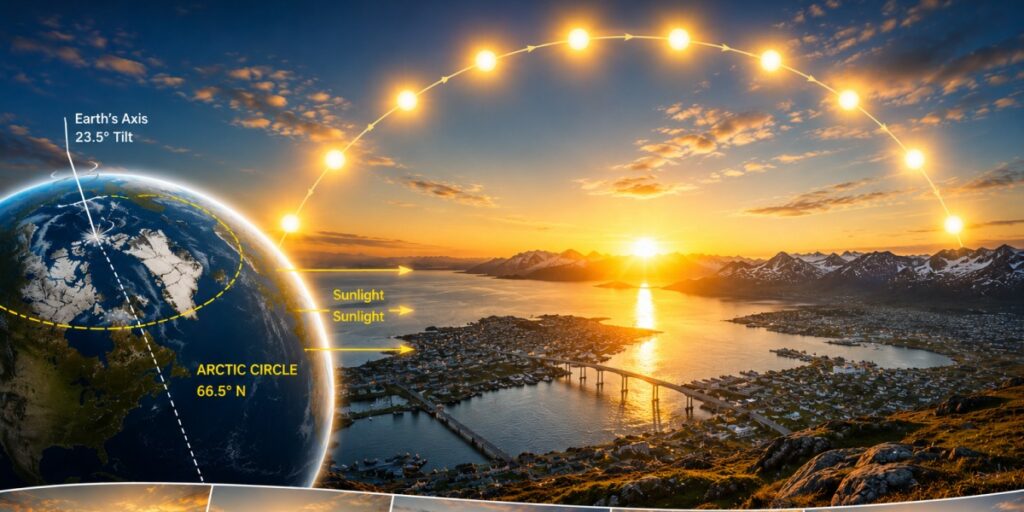
Why doesn’t the sun set in these places? Simple physics: as Earth orbits, one hemisphere gets constant sunlight. Around the summer solstice (about June 21), the northern hemisphere is maximally tilted toward the sun. The result: above the Arctic Circle, the sun stays above the horizon for 24 hours. Even if you keep waiting for sunset after midnight, it won’t dip below the horizon; instead, it circles and rises again.
This effect grows stronger the farther north you go. At the exact Arctic Circle line, the sun theoretically stays up for one night at the solstice, but due to atmospheric refraction, even areas slightly south see it a bit. By mid-latitude Norway (below the Arctic Circle), nights are short but still dark. But once you cross into Tromsø or Hammerfest, for example, you can have true sunset-less nights in summer. Even Iceland (mostly just below the Arctic Circle) enjoys very long summer evenings with soft “white nights.” In short, the sun never sets phenomenon is all about latitude and the big tilt of our planet.
Norway – Country of the Midnight Sun
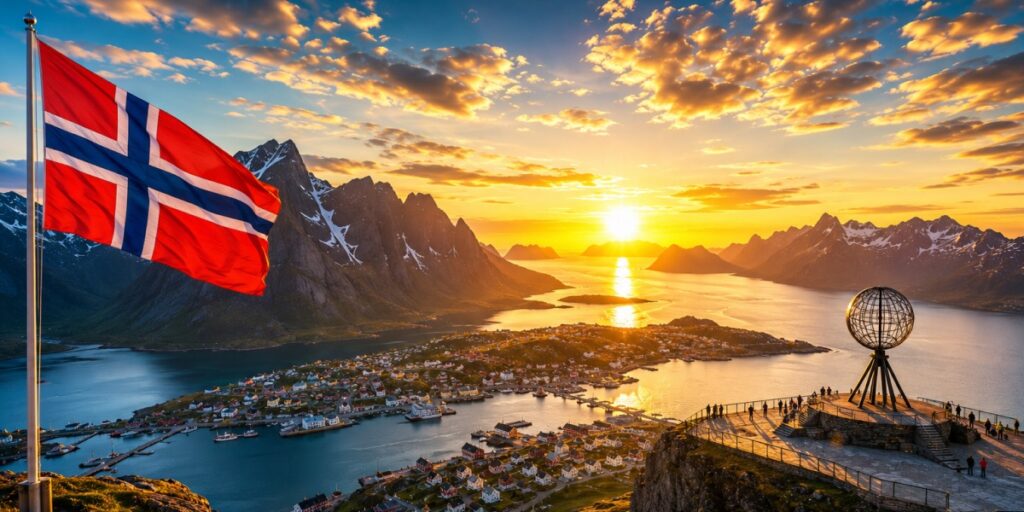
If you think the sunset in Norway is surreal, there is an even better view in the Midnight Sun, which is one of the Best places to go in the world. Norway is perhaps the poster child for midnight sun travel. Much of northern Norway lies above the Arctic Circle, so in summer the sun just keeps shining. Cities like Tromsø and Alta have weeks of midnight sun. For instance, Tromsø sees sunlight from roughly May 20 until July 25, and even Norway’s most northern town, Longyearbyen (in Svalbard), basks in 24-hour sun from late April until late August. North Cape (Nordkapp), the northern tip of mainland Europe in midnight sun in Norway from mid-May to the end of July as well.
Where to See the Midnight Sun
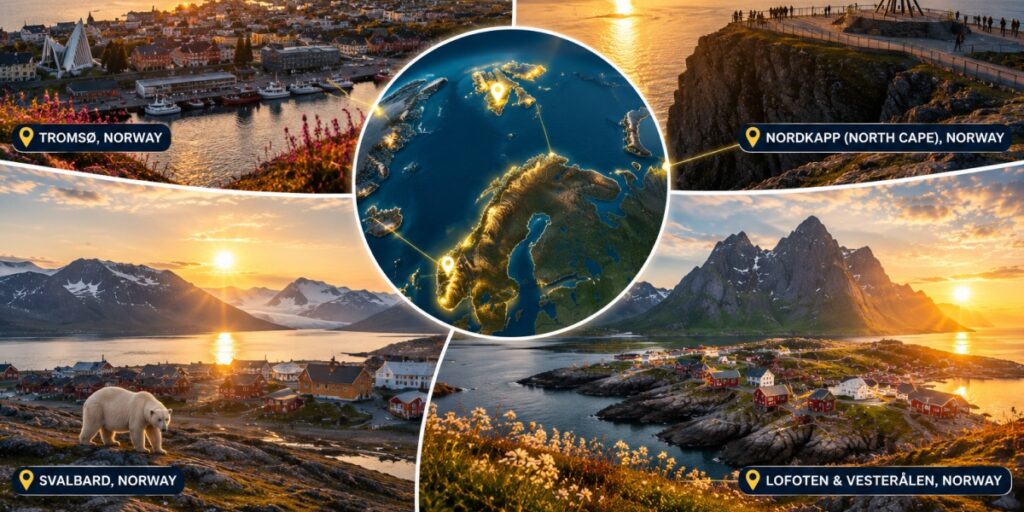
There are many great places where you can see the midnight sun for a surreal experience:
- Tromsø, Norway – The most famous “Arctic capital,” Tromsø offers midnight sun from late May through late July. It’s well-connected and lively, with festivals and boat tours under the sun that never sets.
- Nordkapp (North Cape), Norway – Europe’s northernmost cliff. Here, the sun circles at midnight between mid-May and late July. The North Cape Plateau (with its iconic globe monument) provides a dramatic panoramic view of endless daylight.
- Svalbard, Norway – This far-north archipelago enjoys the longest run of midnight sun: roughly April 20 to August 22. That means over 4 months of constant daylight! It’s ideal for a true Arctic adventure, from polar bear sightings to glacier hikes, all under the midnight sun.
- Lofoten & Vesterålen, Norway – These rugged islands are famous for dramatic peaks and beaches. They have midnight sun, roughly late May through mid-July. The scenery, lit by golden midnight light, is world-famous for photographers.
No matter which location you choose, remember: when the midnight sun happens depends on latitude. The further north, the longer the season. Section 1 (Introduction) gave a quick list of where; here you have the top spots, mostly in Norway but also other Arctic lands. Each is a top midnight sun place where you can safely watch the sun at “midnight.”
When to See the Midnight Sun
There are several best periods, where you can experience the best midnight sun with the right planning:
- Summer Solstice Peak (around June 21): The official longest day of the year. If you time-travel near June 21, anywhere above the Arctic Circle will have 24-hour sun.
- Northern Norway (mid-May to mid-July): In towns like Tromsø or Bodø, the midnight sun usually runs from about late May through mid-July. Plan your trip anytime in this window for the best odds.
- Svalbard (late April to late August): The High Arctic here is extreme; they enjoy midnight sun from roughly April 20 all the way to August 22. Early or late in summer, you’ll still find sunlight at midnight.
- Higher Latitudes (late April – mid-August): Above Svalbard (toward the North Pole), nights vanish for even longer. Near the North Pole, sunlight is constant for ~6 months.
- Shoulder “Twilight” (May/August in far North): Even outside the official dates, northern areas have very late “sunsets.” Early May or early August can still feel like bright evenings.
Why Midnight Sun is Special
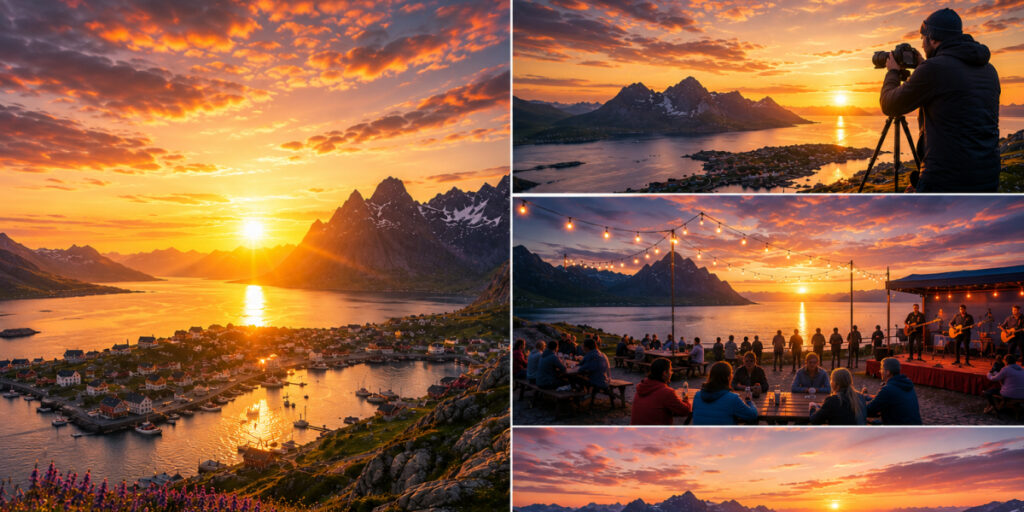
There are several reasons why you shouldn’t miss the Midnight Sun:
- Golden-Hour All Night: The sunlight under the midnight sun is soft and golden, just like dawn/dusk. In fact, photographers say the golden hour is “stretched out almost the entire night”. In practical terms, that means any time is photo-time, the sky glows with pinks, ambers, and blues even at 2 AM.
- Local Culture & Festivals: Arctic communities celebrate the endless day. Towns stage midnight sun festivals, barbecues, and concerts in the late evening. Norwegians call this “friluftsliv”, love of the outdoors, and they make the most of their bright nights with social gatherings and outdoor living.
- Enhanced Photography: With soft light around the clock, you can snap picture-perfect scenes almost any time. Unlike regular summer, where golden light lasts an hour, the midnight sun can give you that warm twilight glow for hours. Pack your camera, the light is surreal.
Travel Tips for Visiting Midnight Sun Places
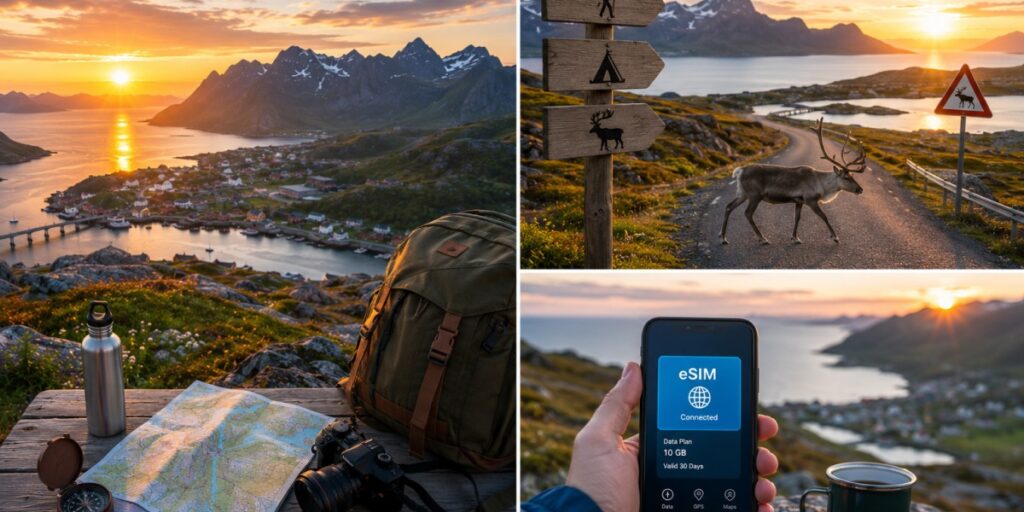
If you are planning to visit the land of the midnight sun country, here are a few tips that you should follow:
- Plan & Book Early: Midsummer is peak travel season up north. Book your flights, hotels, and any tours or cars well in advance for a budget Europe trip. Remote towns have limited rooms. Also, transportation (ferries, planes) may run on a different schedule or fill up.
- Stay Safe & Stock Up: Even though it’s daylight, always keep safety in mind. Carry a reusable water bottle, a map/app in case cellphone signal is spotty, and let someone know your plans if venturing alone. Watch for wildlife on roads (moose and reindeer can appear suddenly under the midnight sun).
- Stay Connected: In remote Arctic areas, Wi-Fi can be unreliable, and roaming charges are high. Before you go, consider getting an international travel eSIM (like Airhub) in your phone. That way, you have mobile data for GPS, translations, photos, or emergency calls, without hunting for a local SIM or paying huge roaming fees.
Stay Connected Under Endless Daylight
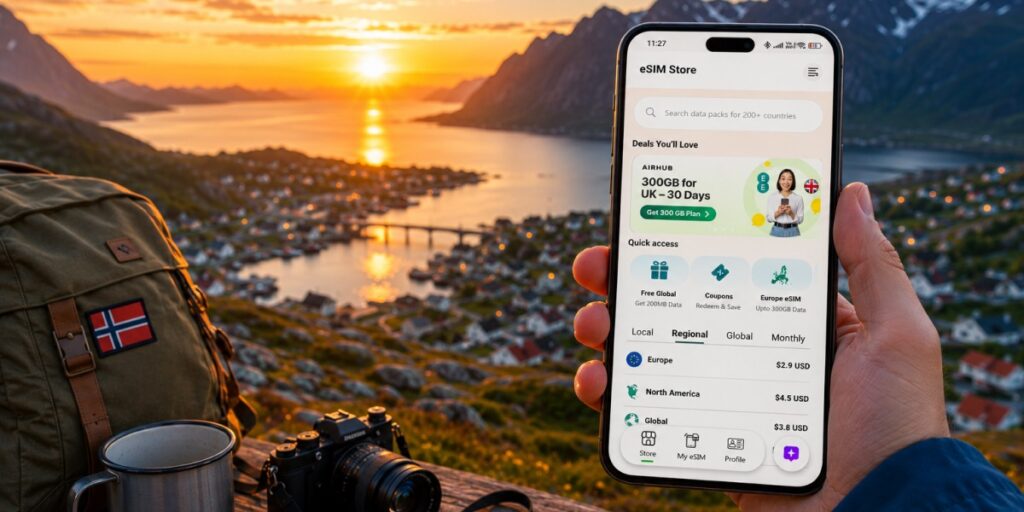
If you are going to Norway, do not forget to buy an eSIM online from Airhub. It is one of the most trustworthy eSIM providers, which gives you access to the local internet within a few taps. The process of buying is simple. You just have to pay for the eSIM and get a QR code online, and your eSIM gets activated within a few minutes.
eSIM for Your Midnight Sun Adventure
Exploring the land of the midnight sun is a once-in-a-lifetime thrill. Endless summer nights, dramatic light, and unique wildlife create unforgettable experiences. To fully enjoy them, you’ll want reliable gear and good planning, including how you stay online. An eSIM (embedded SIM) is perfect for this. With it, your phone works seamlessly across Norway and the Arctic without swapping physical SIM cards or paying roaming bills. This means you can navigate by GPS even at midnight, use local apps, and keep in touch with family safely.
FAQs
1. What is the “land of the midnight sun”?
The land where the sun never sets is the place where the sun dips only slightly below the horizon (or not at all) on summer nights. The “midnight sun” (also called polar day) is a real natural phenomenon: during summer months north of the Arctic Circle, the Earth’s tilt keeps the sun visible at local midnight.
2. Is it cold during the midnight sun in Norway?
During the Midnight Sun season in Norway, temperatures are usually around 5°C to 18°C in northern areas like Tromsø. Some warmer summer days can reach above 20°C, but nights often feel cool because of Arctic winds.
3. What are the best midnight sun places to visit?
The best places to experience the midnight sun in Norway are Tromsø, the Lofoten Islands, and Nordkapp. These locations offer stunning Arctic landscapes with sunlight visible even at midnight.
4. When is the best time to see the midnight sun in Norway?
The best time is from late May to late July in northern Norway. June is usually considered the peak season for clear skies and long bright nights.
5. Is the midnight sun visible everywhere in Norway?
No, the midnight sun is mainly visible above the Arctic Circle in northern Norway. Southern parts of the country get very long daylight hours, but not a true midnight sun.
6. What are the best activities during the midnight sun?
Popular activities include hiking, kayaking, fishing, road trips, and midnight photography. Many visitors also enjoy camping and wildlife watching under the bright night sky.

